
The sign rules, from zero
There are TWO sign rules, not one, and confusing them is the mistake that makes half the integer exercises go wrong. For ADDING AND SUBTRACTING: if the two numbers have the same sign the values are added and it keeps that sign (−3 + (−5) = −8); if they have different signs they are subtracted and the sign of the bigger one in absolute value wins (−9 + 4 = −5). For MULTIPLYING AND DIVIDING — and only for that — the famous rule holds: same signs give positive, different signs give negative ((−6) × (−4) = 24). Minus times minus gives plus because it is the only thing that keeps the pattern of the −3 times table. And when two signs appear in a row they join into one first: 5 − (−3) = 5 + 3 = 8. The first thing is always to look at WHICH OPERATION it is, because that is what decides which rule applies.
The sign rules, and why there are really two of them.
What the integers are
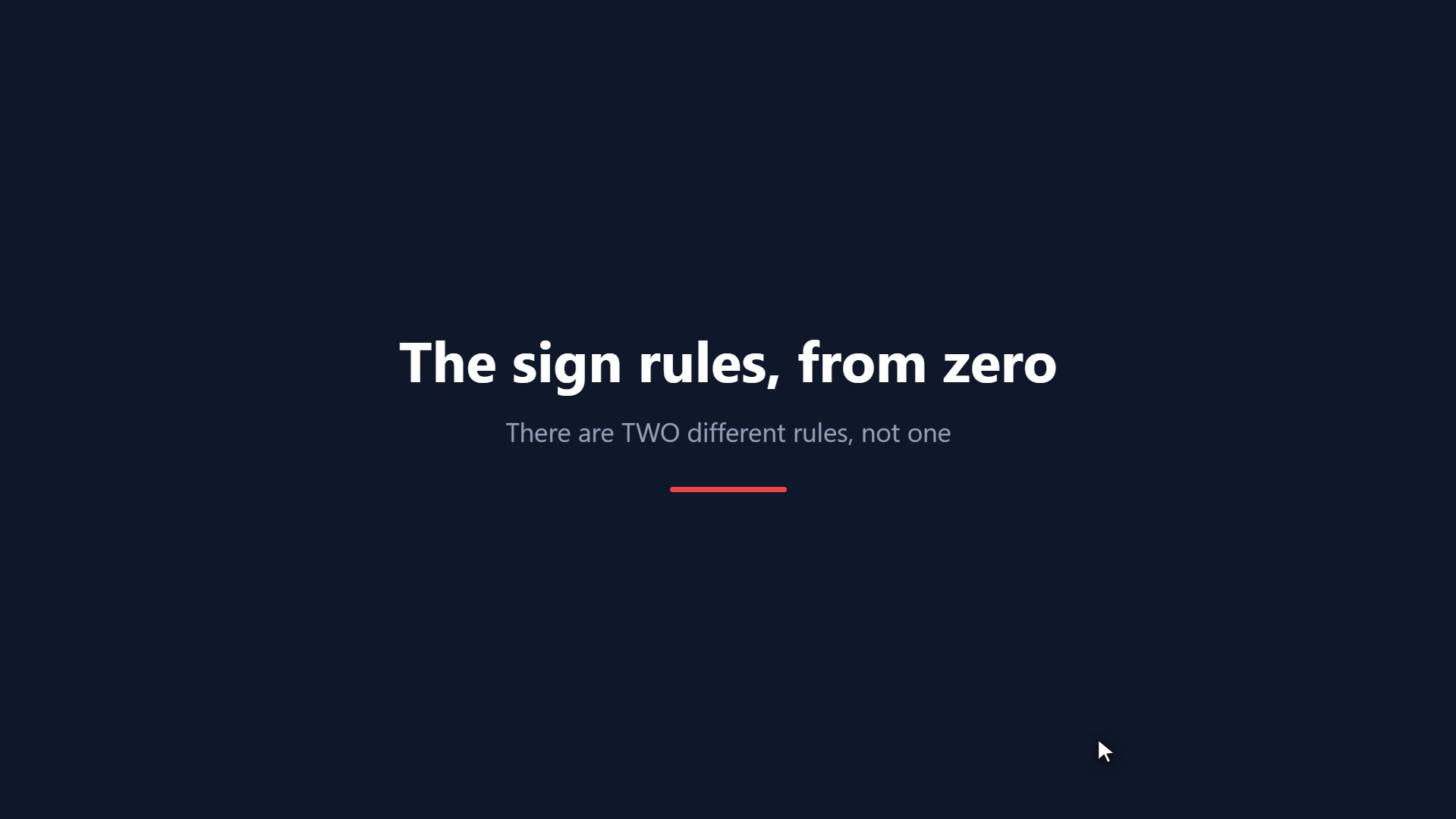
Let us start with the basics, which takes thirty seconds and is needed. The integers are the everyday numbers — one, two, three — plus zero, plus the negatives: minus one, minus two, minus three. No decimals and no fractions: integers. And the most useful way to see them is a line: zero in the middle, the positives on the right and the negatives on the left. The further to the left, the smaller the number, even if the digit looks big. And this is not a classroom invention: negatives are debts, temperatures below zero and the floors of a basement. Anywhere you can go past a natural starting point and keep going, you need them.
There are TWO rules, not one
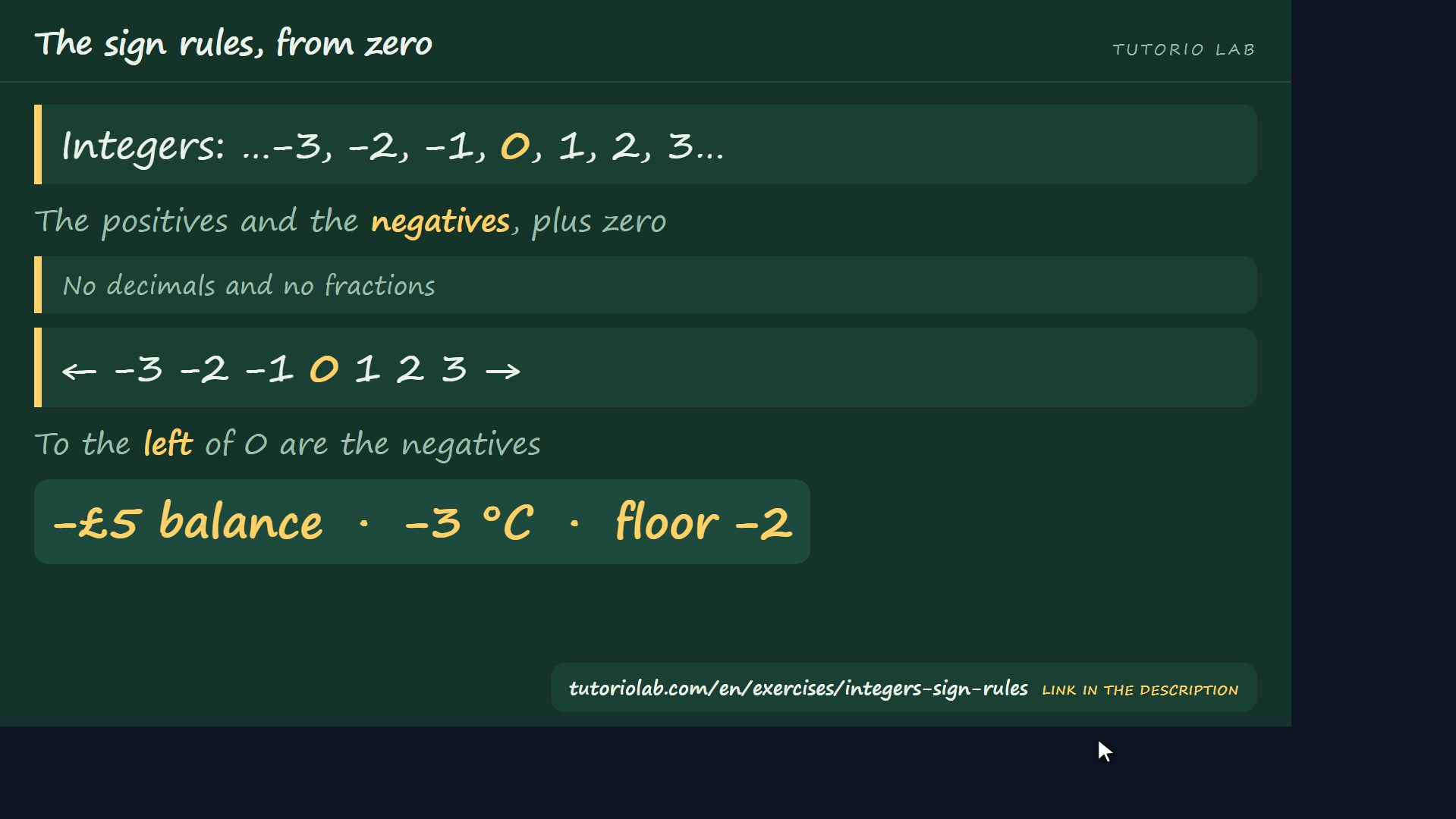
And now the most important thing in this video, and I am saying it before anything else because it is what goes wrong most. When somebody says the sign rule, they are almost always thinking of that thing about minus times minus being plus. But that rule is only for multiplying and dividing. For adding and subtracting there is ANOTHER rule, a different one, and they are not alike. So there are two sign rules, not one, and mixing them up is, by far, mistake number one in every integer exercise. An example of what happens when you mix them: minus three plus minus five. A lot of people think minus times minus, plus, and answer eight. And it is minus eight. Let us look at it properly.
Adding: same sign
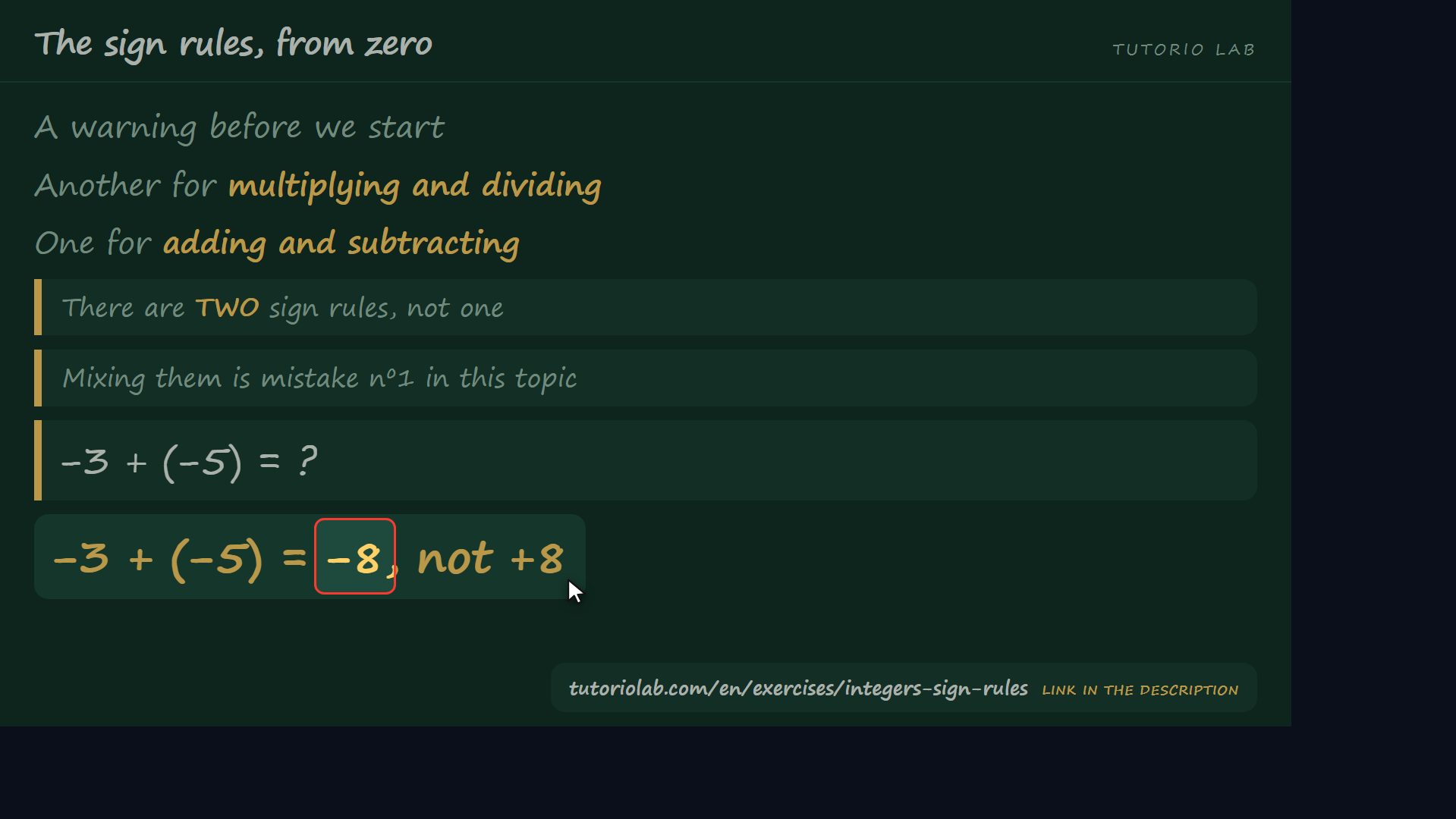
We start with the rule for adding and subtracting, which splits into two cases. First case: the two numbers have the same sign. Then the values are added and the result keeps that same sign. Minus three plus minus five: both are negative, so I add three plus five, eight, and the result is minus eight. And with positives it is the usual thing: four plus seven, eleven. The way to remember it without memorising anything is to think in debts: if you owe three and you also owe five, you do not owe less, you owe eight. Two debts together make a bigger debt. Nobody who owes three pounds and then owes five more ends up owing two, and that is exactly the arithmetic here.
Adding: different signs
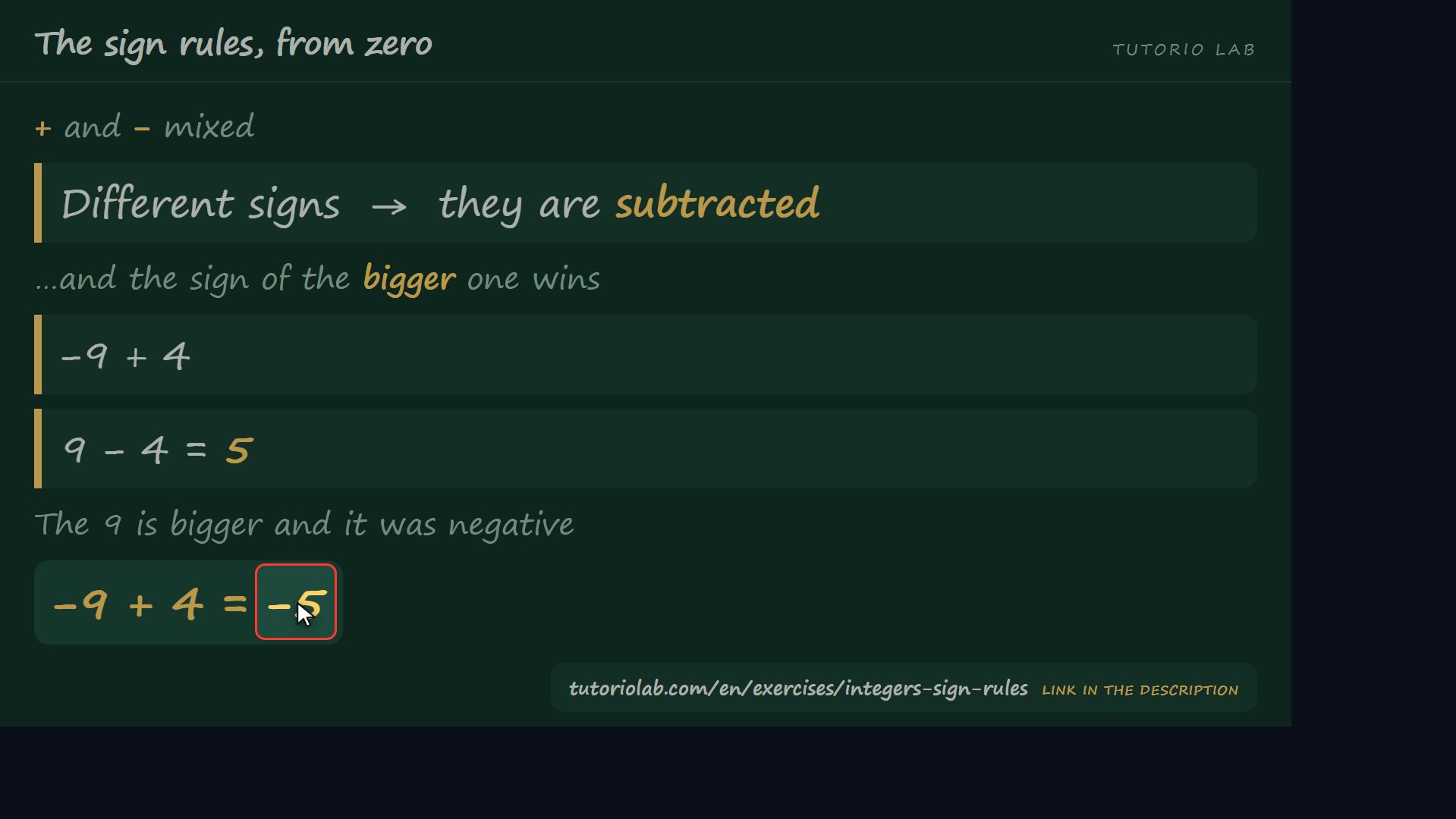
Second case, and it is the one people get stuck on most: the two numbers have different signs. Then they are NOT added: they are subtracted. And the result keeps the sign of the bigger one in absolute value, that is, of the one with the bigger digit without looking at the sign. Let us do an example: minus nine plus four. Different signs, so I subtract: nine minus four, five. And which sign do I put on it? I look at which is bigger without the sign: the nine. And the nine was the negative one. So the result is minus five. With debts again: if you owe nine and they pay you four, you still owe five. The four did not cancel the debt, it only made it smaller, and that is why the sign stays negative.
Multiplying: the famous rule
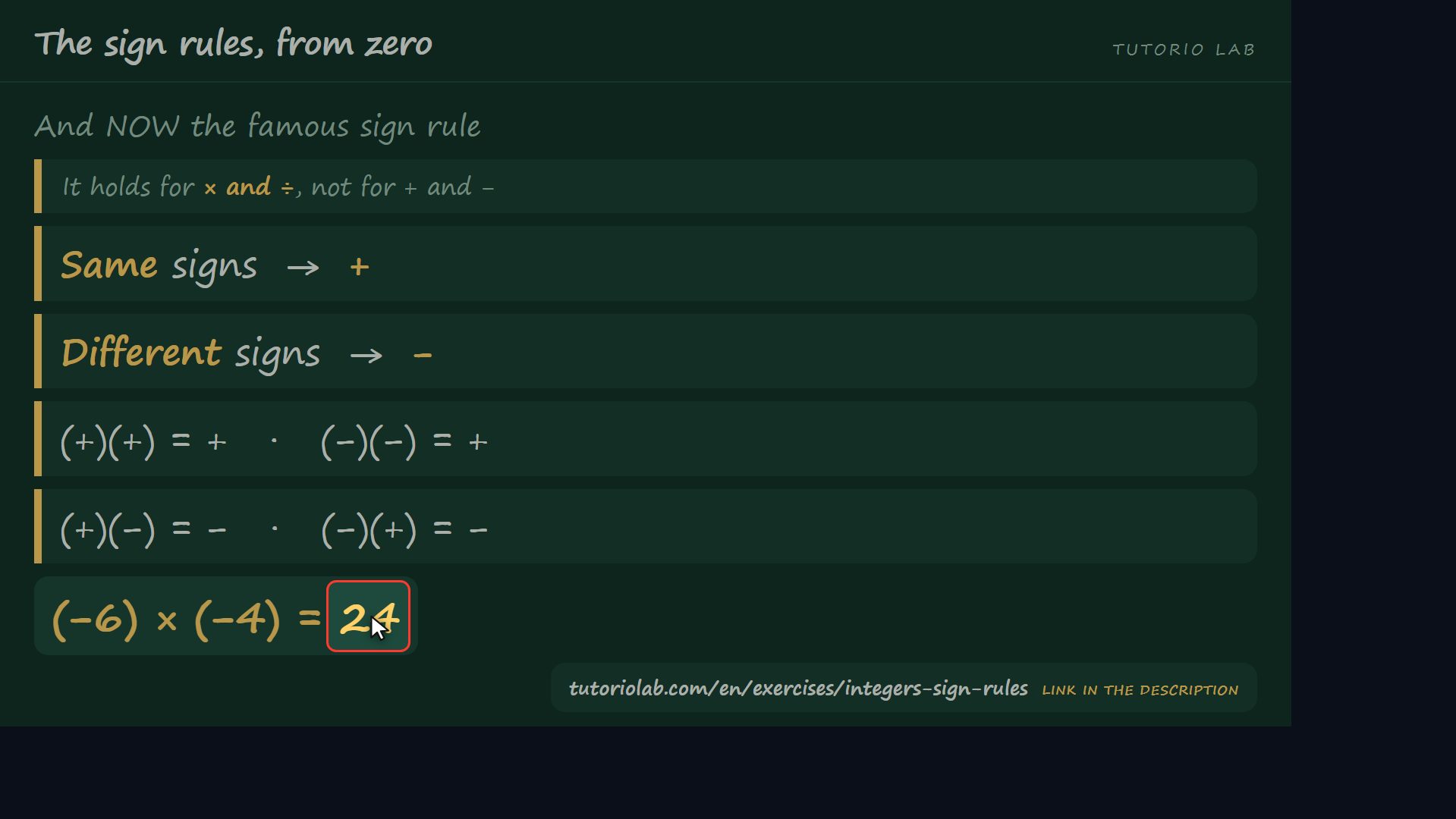
And now, yes, the famous sign rule, the one for multiplying and dividing. And I repeat, because it is the key to this video: this rule is only for multiplying and dividing. It goes like this: if the two signs are the same, the result is positive. If they are different, the result is negative. The four cases, which are these: plus times plus, plus. Minus times minus, plus. Plus times minus, minus. And minus times plus, minus. An example: minus six times minus four. Same signs, so the result is positive: six times four, twenty-four.
Why (−)·(−) gives +
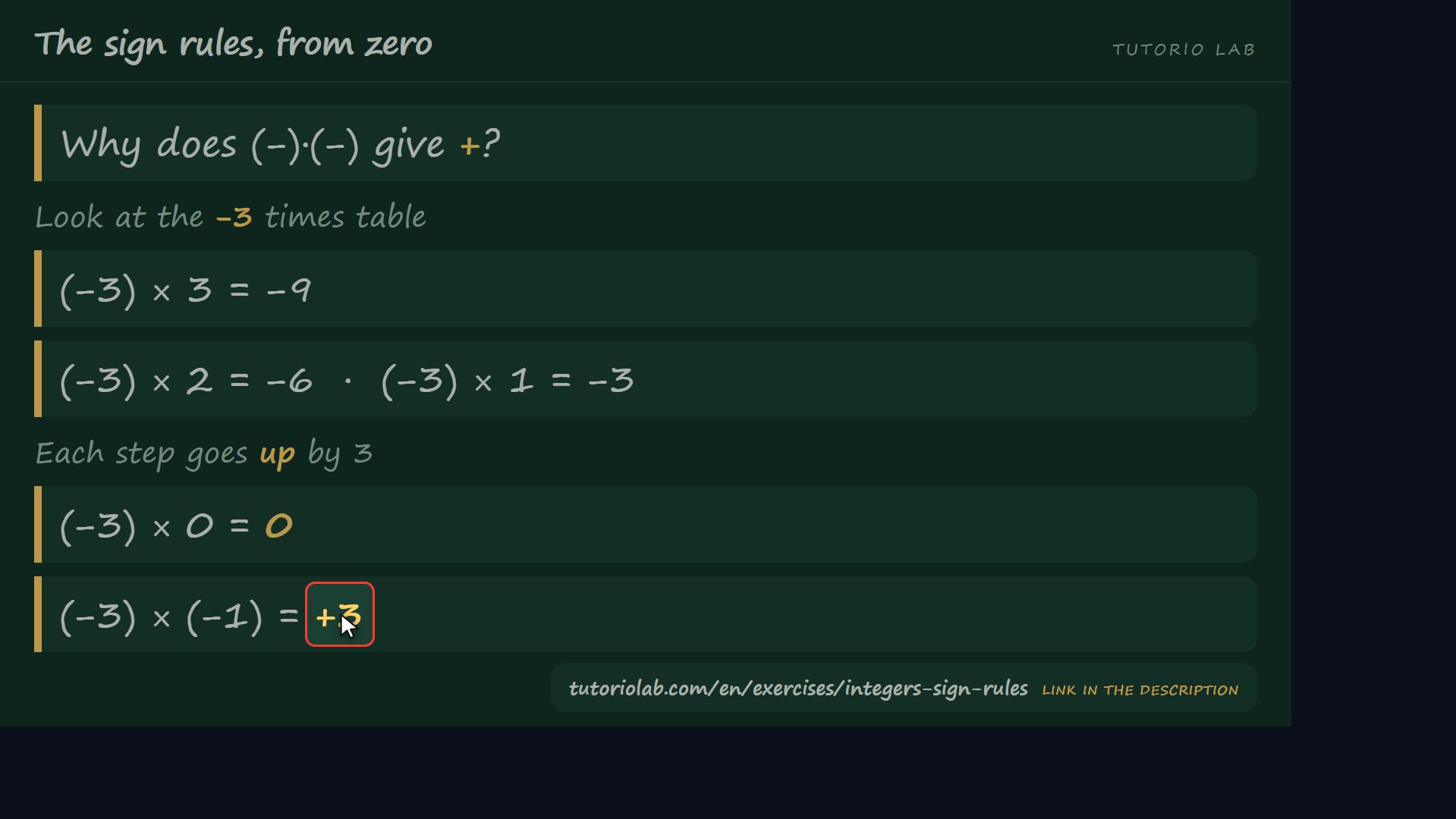
And here comes the question almost nobody answers: why does minus times minus give plus? It is not a whim, and you can see it with a table. Look: minus three times three is minus nine. Minus three times two is minus six. Minus three times one is minus three. Do you see what is happening? Every time I go down one in the second factor, the result goes up by three. Let us carry on: minus three times zero is zero. And the next one, following the same pattern, has to be plus three. And that one is minus three times minus one. So minus times minus gives plus because it is the only way for the pattern to keep working. Nobody decided it: it is what the rest of the arithmetic forces.
The double sign
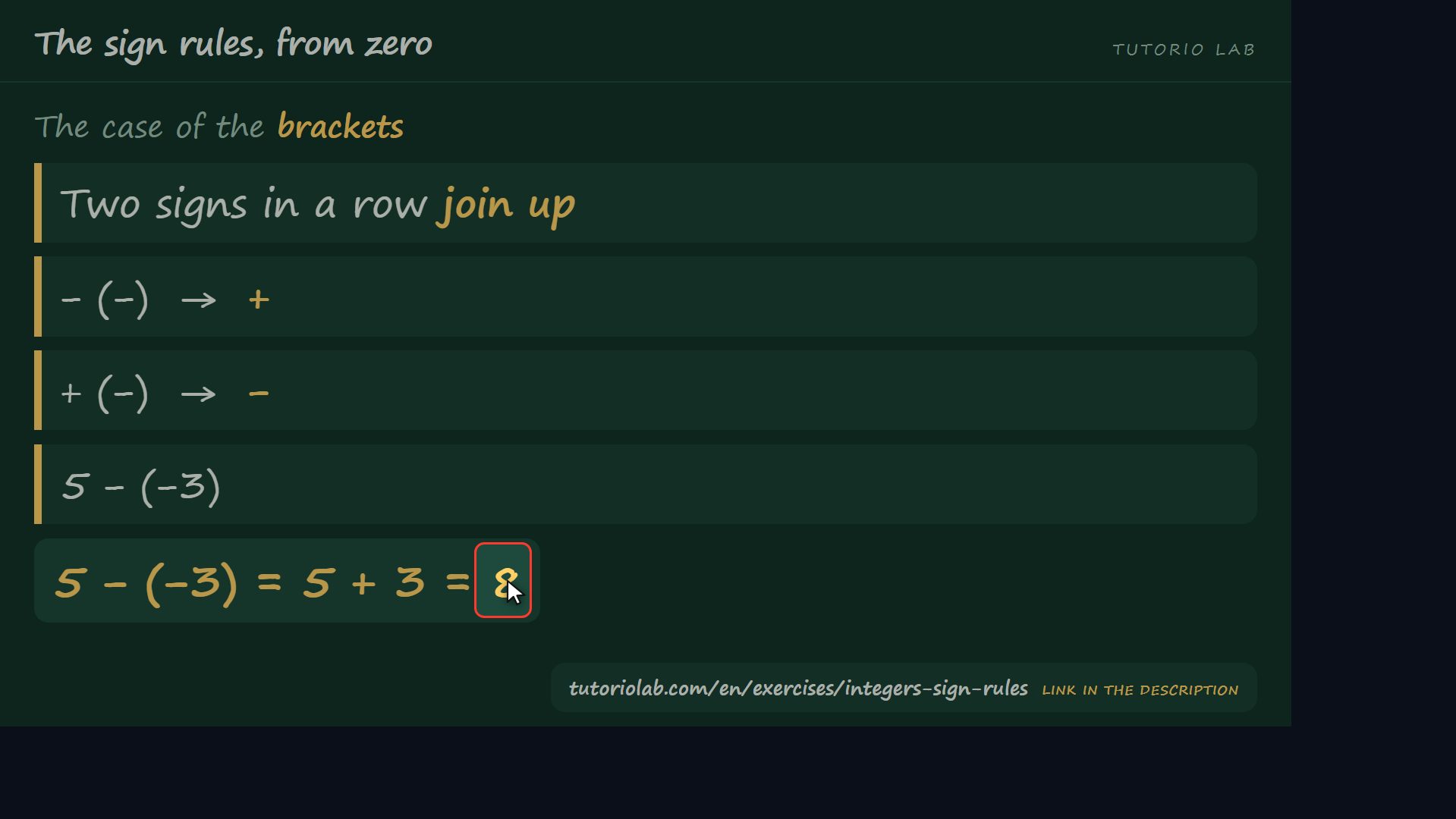
And there is the case of the brackets left, which is what gets asked most after the rule. When you come across two signs in a row, the first thing you do is join them into one, and that is where the sign rule does get used. A minus in front of a minus turns into a plus. A plus in front of a minus turns into a minus. Example: five minus, open bracket, minus three. The two minus signs join up and give a plus: five plus three, eight. And with debts it explains itself: if a debt of three is taken away from you, you have gained three. And watch the order: first you join the signs, and only then you add with the adding rule.
Exercise 1, step by step
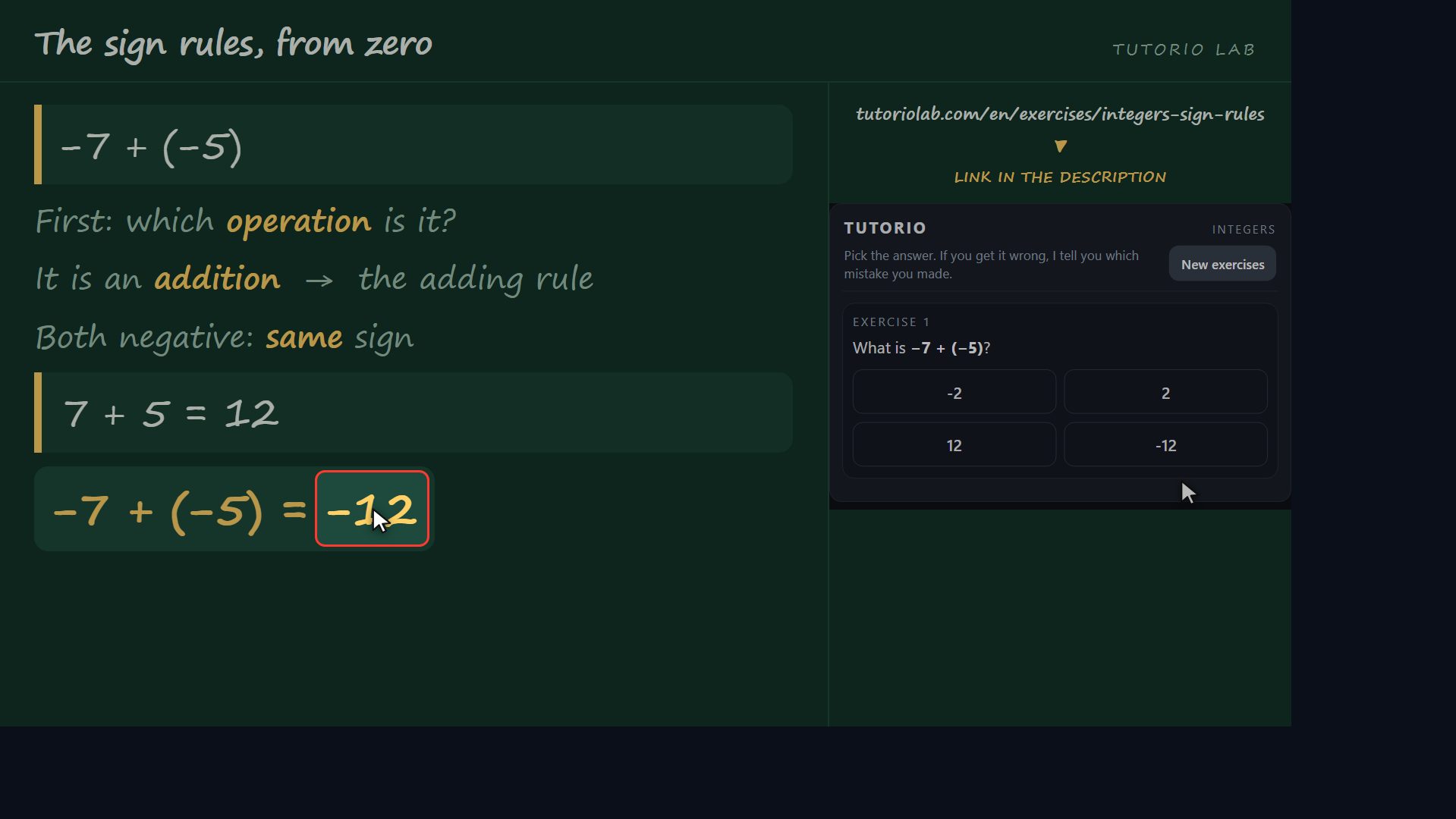
Let us do the first exercise, and we will solve it together before touching anything. Minus seven plus, in brackets, minus five. First, and this is what you always have to do: look at which operation it is. Here the sign in the middle is a plus, so it is an ADDITION, and for adding the adding rule is in charge, not the multiplying one. Second: what signs do they have? Both are negative, that is the same sign. And with the same sign the values are added: seven plus five, twelve. And the result stays negative: minus twelve. And look at the plus twelve trap: it comes from applying the multiplying rule here, which does not apply. I mark the minus twelve.
Practise for free
And I want you to take a good look at this on your right here, because it is ours and it is free. It is an exercise page: tutoriolab.com, slash e n, slash exercises, slash integers sign rules. You get the three cases from the video: adding with signs, multiplying with signs and the double sign, with different numbers every time. And what really matters: when you get one wrong it does not just throw an incorrect at you and leave you where you were. It tells you what mistake you made, by name.

Exercise 2, step by step
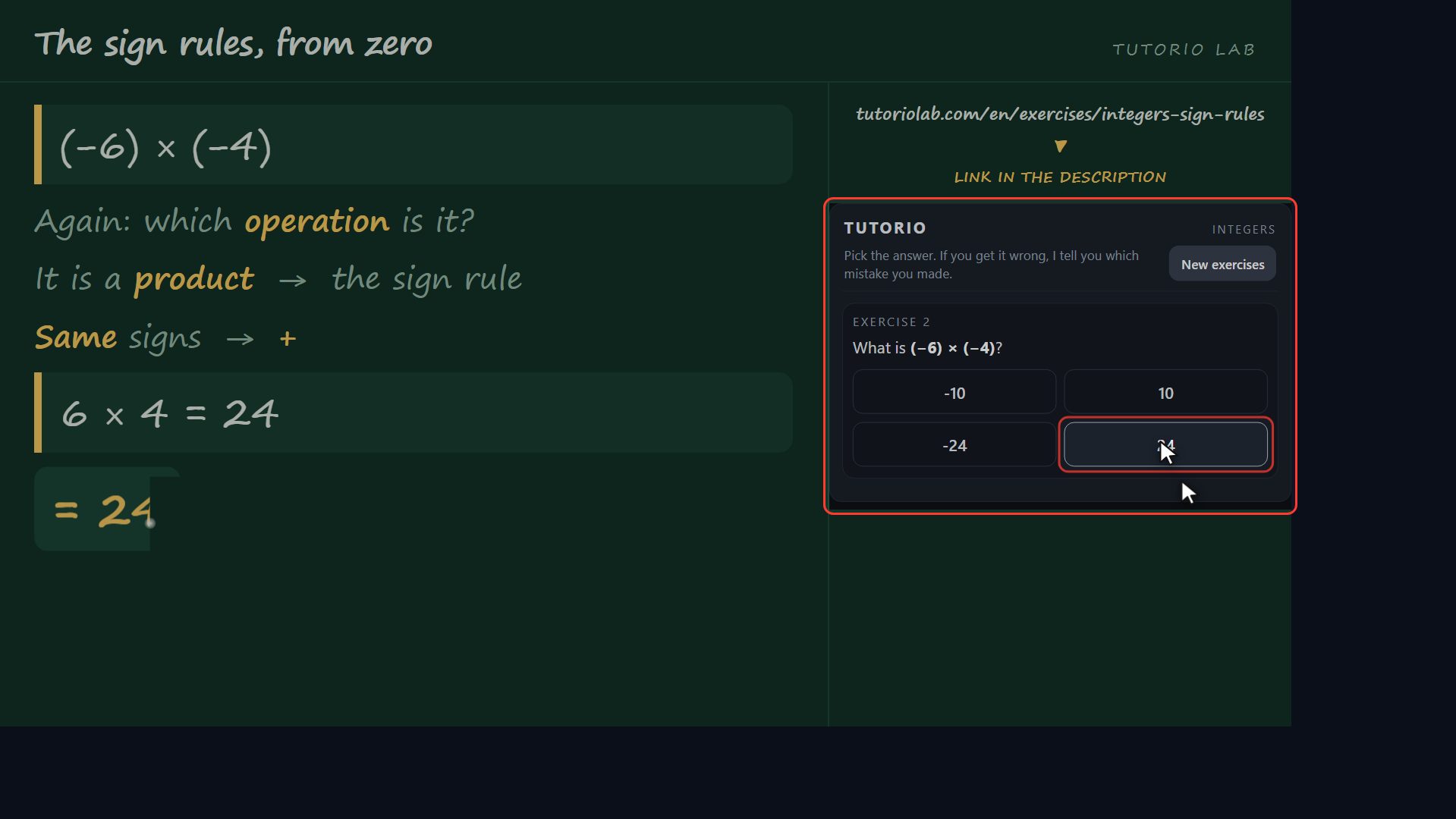
Second and last exercise, and it is exactly the other case so you can see the difference. Minus six, times, minus four. First the usual thing: which operation is it? The sign in the middle is a times, so it is a multiplication, and here the sign rule is in charge. Both are negative, that is the same signs, so the result is positive. Six times four, twenty-four. The answer is twenty-four, positive. And now compare it with the previous exercise, which is what I want you to take away: with the same signs, minus six PLUS minus four would give minus ten, and minus six TIMES minus four gives plus twenty-four. The same signs and results of opposite sign, because they are two different rules.
What to take away
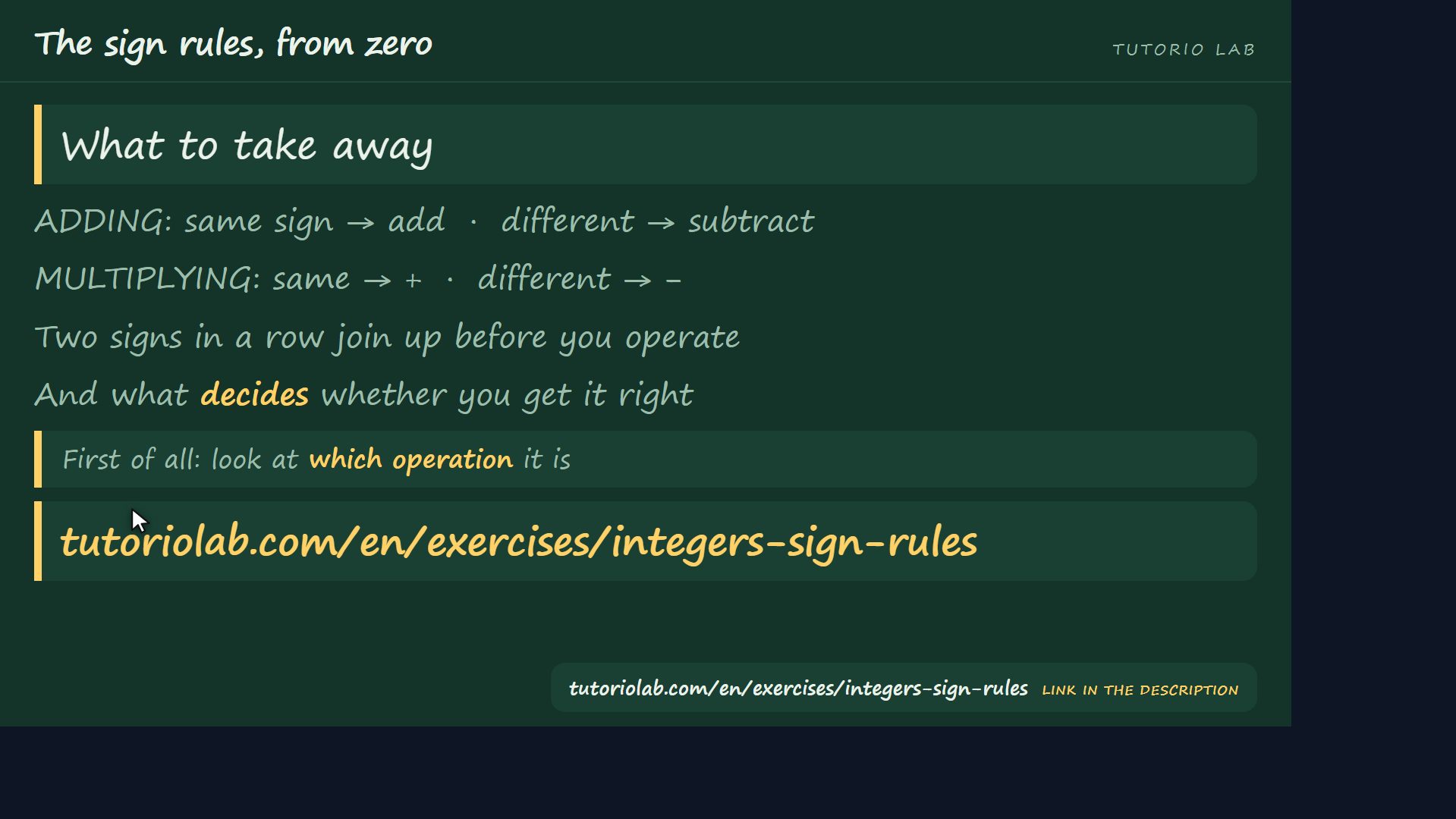
Let us go over what you have to take away. For adding and subtracting: if the signs are the same the values are added and it keeps that sign; if they are different they are subtracted and the sign of the bigger one wins. For multiplying and dividing: same signs give positive, different signs give negative. When there are two signs in a row, they join into one first. And the most important thing of all, the one that decides whether you get it right: before looking at the signs, look at which operation it is, because that is what tells you which rule applies. Practise it at tutoriolab.com, slash e n, slash exercises, slash integers sign rules.
If this helped, subscribe.

Common questions
What are the sign rules for integers?
There are two. For adding and subtracting: same sign, add the values and keep that sign; different signs, subtract them and the sign of the bigger one wins. For multiplying and dividing: same signs give positive, different signs give negative. They are different rules and mixing them up is the most common mistake.
Why is −3 + (−5) equal to −8 and not +8?
Because that is an addition, not a multiplication. The minus times minus is plus rule is only for multiplying and dividing. Two negatives added together give a bigger negative: if you owe 3 and you owe 5, you owe 8.
Why is a negative times a negative a positive?
Look at the −3 times table: (−3)×3 = −9, (−3)×2 = −6, (−3)×1 = −3, (−3)×0 = 0. Each step goes up by 3, so the next one has to be +3, and that one is (−3)×(−1). It is the only way the pattern keeps working.
What do you do with two signs in a row, like 5 − (−3)?
You join them into one first, and there the sign rule does apply: minus in front of a minus gives a plus, so 5 − (−3) = 5 + 3 = 8. Taking away a debt is gaining. Only after joining them do you add with the adding rule.
How do I know which rule to use?
Look at the operation before looking at the signs. If the sign in the middle is a + or a −, it is the adding rule. If it is a × or a ÷, it is the famous sign rule. With the same numbers, −6 + (−4) = −10 and (−6) × (−4) = +24.
Are there exercises to practise?
Yes, and they are free: tutoriolab.com/en/exercises/integers-sign-rules. You get the three cases from the video — adding with signs, multiplying with signs and the double sign — with new numbers every time, and when you get one wrong it tells you which mistake you made.