Square root by hand, no calculator
Taking a square root by hand has four steps. You split the number into groups of two digits from the right (the left group may keep only one). The first digit of the root is the biggest number whose square fits in the first group, and you subtract. You bring down the next group, double the root so far and look for the digit d such that the number formed with it, multiplied by d, fits in the remainder. With √576: 5|76, first digit 2 (remainder 1), double 4, 44×4 = 176, second digit 4, remainder 0, root 24. If the final remainder is not zero the root is not exact and what comes out is the whole part. And everything is checked by multiplying the root by itself.
Square root by hand, no calculator and skipping nothing.
What a square root is
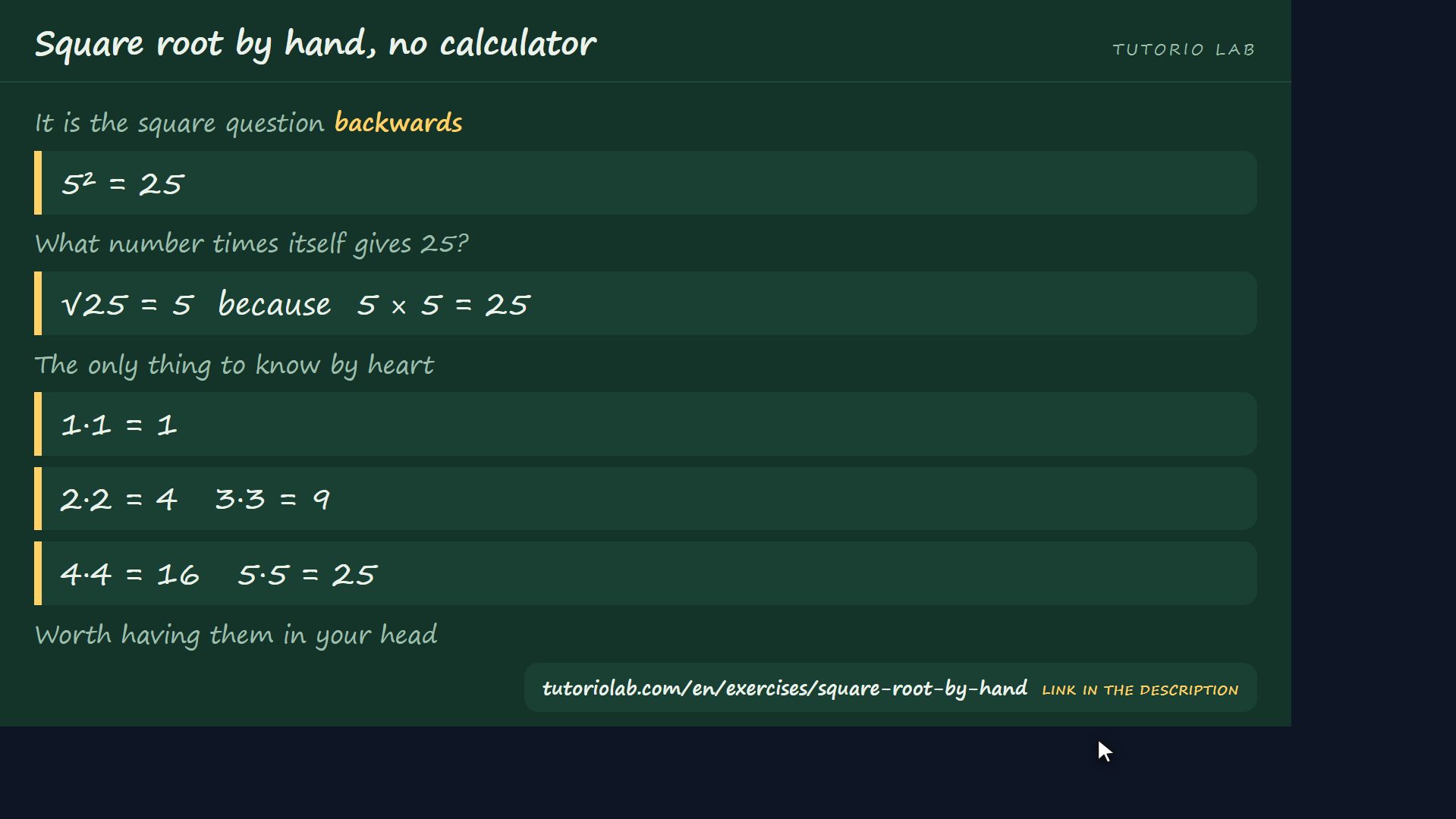
Let us start with the very basics, because I do not want to assume anything. The square root of a number is the backwards question of the square. If I tell you that the square of five is twenty-five, because five times five is twenty-five, the square root asks you the opposite: what number multiplied by itself gives twenty-five? And the answer is five. There is only one thing worth having in your head before we go on, and that is the table of squares from one to ten. One times one, one. Two times two, four. Three times three, nine. Four times four, sixteen. Five times five, twenty-five.
The mental trick
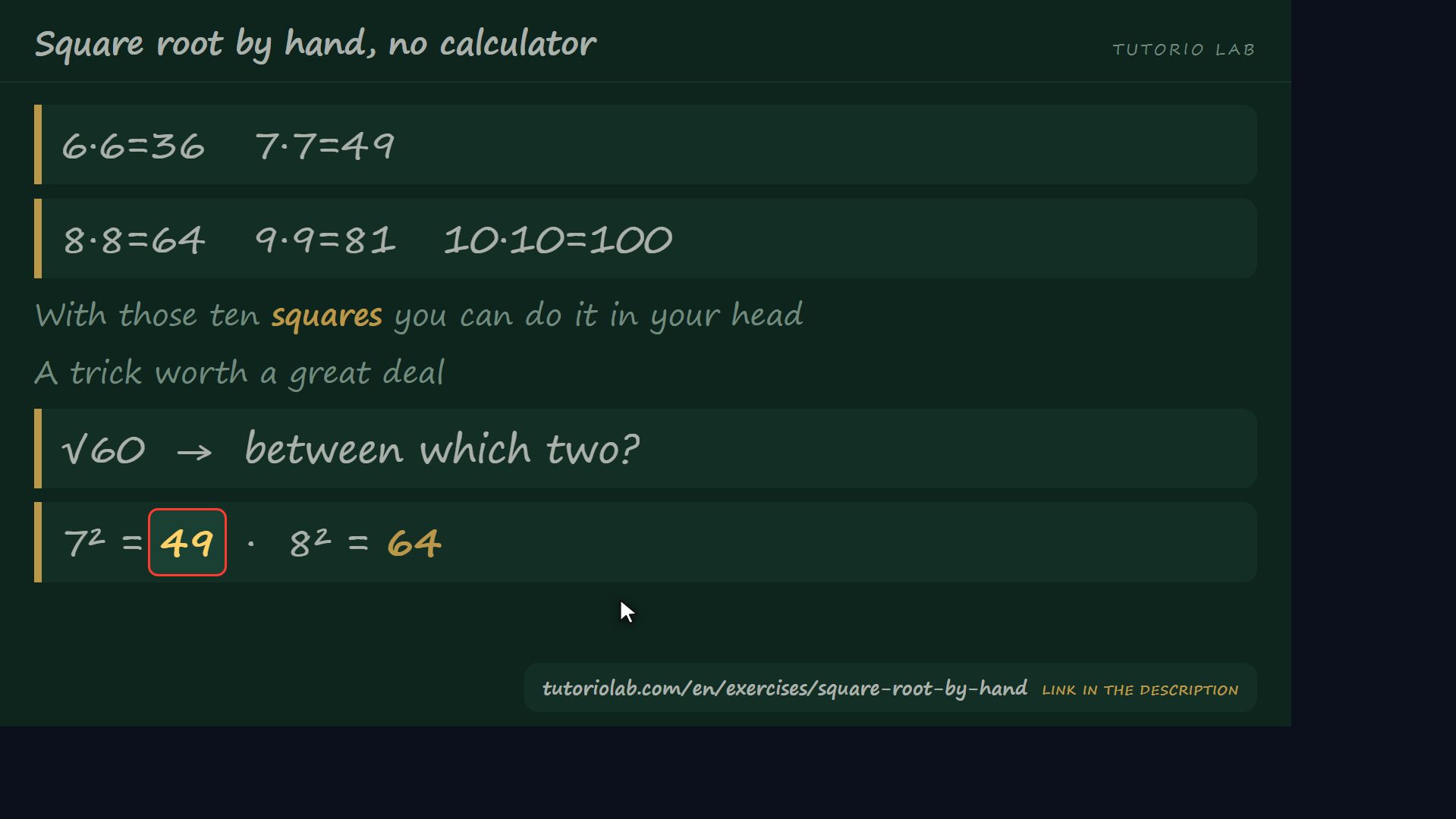
And I carry on: six times six, thirty-six. Seven times seven, forty-nine. Eight times eight, sixty-four. Nine times nine, eighty-one. And ten times ten, a hundred. With just those ten you can already do a trick that is worth a great deal, which is knowing which two numbers a root lies between without calculating anything. Look: the root of sixty. Which two integers does it lie between? You look for the squares that surround it. Seven squared is forty-nine, which falls short. Eight squared is sixty-four, which overshoots. So the root of sixty is between seven and eight. And that, which looks like a small thing, is what saves you from accepting an absurd result.
Splitting the number
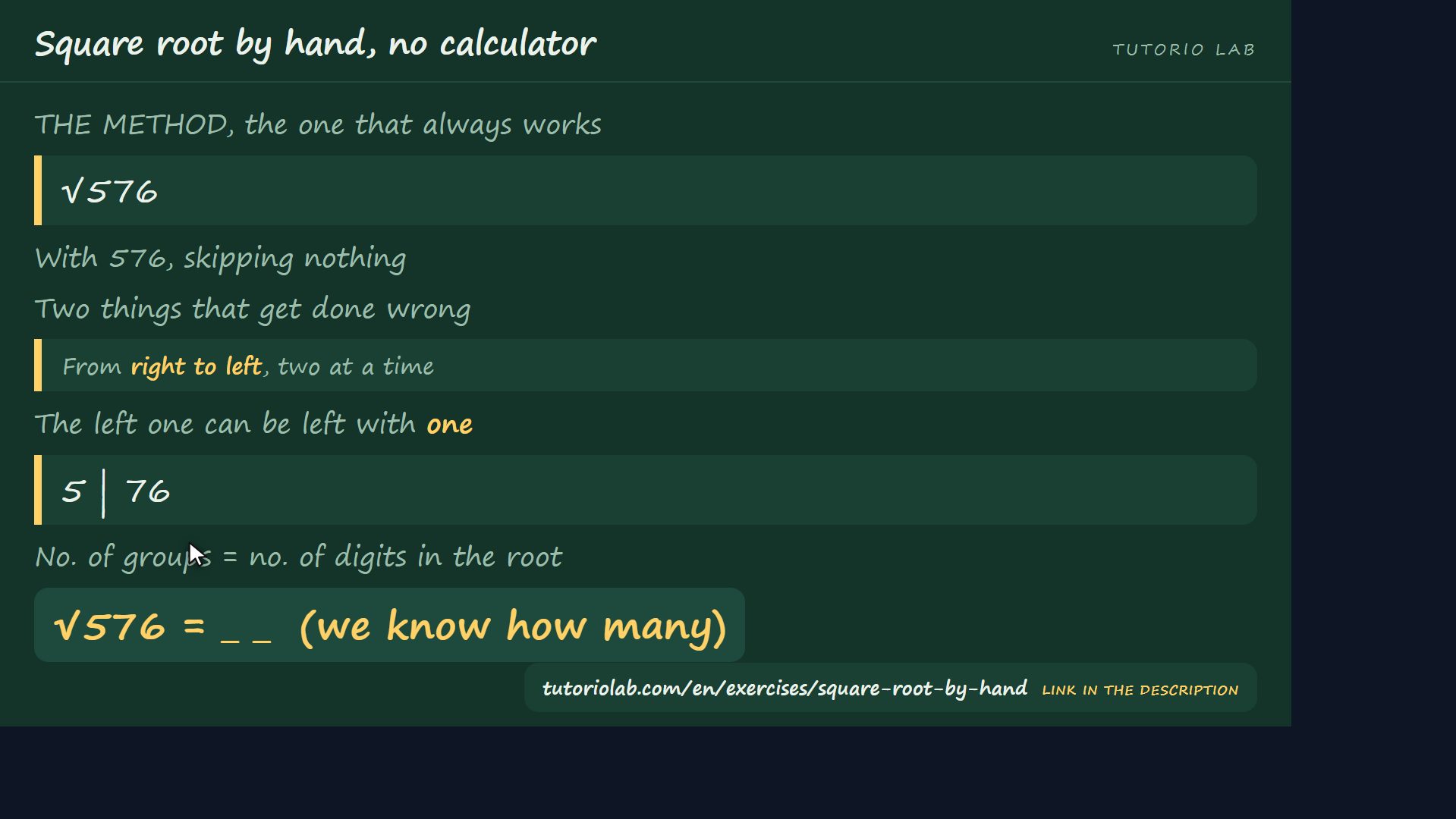
Now let us go to the real method, the one that works for big numbers. I am going to do it with five hundred and seventy-six, step by step and skipping none of them. The first thing is to split the number into groups of two digits, and here there are two things that get done wrong all the time. The first: you split from right to left, not from left to right. And the second: the last group on the left can be left with a single digit, and that is normal. Five hundred and seventy-six splits like this: the five on one side, and the seventy-six on the other. Two groups. And there goes the first useful fact: the number of groups is the number of digits the root will have. Two groups, two digits.
The first digit
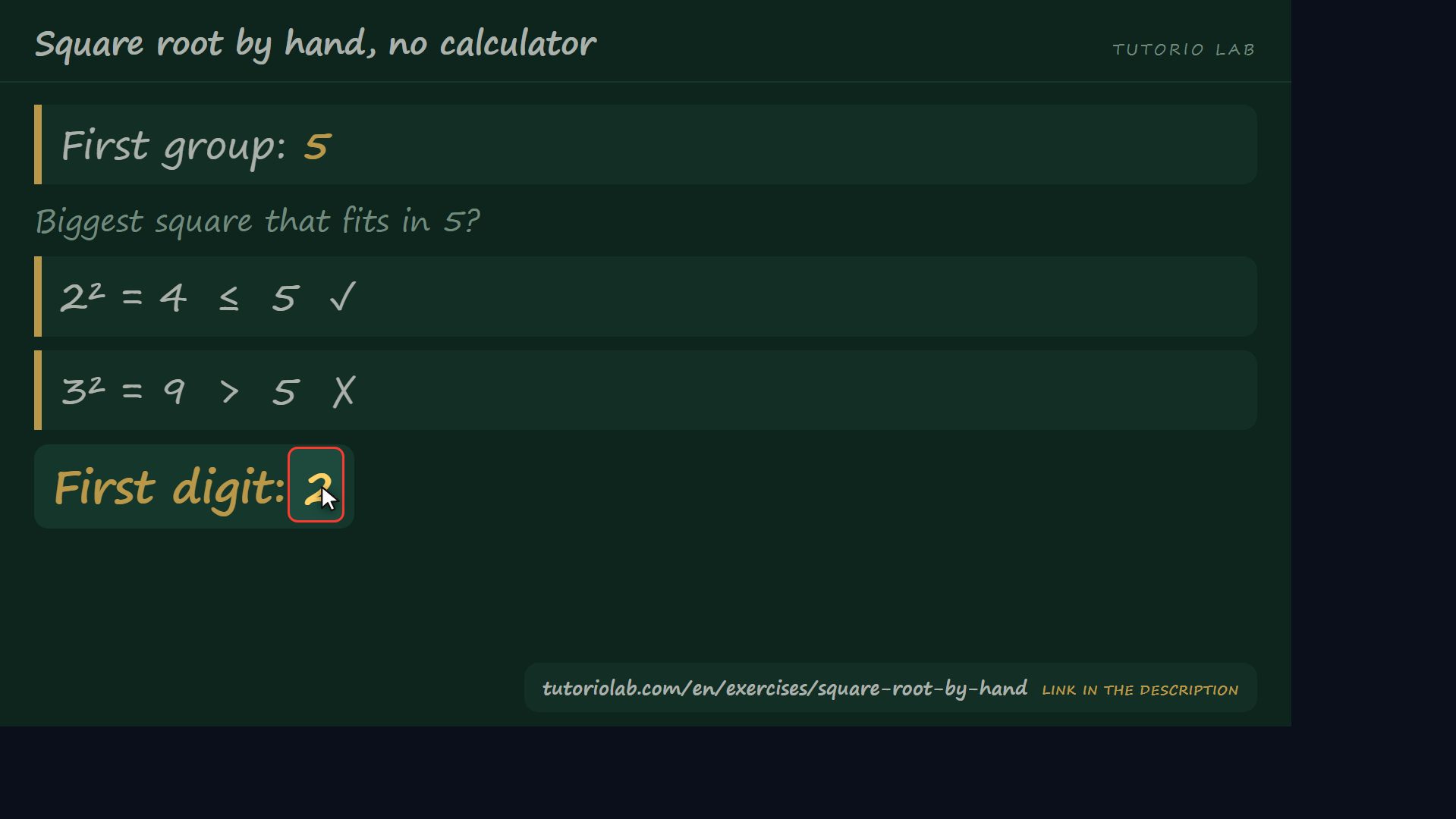
We start with the group on the left, which is the five. The question is: what is the biggest number whose square fits inside the five? Let us try. Two squared is four, and four fits in five. Three squared is nine, and nine no longer fits, it overshoots. So the number is the two. That two is the first digit of our root. And now we subtract, just like in a division: five minus four, which is what two squared is worth, leaves us one. That one is the remainder we carry on with.
Bring down and double
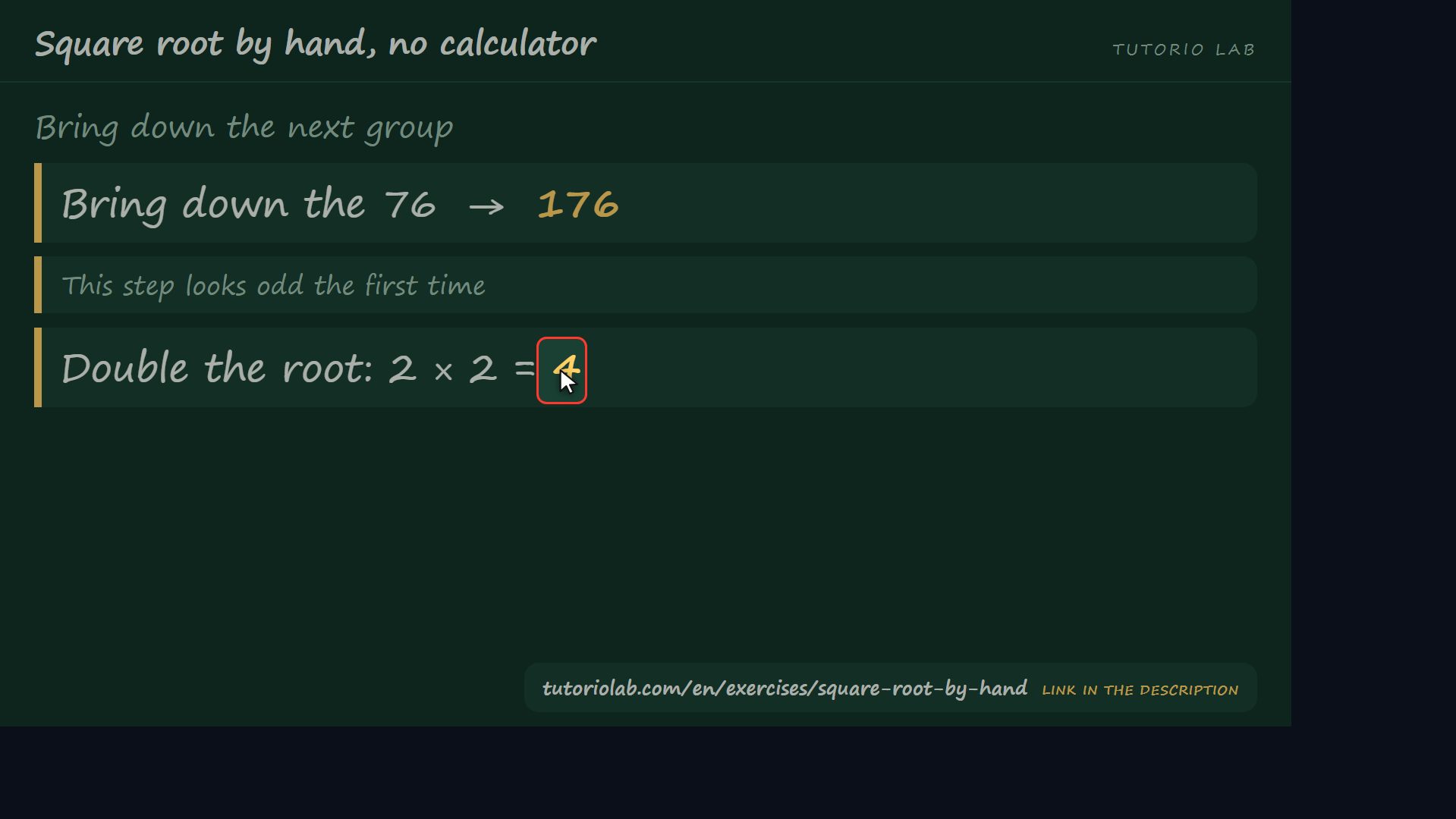
Now we bring down the next group, the seventy-six, and we put it beside the remainder. We had one and we bring down seventy-six, so now we are working with a hundred and seventy-six. And here comes the step that looks odd the first time, so pay attention. We take the part of the root we already have, which is the two, and we double it: two times two, four. We write that four on the left and we are going to put a digit after it that we do not know yet. We will call it d.
The second digit
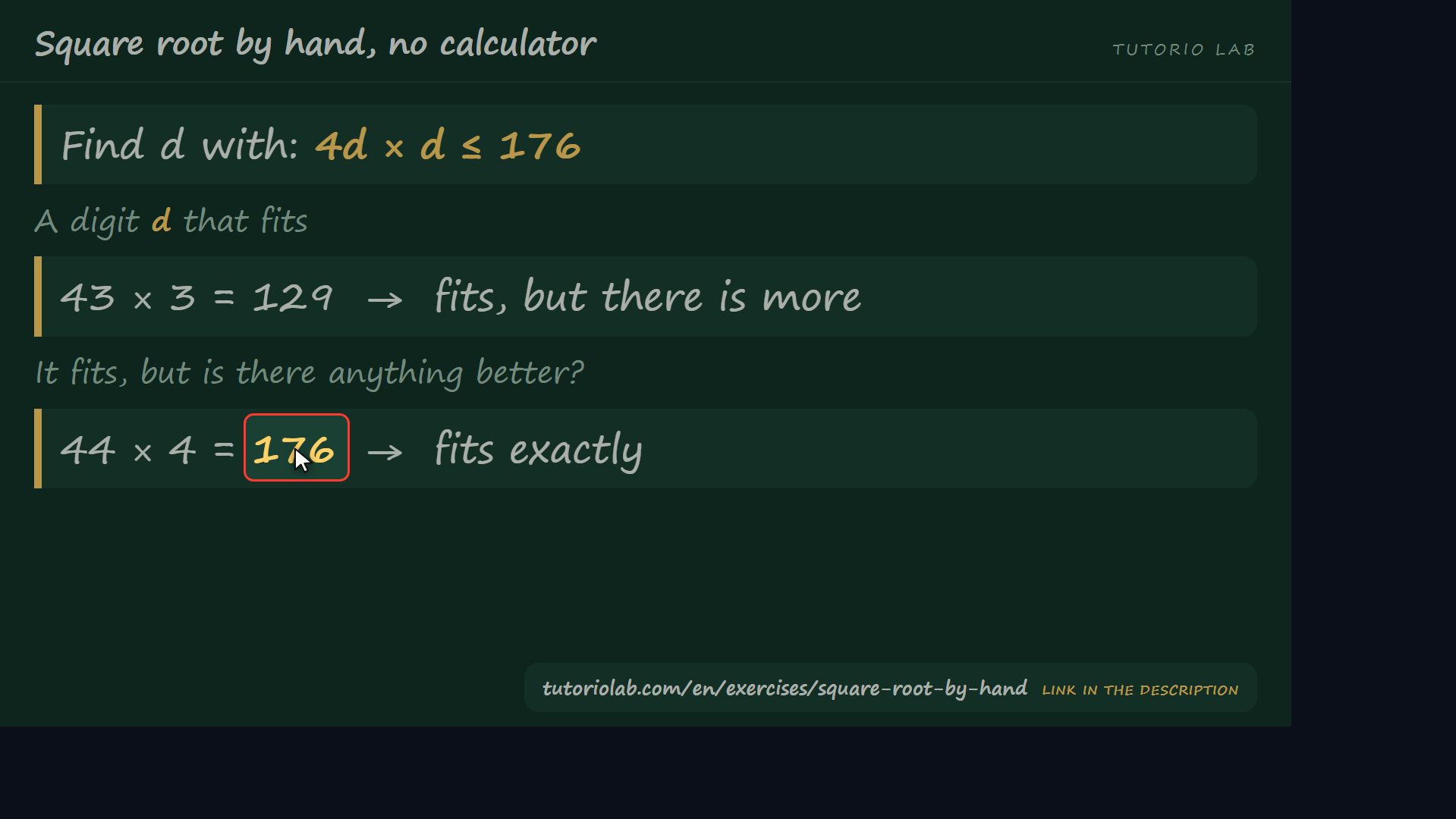
And what we have to find is that digit d, with one condition: the number made of four and d, multiplied by d itself, has to fit inside a hundred and seventy-six without going over. Let us try. If d were three, we would have forty-three times three, which is a hundred and twenty-nine. It fits, but maybe there is something better. If d were four, forty-four times four, which is a hundred and seventy-six. It fits exactly, precisely. And if we tried five, forty-five times five is two hundred and twenty-five, which already overshoots. So d is four. That is the second digit of the root. We subtract: a hundred and seventy-six minus a hundred and seventy-six, zero. A remainder of zero means the root is exact. The square root of five hundred and seventy-six is twenty-four.
Check it yourself
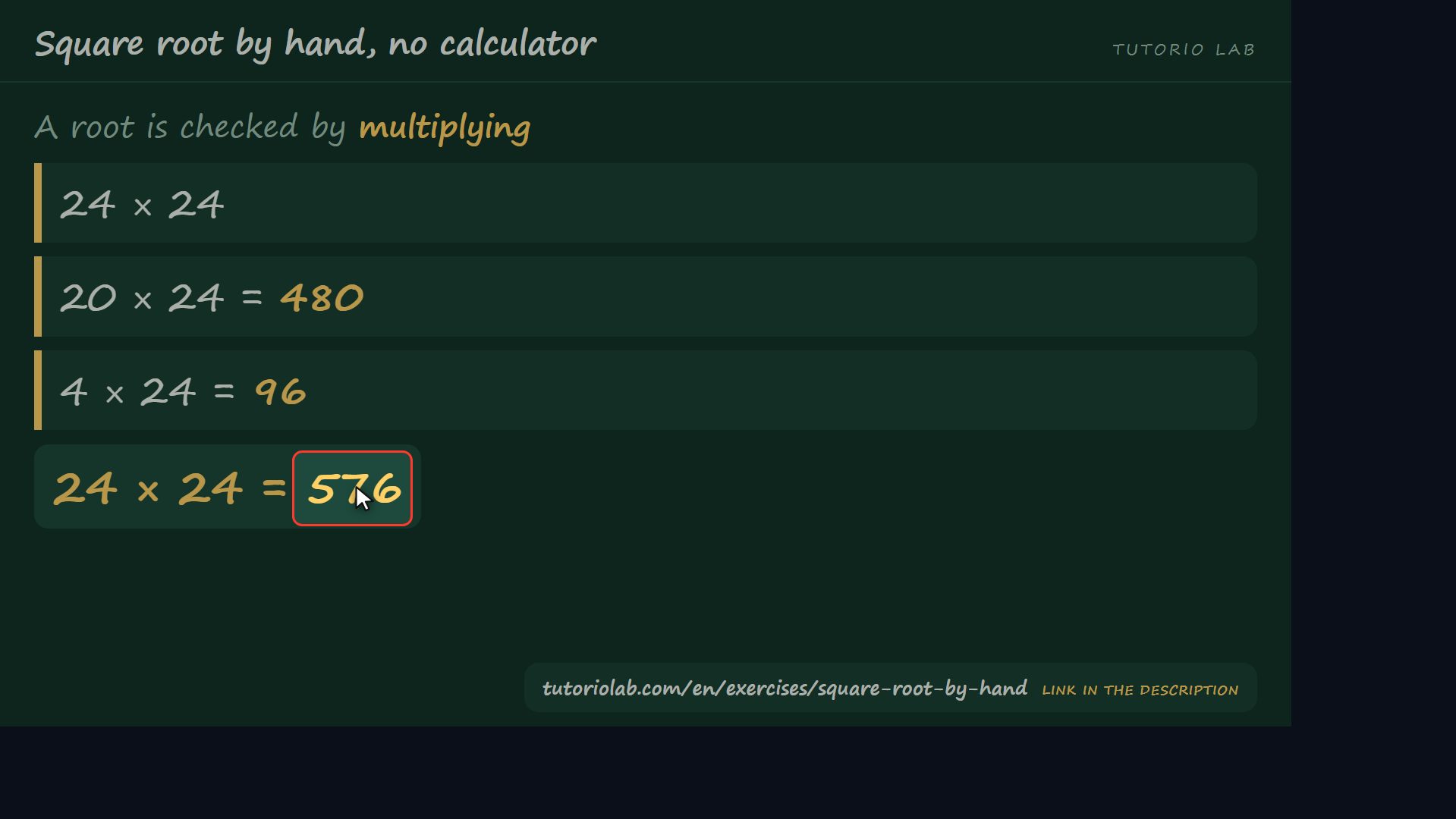
And now what you always have to do, and it is the easiest thing in this whole video: check it. A root is checked by multiplying the result by itself, and it has to give you the number you started with. Twenty-four times twenty-four. Twenty times twenty-four is four hundred and eighty, plus four times twenty-four which is ninety-six: five hundred and seventy-six. Exactly right. If it had given you another number, right there you would know that you have gone wrong at some step.
Exercise 1, step by step
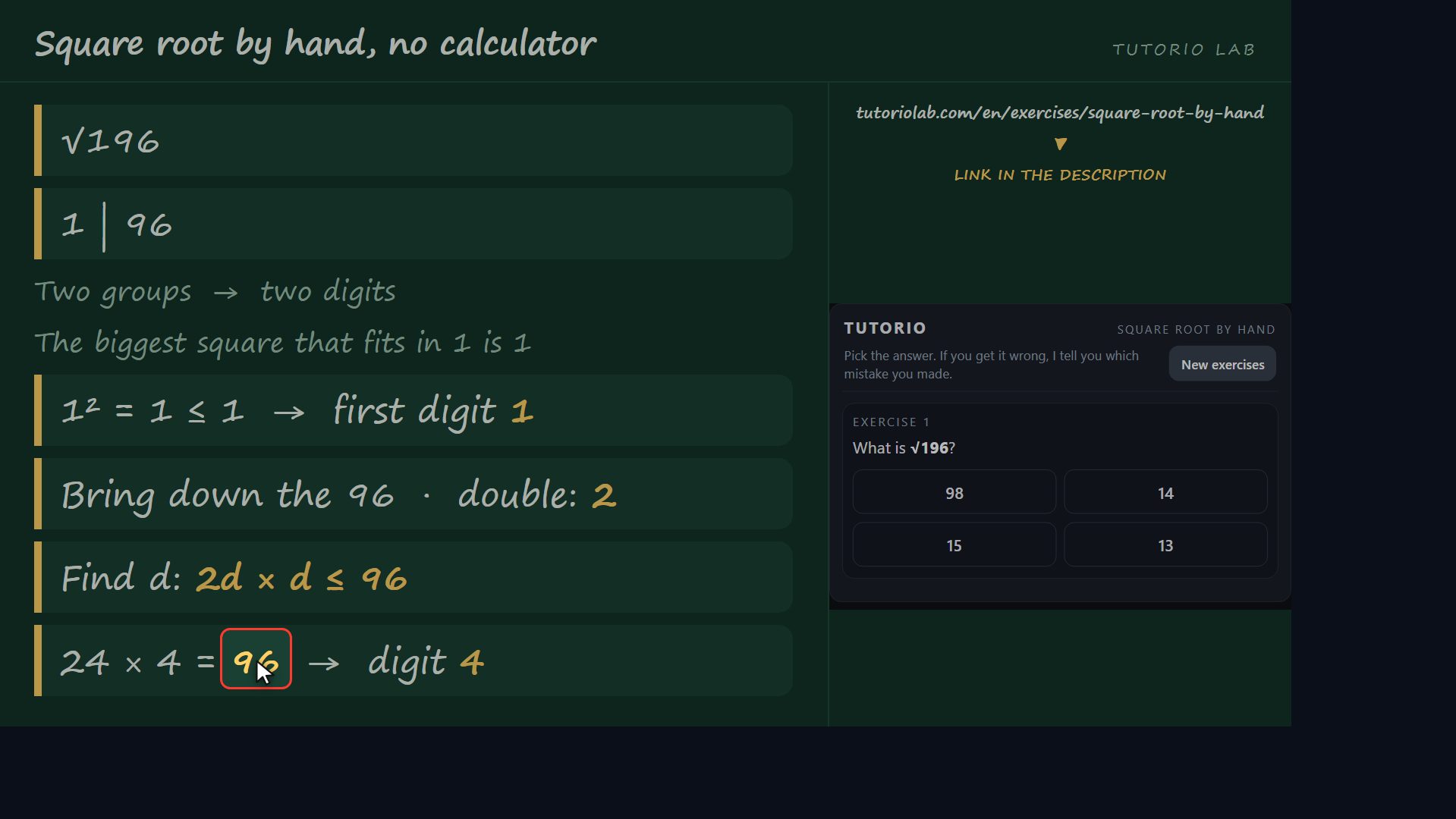
Let us do the first exercise, and we will do it together on the board before touching anything. The root of a hundred and ninety-six. First we split from right to left: the one on one side and the ninety-six on the other. Two groups, so two digits in the root. First group, the one: the biggest square that fits in one is one squared, which is one. First digit, the one, and the remainder is zero. We bring down the ninety-six. We double the root we have so far: two times one, two. And we look for the digit d such that two d times d fits in ninety-six. We try four: twenty-four times four is ninety-six. It fits exactly. So the second digit is four and the root is fourteen. I mark the fourteen.
Practise for free
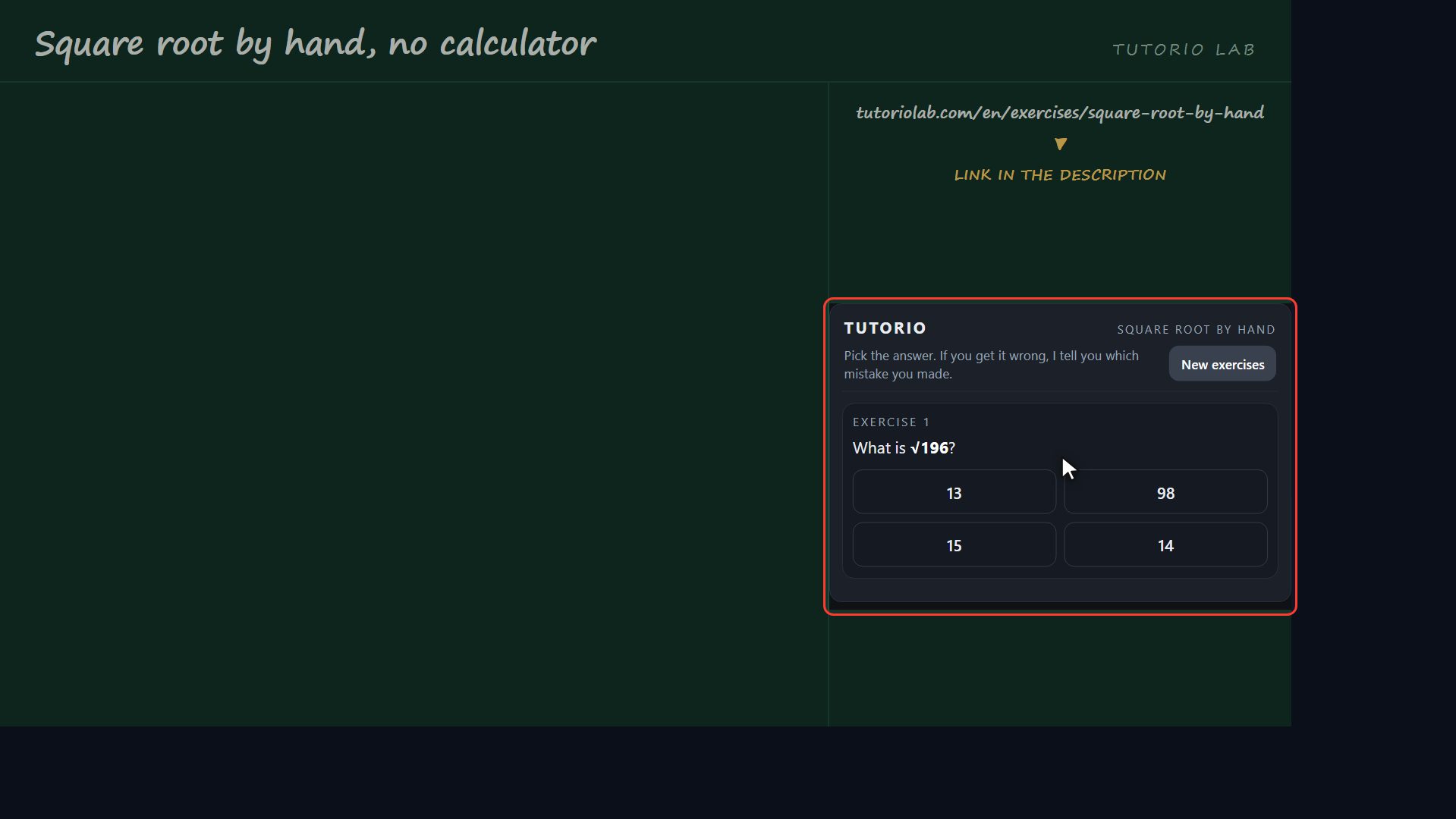
And I want you to take a good look at this on your right here, because it is ours and it is free. It is an exercise page: tutoriolab.com, slash e n, slash exercises, slash square root by hand. Every time you go in you get different numbers, so you can practise as many times as you like without repeating. And what really matters: when you get one wrong it does not just throw an incorrect at you and leave you where you were. It tells you what mistake you made, by name, and it shows you the worked calculation.
When it is not exact
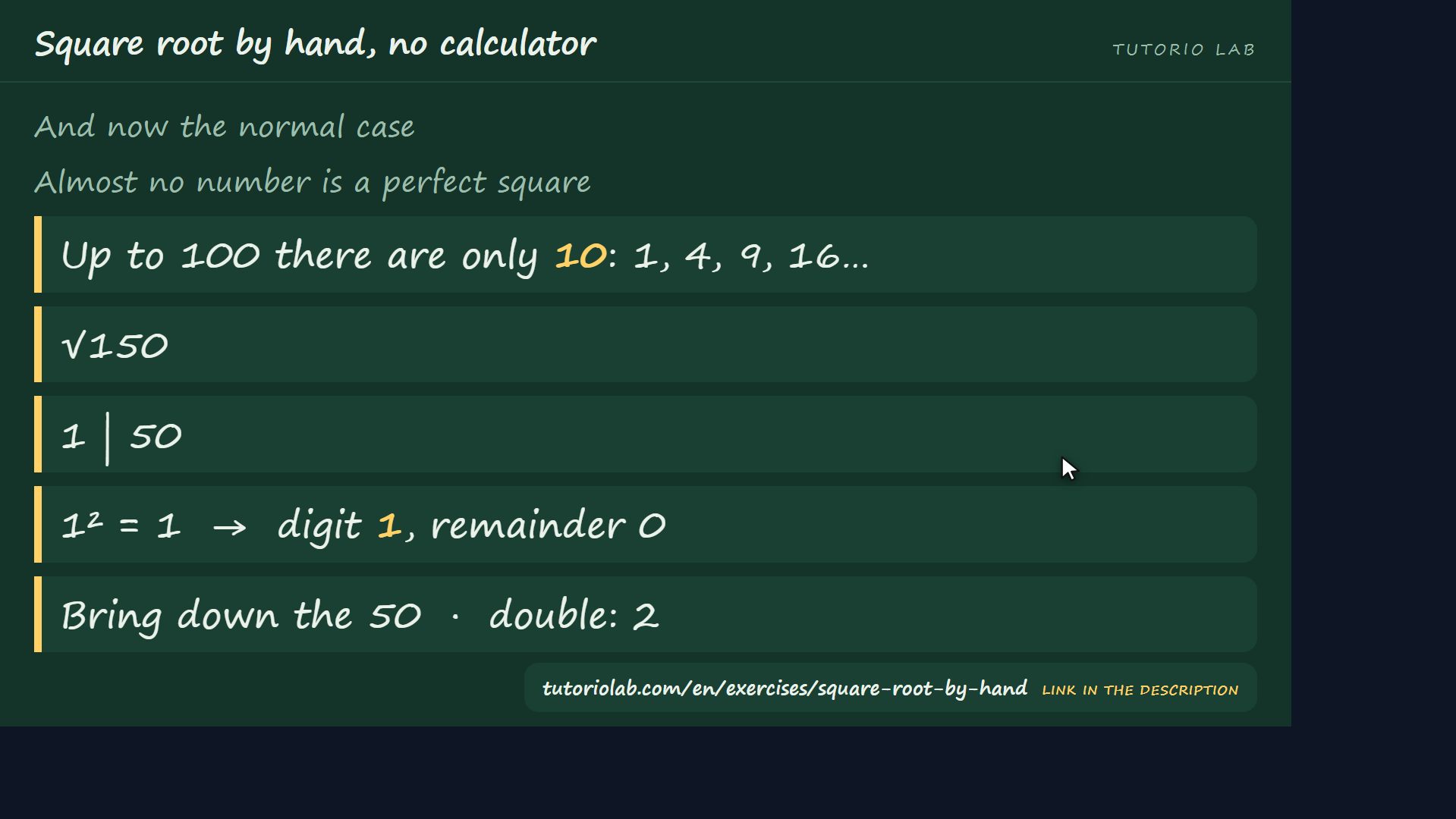
Now what happens almost always, and which a lot of people do not know how to handle: that the root is not exact. Because perfect squares are few, and most numbers are not one. Let us do a hundred and fifty. We split it the same way: the one and the fifty. First group, the one: one squared is one, it fits exactly. First digit one, remainder zero. We bring down the fifty. And we double the root we have so far: two times one, two.
The whole part
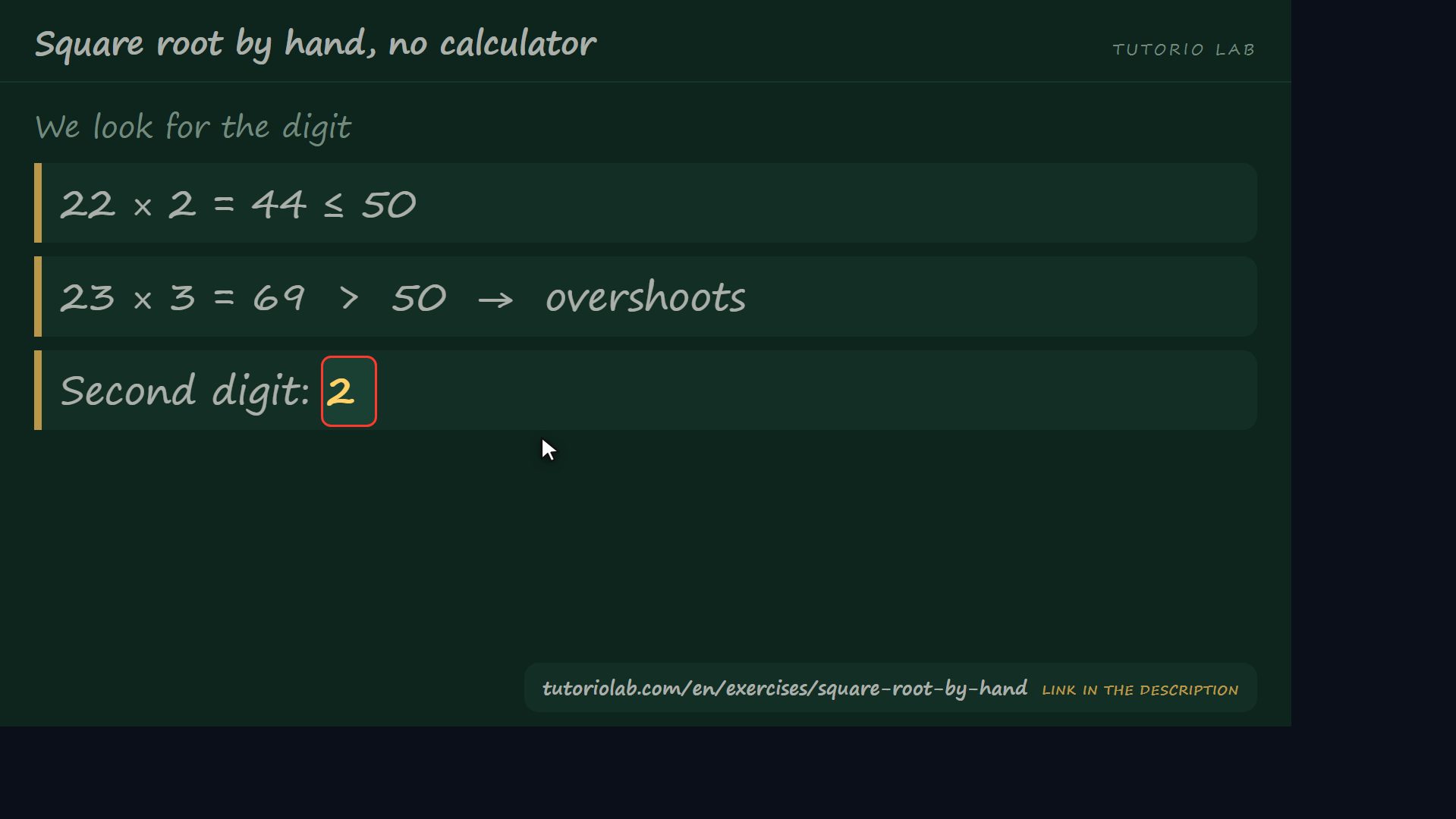
We look for the digit. If it were two, twenty-two times two is forty-four, and forty-four fits inside fifty. If it were three, twenty-three times three is sixty-nine, which already overshoots fifty. So the digit is two. The root we have so far is twelve. And now we subtract: fifty minus forty-four leaves us six. And that six is not zero, so the root is not exact. What does that mean? That twelve is the whole part of the root of a hundred and fifty, and that six is left over. Twelve squared is a hundred and forty-four, and from there to a hundred and fifty six are missing. For almost everything you are going to need, the whole part is enough.
Exercise 2, step by step
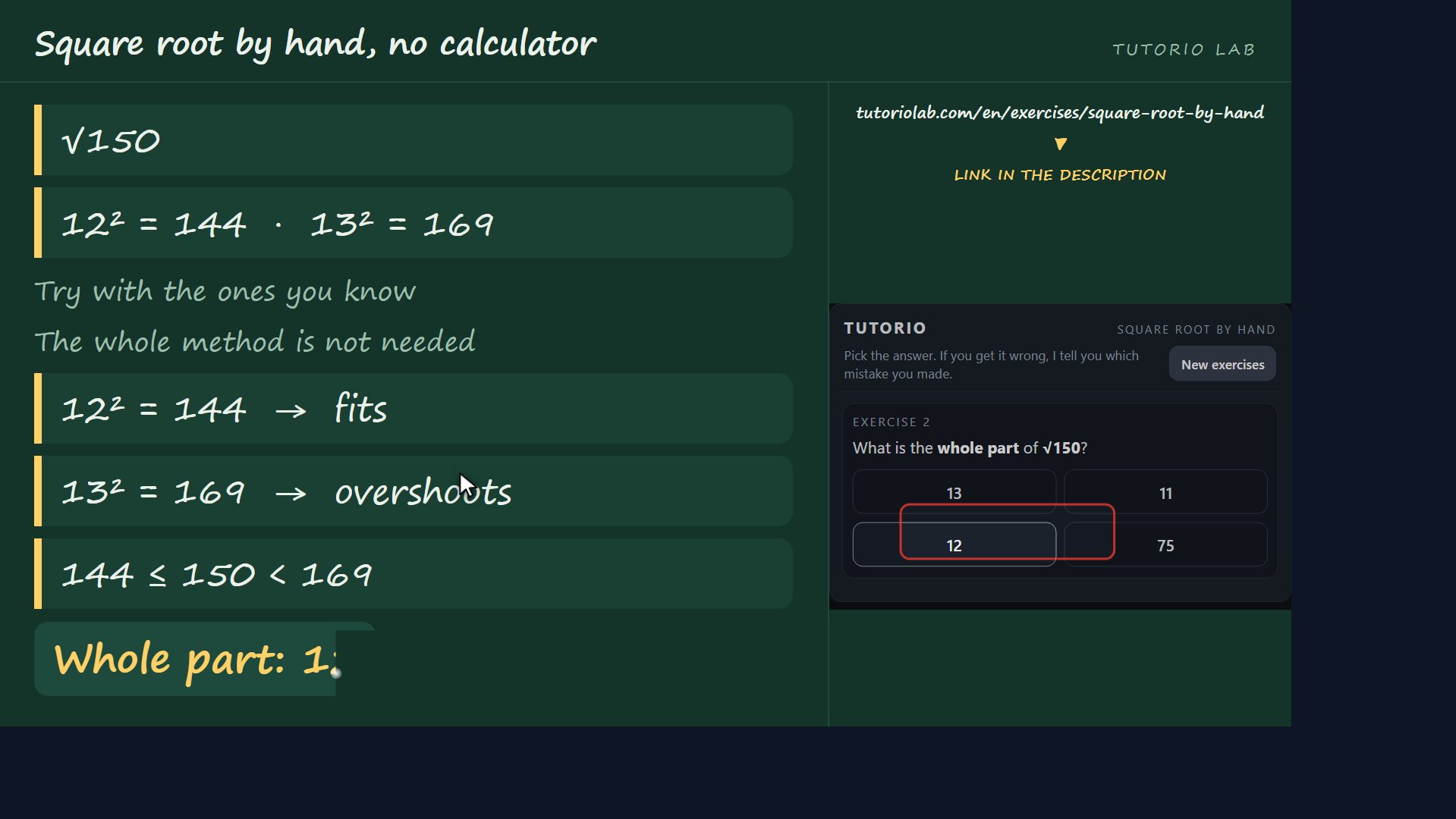
Second and last exercise, and it is that same number: the whole part of the root of a hundred and fifty. And here I want you to see something very useful: if they only ask you for the whole part, you do not need to do the whole method. You can get it in your head, trying with the squares you already know. You keep going. Twelve squared is a hundred and forty-four, which fits in a hundred and fifty. Thirteen squared is a hundred and sixty-nine, which overshoots. So the whole part has to be twelve. And now look at the eleven trap, which is very well placed: eleven squared is a hundred and twenty-one, and a hundred and twenty-one also fits inside a hundred and fifty, so it looks valid. But what is being asked for is not a number that fits: it is the BIGGEST one that fits. And the twelve fits and is bigger than the eleven. That nuance is the whole exercise.
The four steps
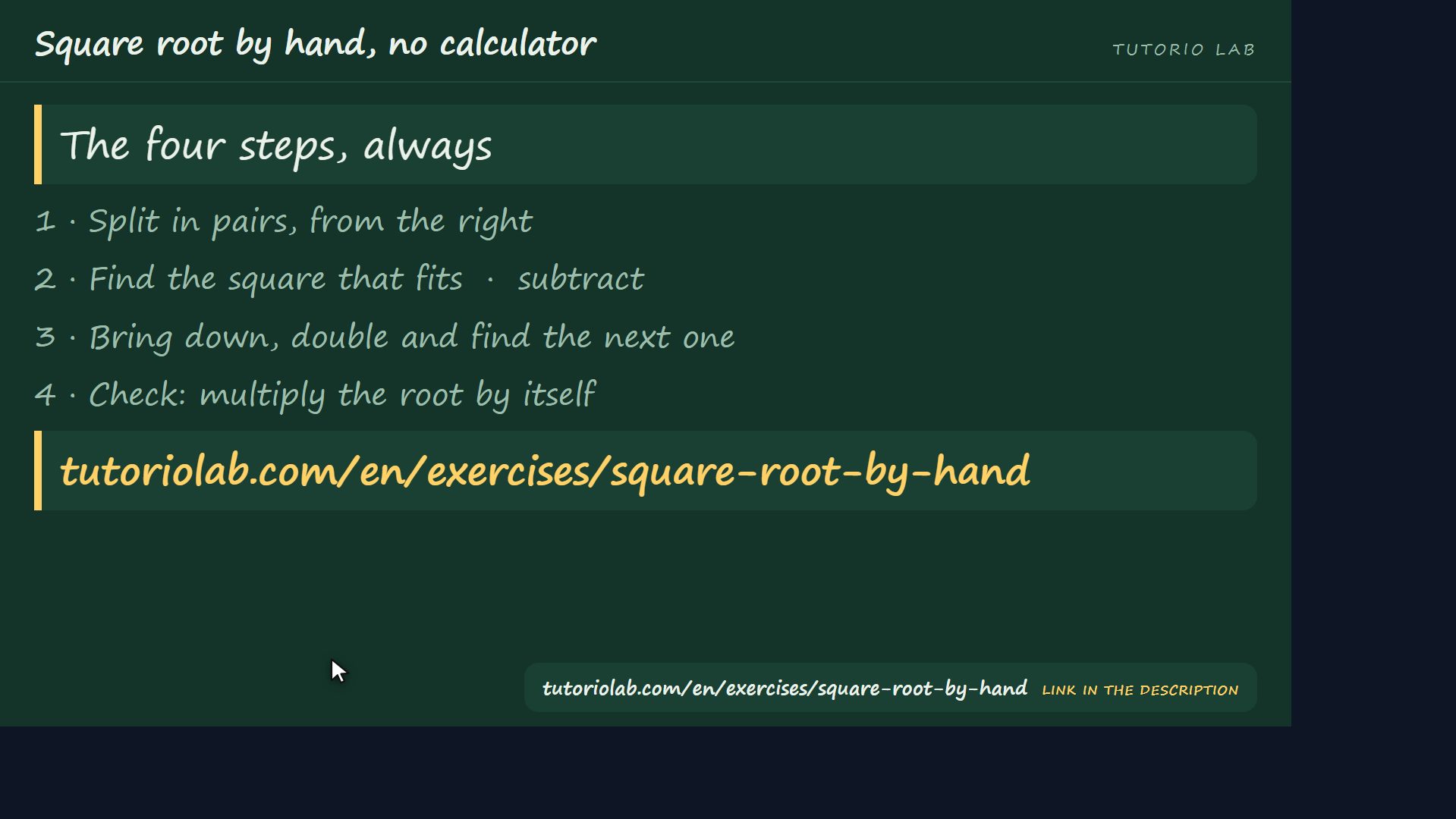
Let us go over the four steps, which are always the same, with whatever number. One: split the number into groups of two digits, from the right, and the one on the left can be left with a single one. Two: the first digit of the root is the biggest number whose square fits in the first group, and you subtract. Three: you bring down the next group, you double the root you have so far, and you look for the digit that fits. And four: always check by multiplying the root by itself. Practise it at tutoriolab.com, slash e n, slash exercises, slash square root by hand.
If this helped, subscribe.

Common questions
How do you work out a square root by hand?
Split the number into pairs of digits from the right, find the biggest number whose square fits in the first group and subtract, bring down the next group, double the root so far and find the digit d such that that number times d fits in the remainder. Repeat until the groups run out, and check by multiplying the root by itself.
Why are the digits split in pairs and from the right?
Because each pair of digits gives exactly one digit of the root, so the number of groups tells you how many digits the answer has. From the right, because that is where the units are; splitting from the left would break the pairing and the group on the left is allowed to keep a single digit.
What do you do when the square root is not exact?
Nothing goes wrong: the final remainder is simply not zero, and what you have found is the whole part. √150 = 12 with 6 left over, because 12² = 144 and 150 − 144 = 6. For almost everything you need, the whole part is enough.
How do I know between which two integers a root lies, without calculating?
With the squares from 1 to 10 in your head. For √60: 7² = 49 falls short and 8² = 64 overshoots, so it is between 7 and 8. It takes seconds and it stops you accepting an absurd result.
If several numbers fit, which one is the whole part?
The BIGGEST one that fits, not just any one that fits. For √150, 11² = 121 fits, but so does 12² = 144 and 12 is bigger; 13² = 169 overshoots. So the whole part is 12. That nuance is where most people lose the mark.
Are there exercises to practise?
Yes, and they are free: tutoriolab.com/en/exercises/square-root-by-hand. You get new numbers every time — exact roots, the whole part and which two integers it sits between — and when you get one wrong it tells you which mistake you made.