How to build an amortization table
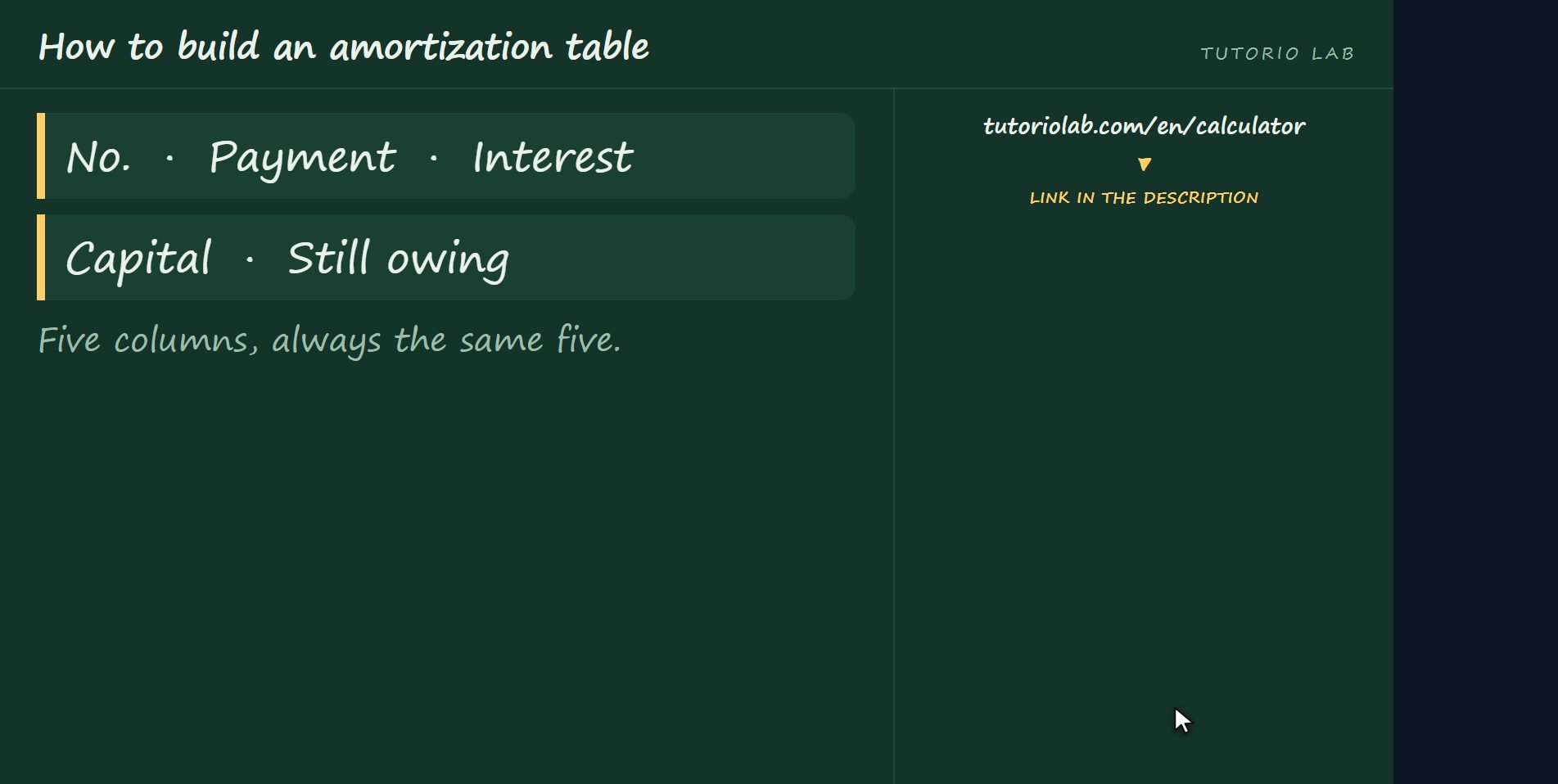
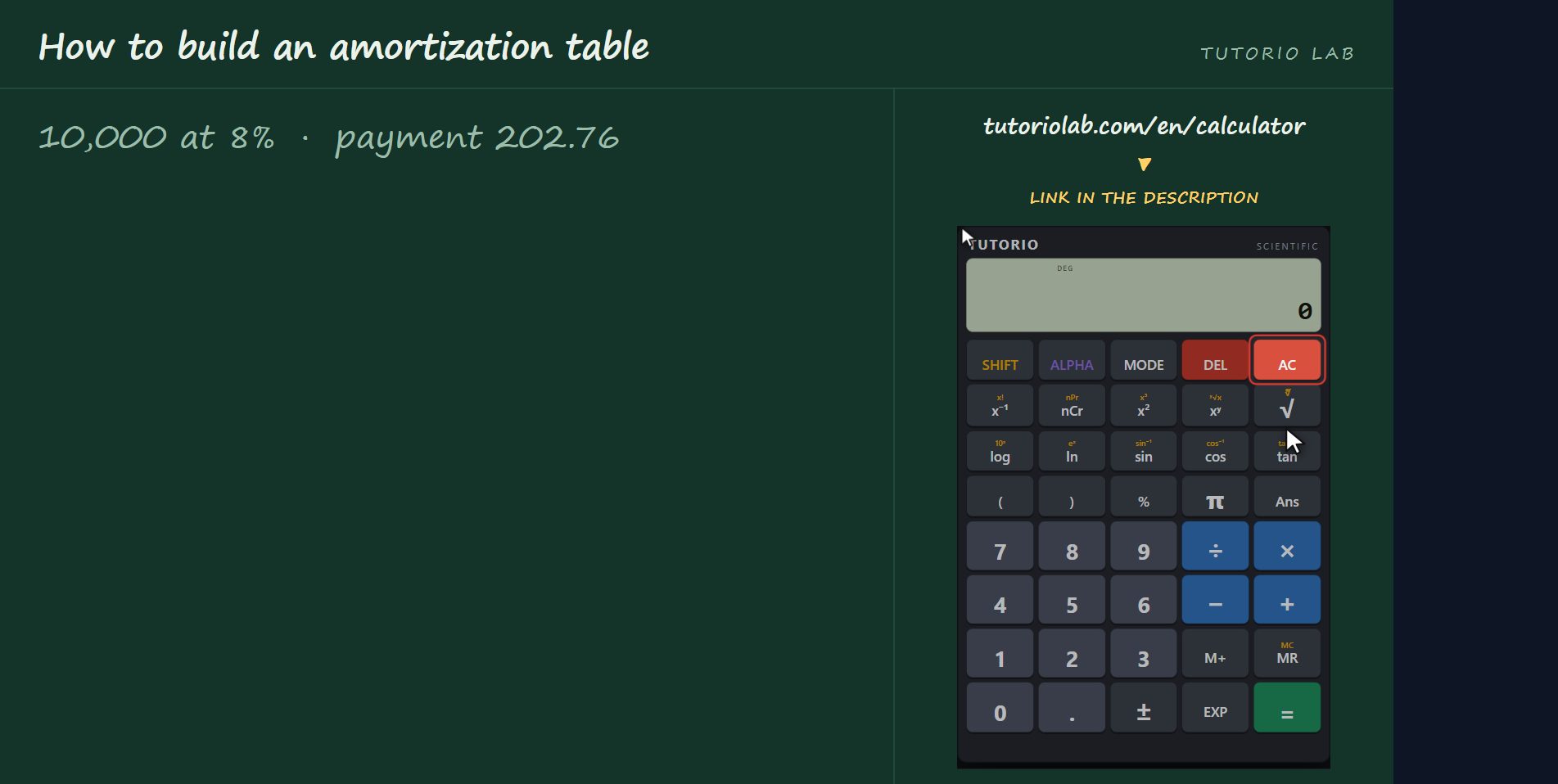
An amortization table has one row per payment and five columns: no., payment, interest, capital and balance. Each month’s interest is worked out on the balance still owing, not on what you borrowed. With 10,000 at 8% over 5 years and a payment of 202.76: in month one, 66.67 is interest and 136.09 clears the debt, leaving 9,863.91. To pay it off today you pay the balance on that row, not the payment times the months left.
You have got a loan, you pay the same amount every month, and you do not really know how much you owe right now. That is what an amortization table tells you. In three minutes I will show you how to build it row by row, and how to use it for the two questions that matter: what do I owe today, and what do I save if I pay early.
What it is and what it is for
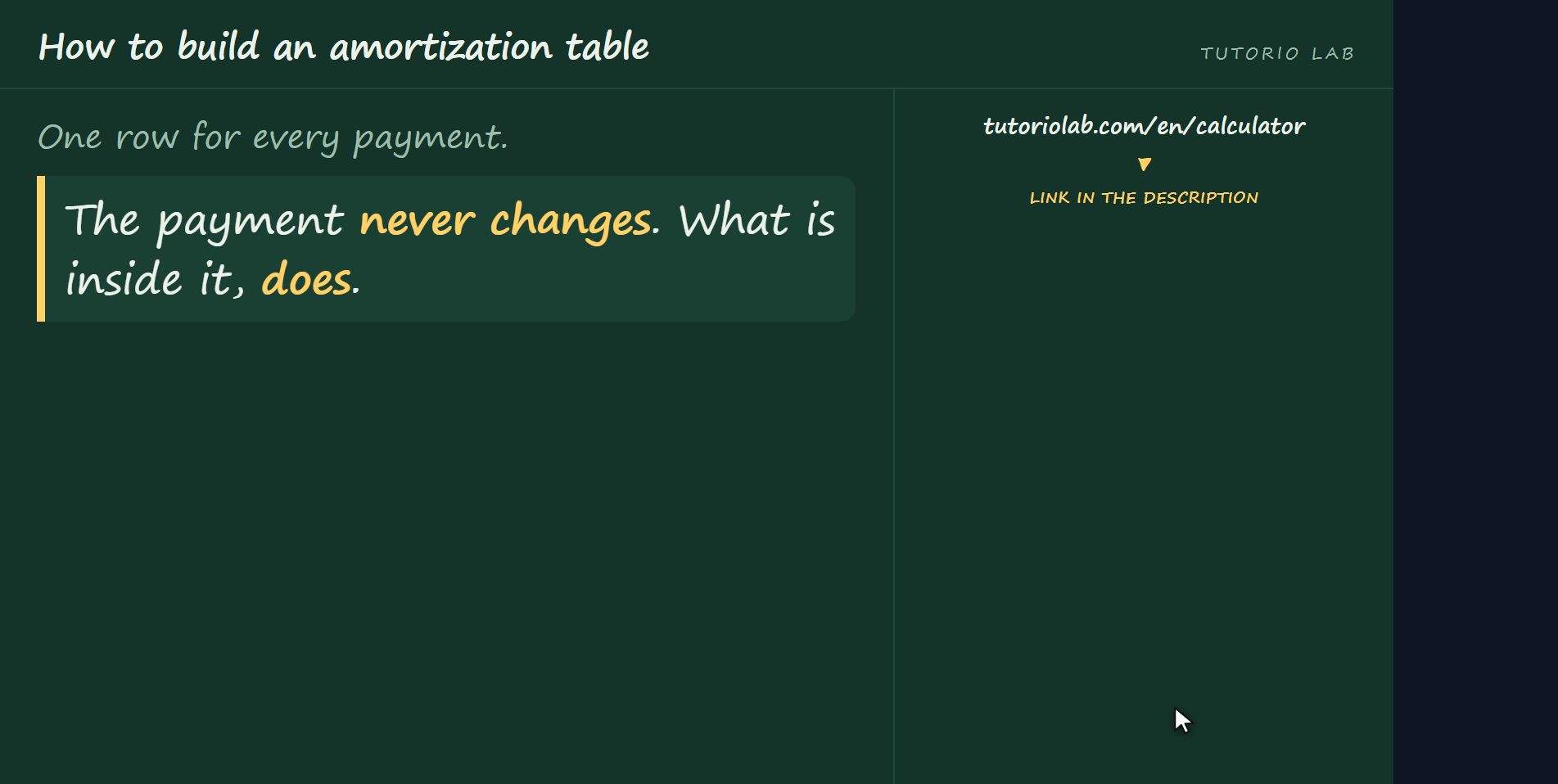
An amortization table is one row for every payment, and it shows something the payment on its own hides: the payment never changes, but what is inside it does. At the start nearly everything you pay is interest; at the end, nearly all of it clears the debt. And in between, what you really owe is not what you think.
The five columns
The table has five columns and always the same five. The payment number. The payment, which is fixed. How much of that payment goes to interest. How much clears the debt. And how much is still owing afterwards. Nothing else.
The month’s interest
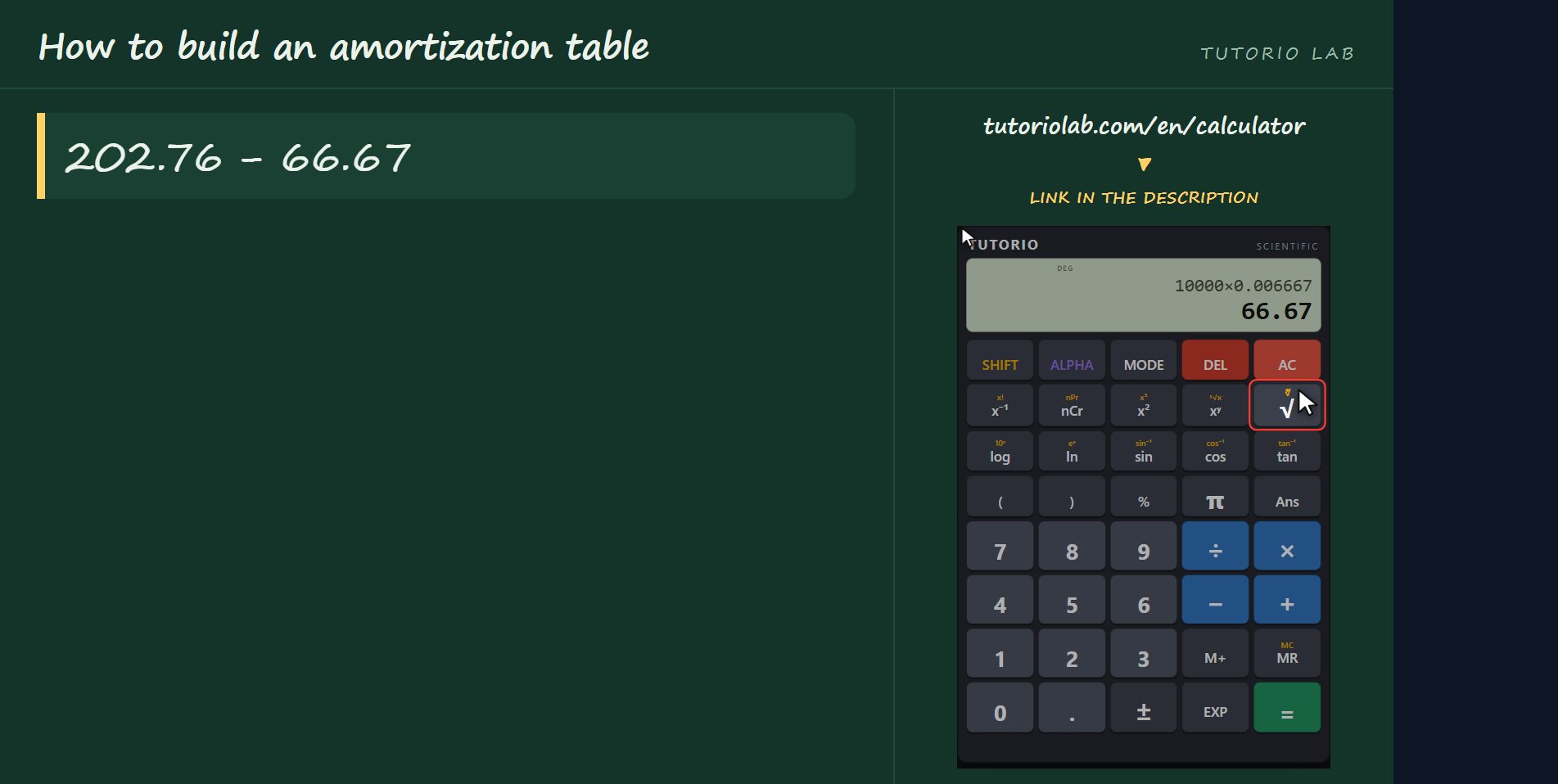
Let us use the example from the last video: ten thousand, at eight per cent a year, over five years, with a payment of two hundred and two seventy-six. The first month’s interest is worked out on what you owe, which is the ten thousand, with one month’s interest: eight divided by twelve, zero point sixty-six per cent. Ten thousand multiplied by zero point zero zero sixty-six: sixty-six sixty-seven.
What clears the debt
And now the most important subtraction in the whole table. Out of the payment of two hundred and two seventy-six, sixty-six sixty-seven is interest. What is left over, a hundred and thirty-six oh nine, is the only part that clears the debt. So after paying you no longer owe ten thousand: you owe nine thousand eight hundred and sixty-three ninety-one.
The second row
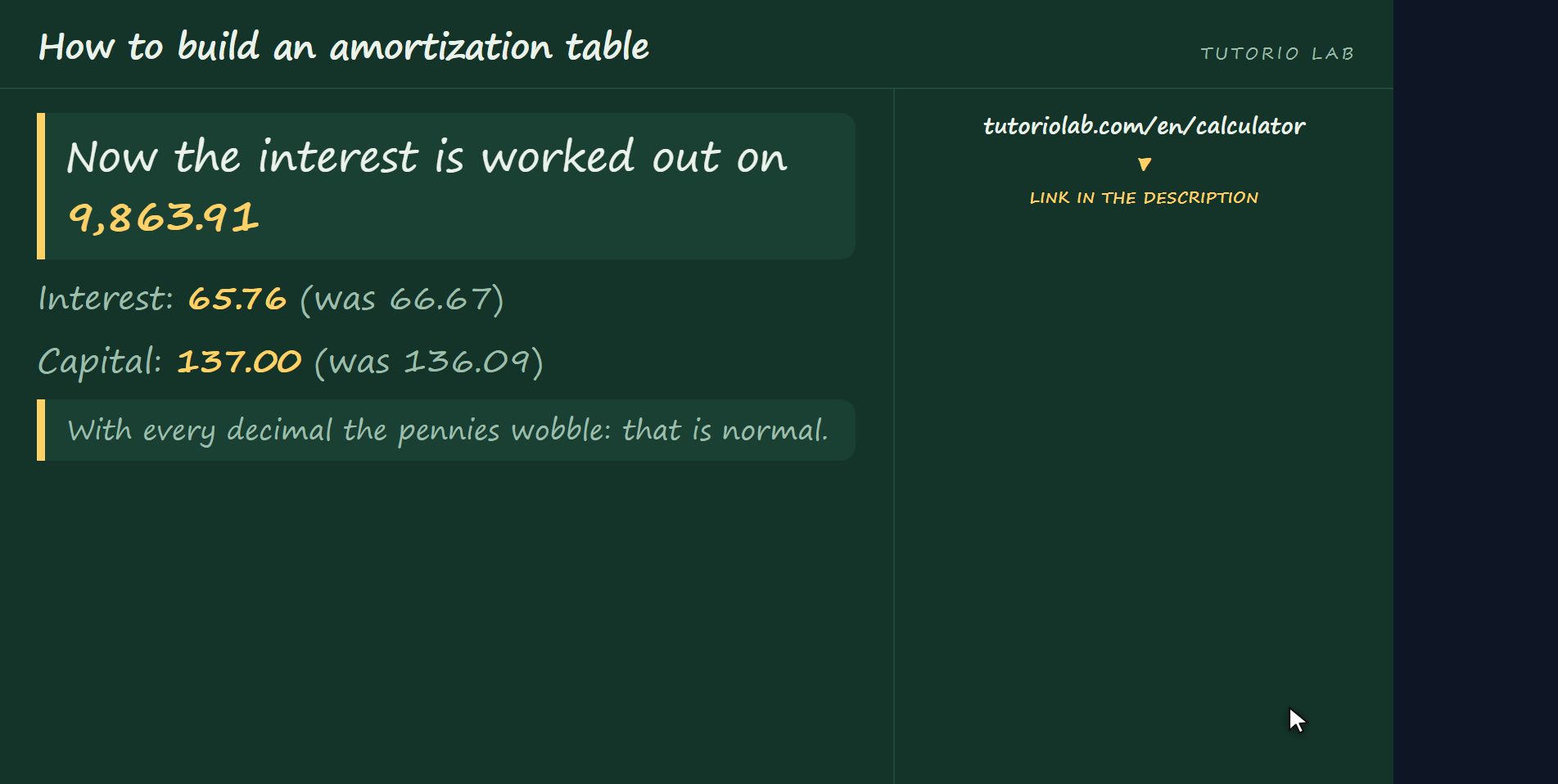
The second row is done exactly the same, but with the new debt. The interest is no longer worked out on ten thousand, but on nine thousand eight hundred and sixty-three. And because the debt is smaller, the interest falls: sixty-five seventy-six instead of sixty-six sixty-seven. And because the payment is still the same, the part that clears the debt goes up: a hundred and thirty-seven. By the way: if you do it with every decimal instead of rounding to pennies, the odd penny will wobble. That is normal, and it is why banks publish the whole table.
Why the split changes
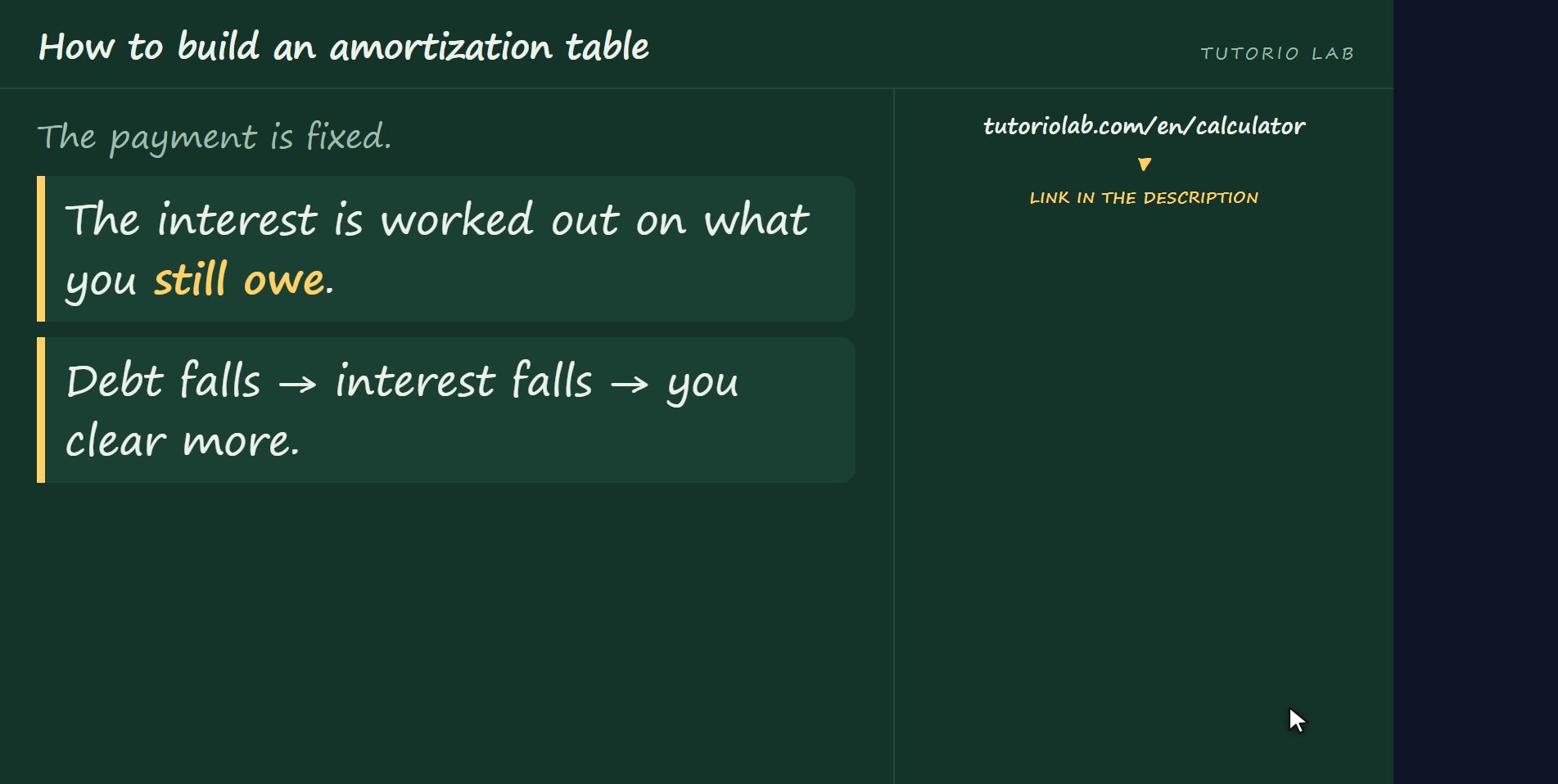
That is the entire mechanism, and there is nothing more to it. The payment is fixed, the interest is worked out on what you still owe, and what is left over clears the debt. Since the debt falls every month, the interest falls every month, and the part that clears it grows every month. That is why the table starts as nearly all interest and ends as nearly all capital.
What you owe today
And this answers the thing people ask most: if I want to pay the loan off today, how much do I pay? It is not the payment times the ones left, because that includes interest you have not run up yet. It is the still-owing column, on the row for the month you are in. That number, and no other.
If you pay early
And the other question: what happens if I pay extra. That money goes entirely to clearing the debt, without passing through interest. And since every month after it works out its interest on a smaller debt, you save interest on all of them. That is why paying early saves a lot and paying late saves almost nothing: it is not the payment that matters, it is how many months are still ahead of it.
The website does it
Nobody is going to do sixty rows by hand, so we will do them for you. At tutoriolab.com, slash e-n, slash loan calculator, you put in the amount, the rate and the term, and out comes the whole table: month by month, how much goes to interest, how much clears the debt and how much is left. It is free, no sign-up, and it downloads as a PDF.
Take away the one rule that explains all of it: each month’s interest is worked out on what you still owe. From there comes why it is nearly all interest at the start, and why paying early saves so much. The links are in the description. If this helped, do subscribe.
Common questions
How much do I owe if I want to pay the loan off today?
The balance on the row for the month you are in. It is not the payment times the payments left: that would include interest you have not run up yet.
Why does so little of the first payment clear the debt?
Because the interest is worked out on what you still owe, and at the start you owe nearly all of it. On 10,000 at 8%, month one is 66.67 of interest and only 136.09 of capital.
My pennies do not match the bank’s table exactly.
That is normal. Rounding each row to pennies is not the same as carrying every decimal through. The odd penny wobbles; the totals stay the same.
Is it worth paying extra?
Yes, and the earlier the better. An extra payment goes entirely to clearing the debt and saves you interest on every month that follows. The same payment in the last year barely changes anything.
Is there a calculator that builds the table?
Yes, and it is free: tutoriolab.com/en/loan-calculator. It gives you the whole table month by month with interest, capital and balance, and downloads as a PDF.