
Solving for x, step by step
Solving for x has three steps, always the same. First remove what is adding or subtracting, crossing it to the other side with the sign changed; then remove what is multiplying or dividing, doing the opposite; and finally check by putting your answer into the original equation. With 3x + 5 = 20: the +5 crosses over subtracting (3x = 15) and the 3 crosses over dividing (x = 5). When the x is on both sides, take all the x to the side with more of them and all the numbers to the other (5x − 3 = 2x + 9 → 3x = 12 → x = 4). With a bracket, the number outside multiplies EVERYTHING inside: 2(x + 4) = 2x + 8. With a fraction, nothing changes: the divider crosses over multiplying. And in word problems you write the equation yourself: three times a number minus 7 gives 20 → 3x − 7 = 20 → x = 9.
Solving for x, step by step and skipping nothing.
What it is and what isolating means
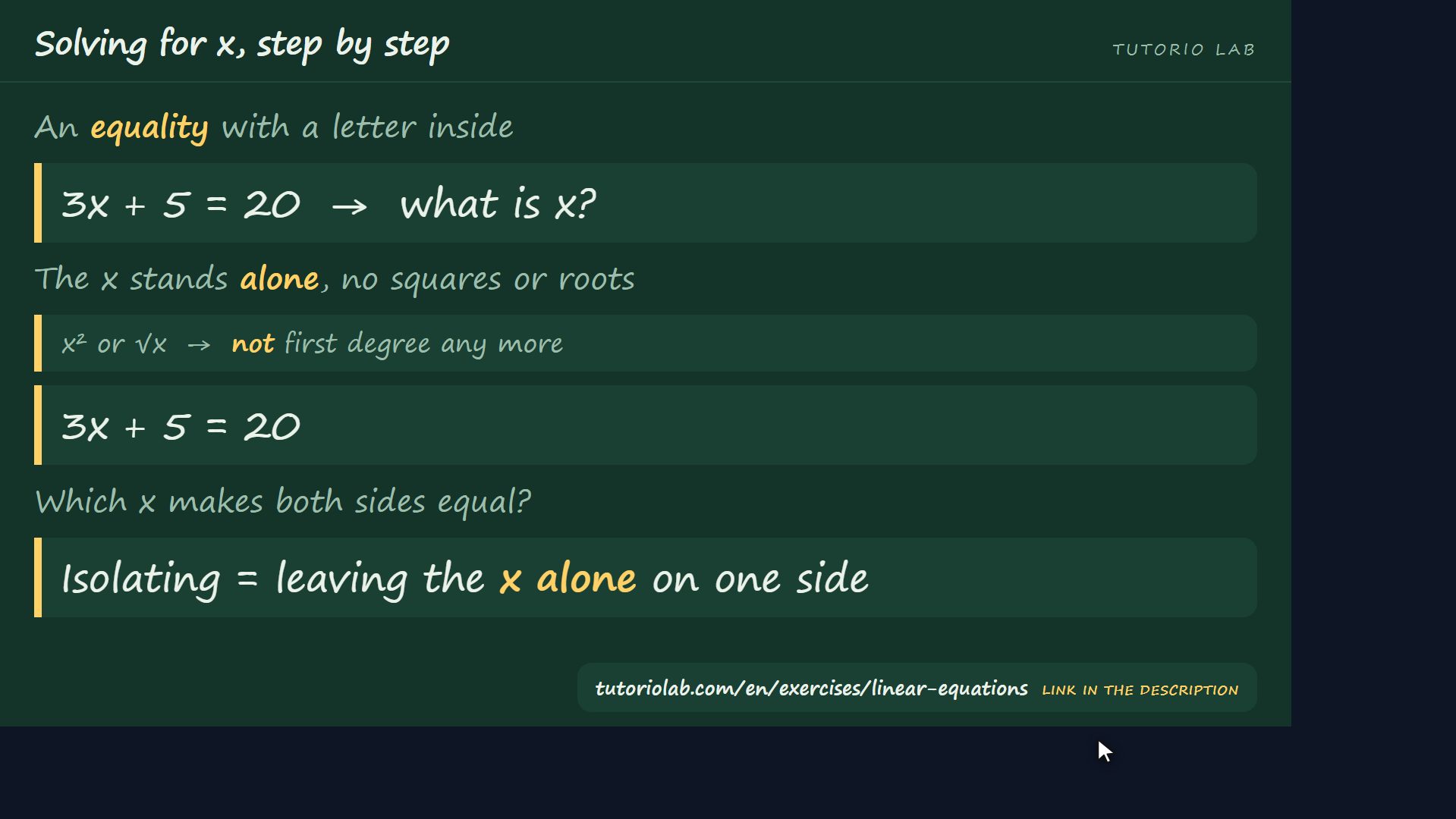
Let us start with the very basics, because I do not want to assume anything. A first degree equation is an equality with a letter in it, usually the x, and that letter stands alone: it is not squared, not inside a root, nor anything like that. Just x. For example: three x plus five equals twenty. And solving it means working out what number the x is so that the equality is true. That job is called isolating: leaving the x alone on one side of the equals sign, with nothing attached to it.
The balance idea
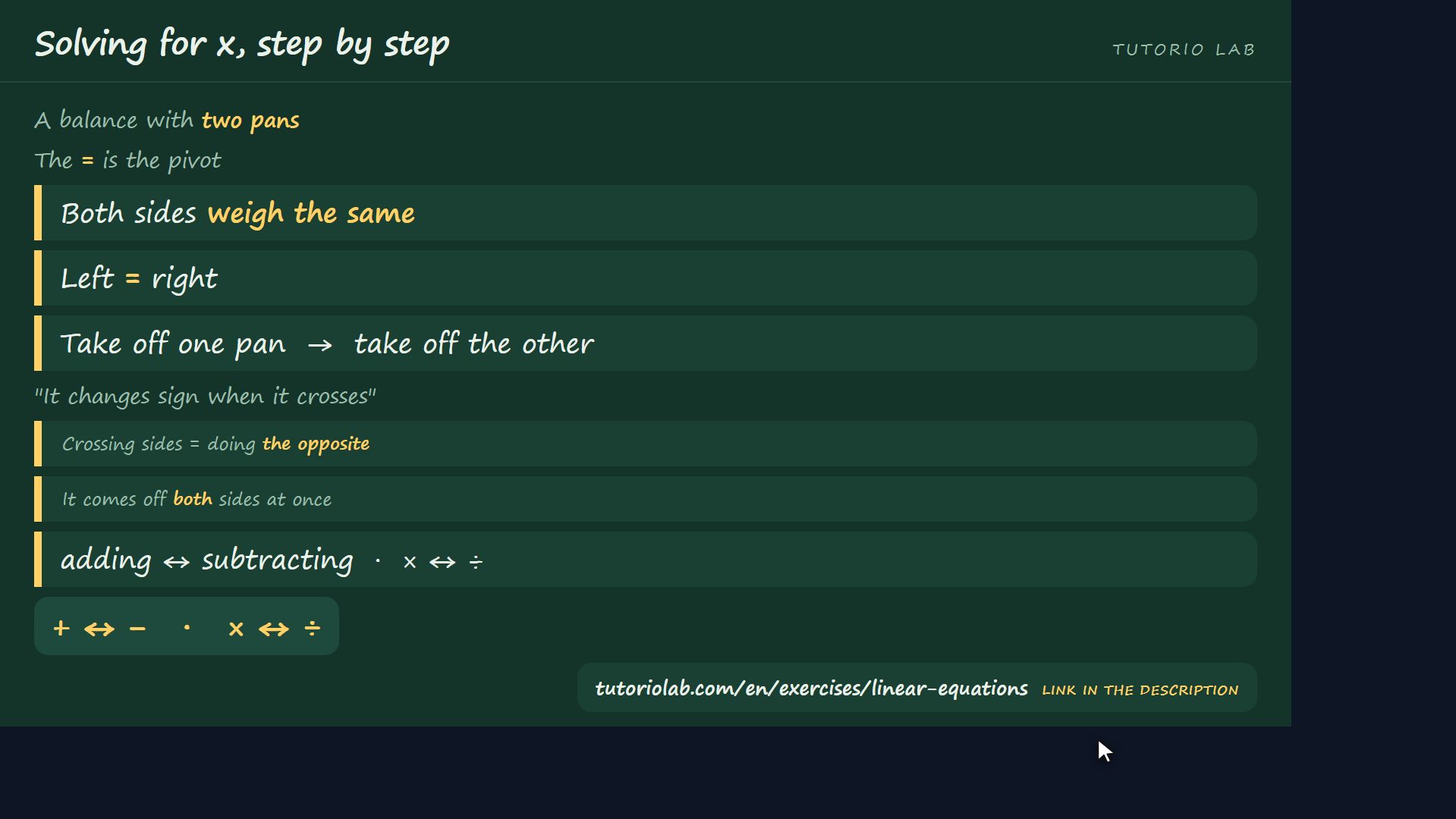
Before touching numbers I want you to understand the idea, because if you understand it you will not have to memorise any rule. Picture an old-fashioned balance, with two pans. The equals sign is the pivot: what is on the left weighs exactly the same as what is on the right. And here is the whole secret: if you take something off one pan, you have to take the same off the other, or the balance tips. That is what that phrase you have heard a thousand times means, the one about a number changing sign when it crosses to the other side. It is not magic and it is not a trick: it is that you are taking it off both sides at once. That is why what is adding crosses over subtracting, what is subtracting crosses over adding, what multiplies crosses over dividing, and what divides crosses over multiplying. Always the opposite.
Removing what adds
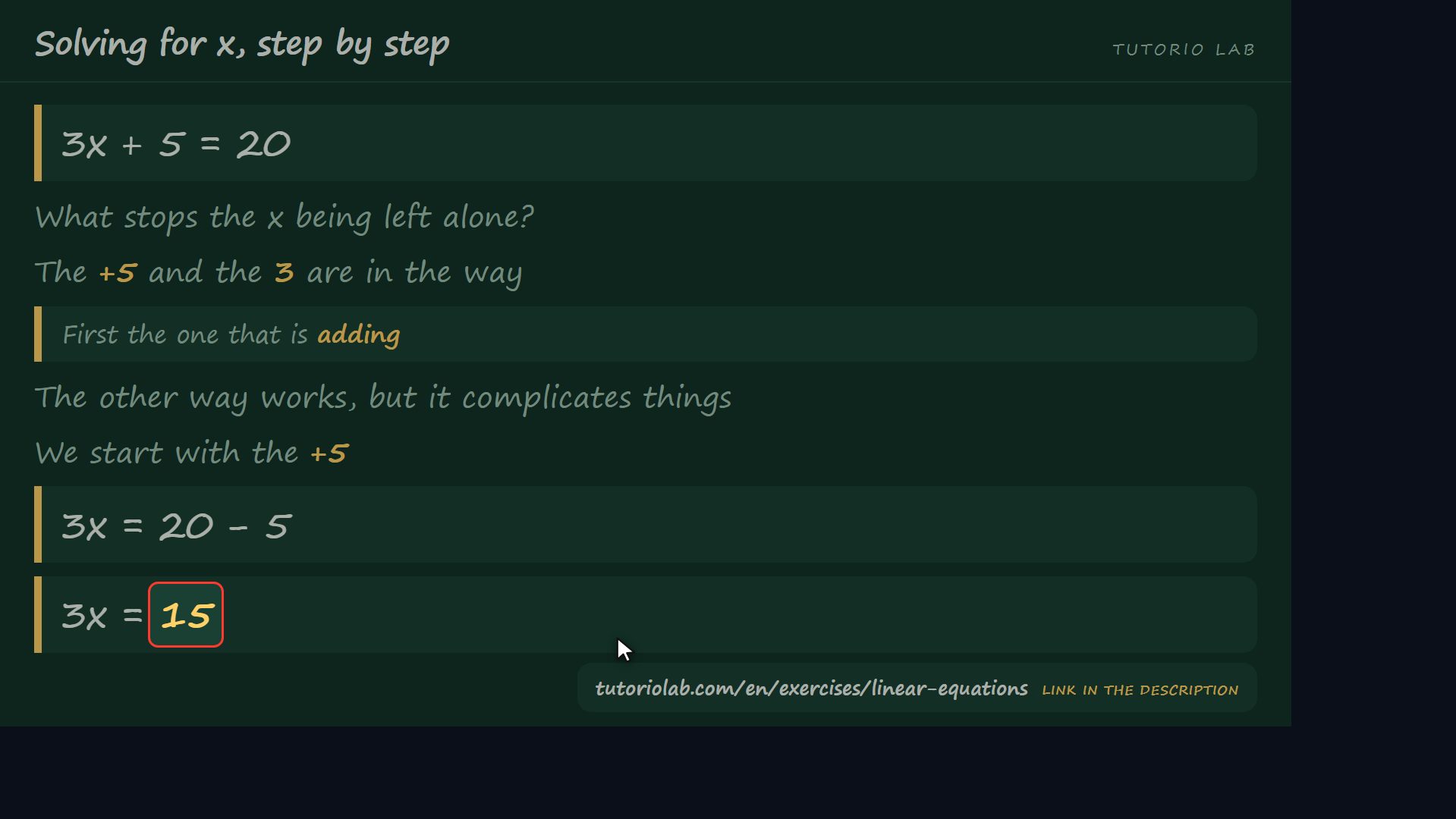
Let us do our example: three x plus five equals twenty. What is stopping the x from being left alone? Two things: the plus five, which is adding, and the three, which is multiplying the x. And the order matters, so write it down: first you remove what adds or subtracts, and afterwards what multiplies or divides. The other way round also works, but it makes the arithmetic harder. We start with the five. It is adding on the left-hand side, so to remove it we do the opposite: it crosses to the other side subtracting. We are left with three x equals twenty minus five. And twenty minus five is fifteen. Three x equals fifteen.
Removing what multiplies
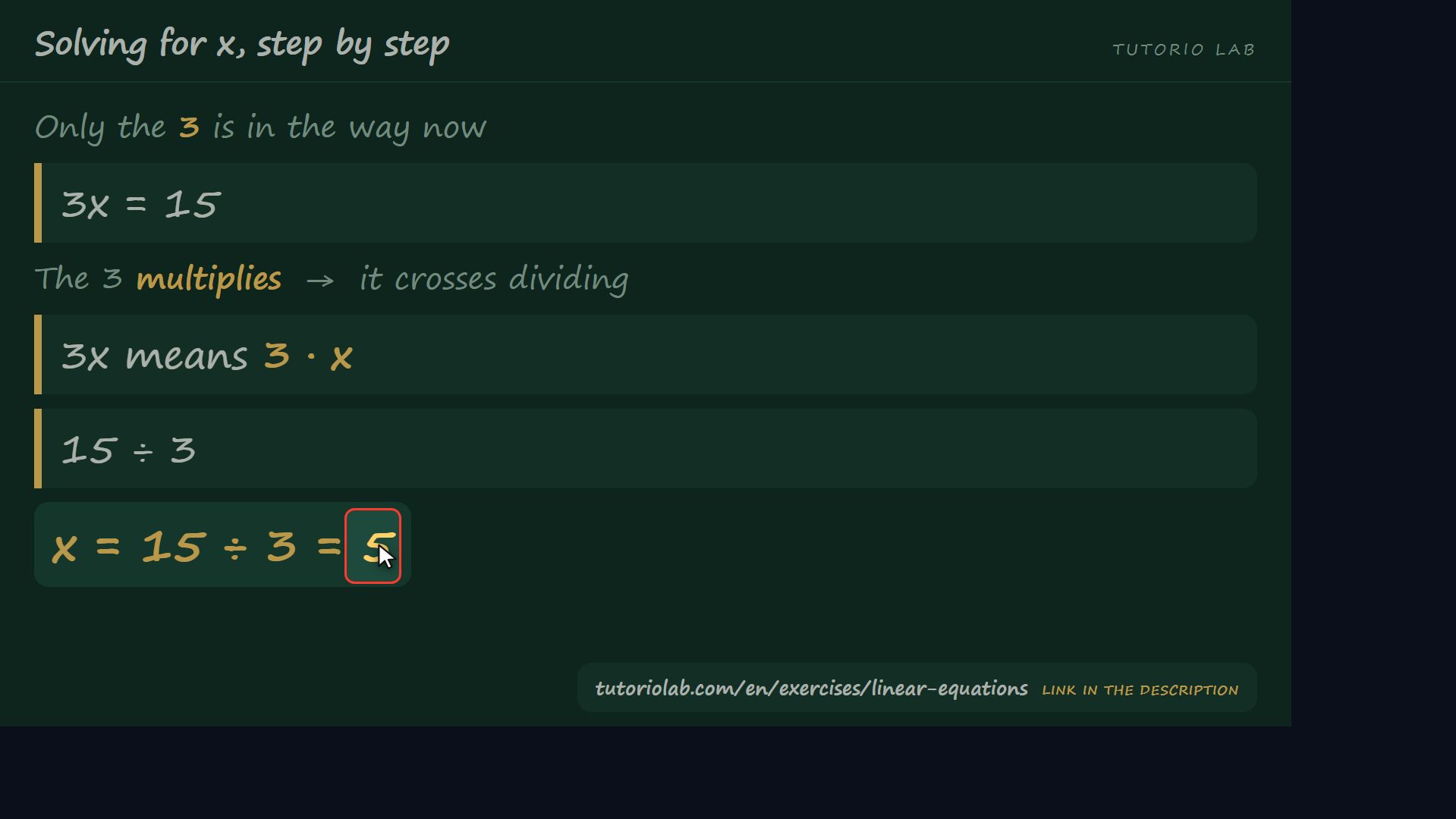
Now only the three is in the way. And look at what that three is doing: it is multiplying the x, because three x means three times x. So to remove it, we do the opposite of multiplying, which is dividing. The three crosses to the other side dividing. x equals fifteen divided by three. And fifteen over three is five. There it is: x is worth five. We have left it alone, which was all there was to do.
Check it yourself
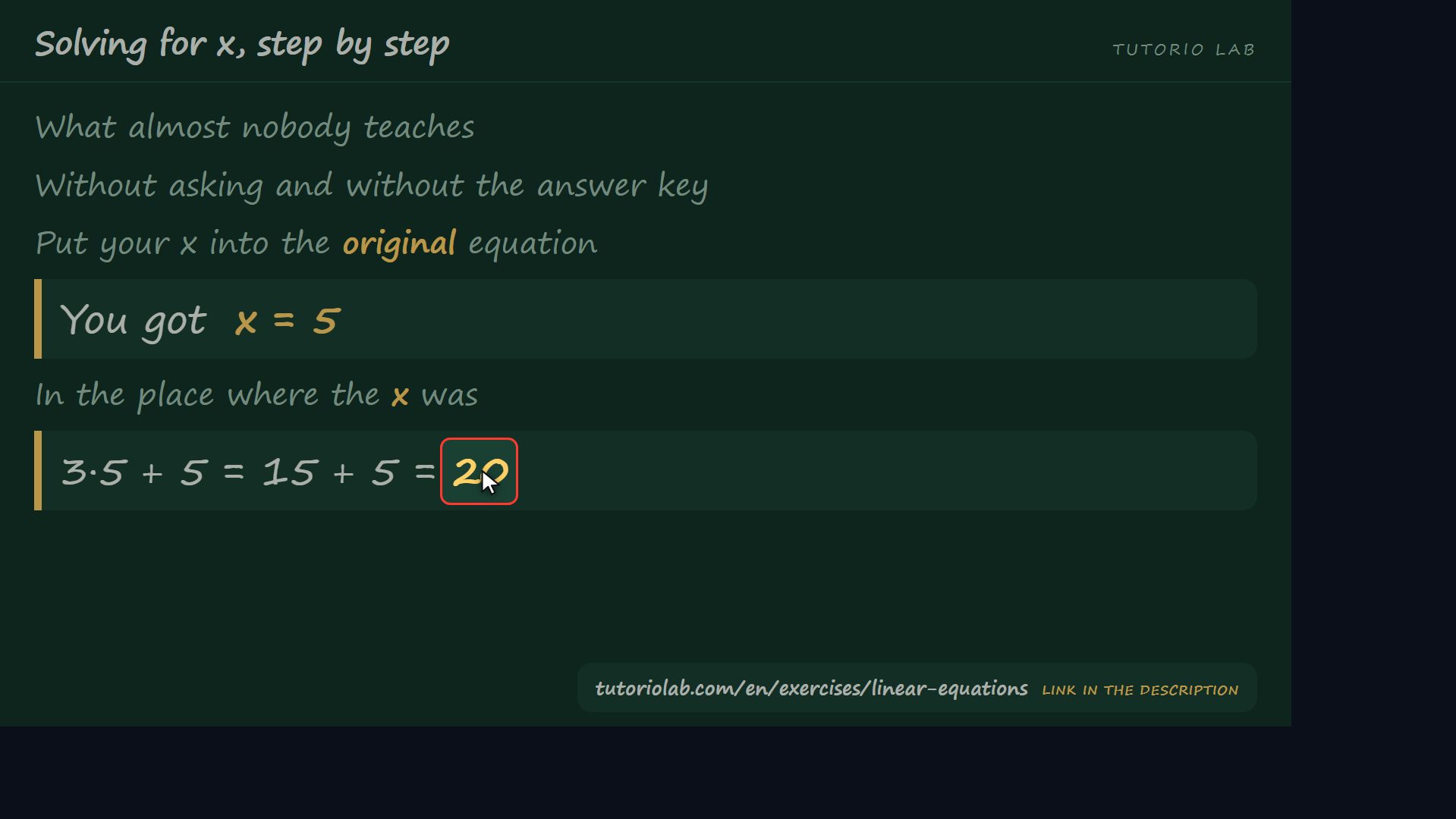
And now I am going to show you something almost nobody explains and that is worth it in every exam of your life: how to know on your own whether you have done it right, without asking anybody and without looking at any answer. You take the number you got and you put it into the original equation, in the place where the x was. If the equality holds, it is correct. Here we go: three times five, plus five. Three times five is fifteen, plus five is twenty. And the equation said it had to give twenty. It matches. If it had given you any other number, right there you would know you had gone wrong, and you would know it before handing anything in.
Exercise 1, step by step
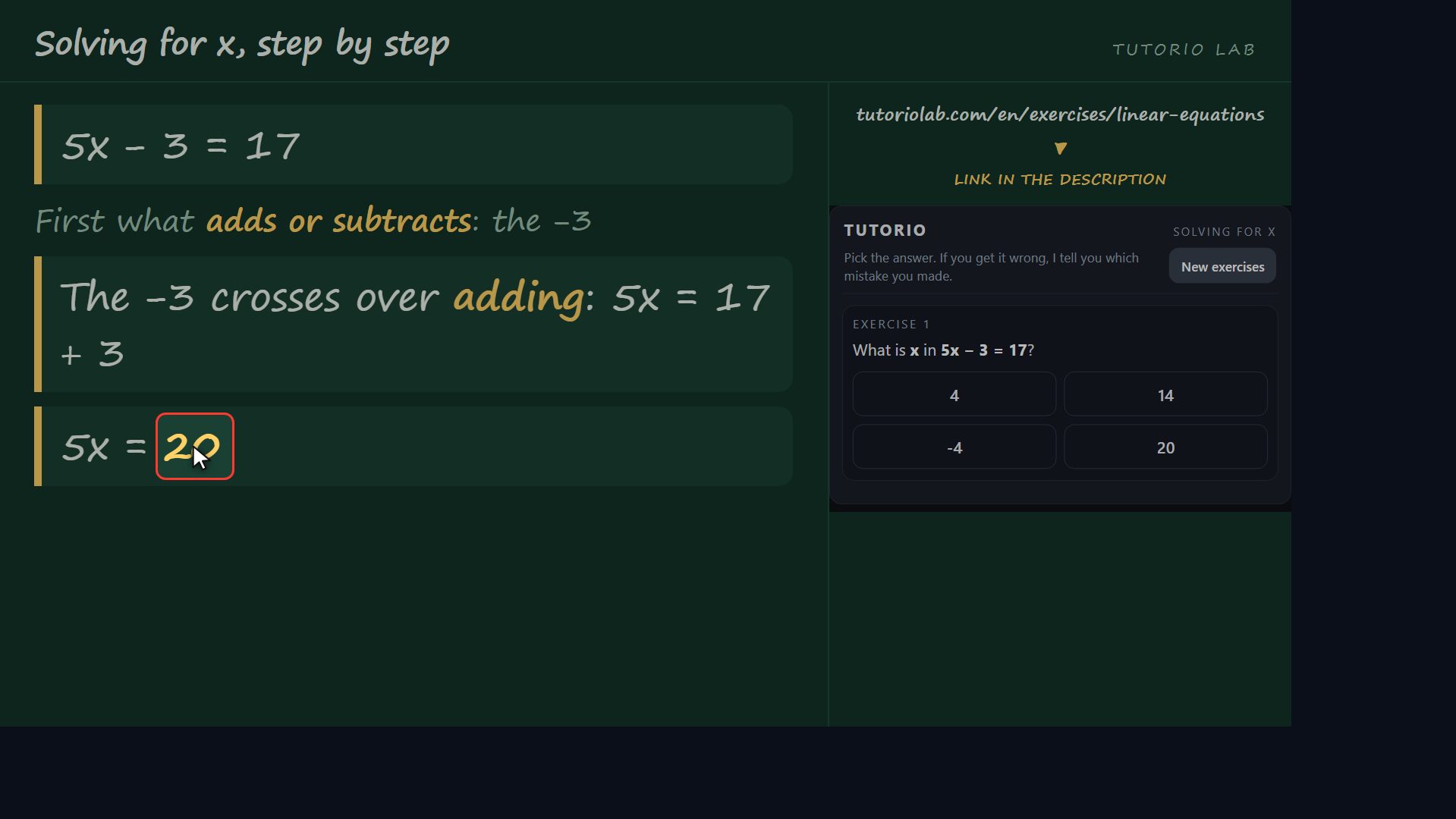
Let us do the first exercise, and we will solve it together on the board before touching anything. Five x minus three equals seventeen. First, what adds or subtracts: here we have a minus three. It is subtracting, so it crosses to the other side adding. Five x equals seventeen plus three, which is twenty. Now what multiplies: the five. It crosses over dividing. x equals twenty over five, which is four. And look carefully at one of the options, the twenty, because it is the best placed trap: the twenty is a number that really does appear in the working, but it is what five x is worth, not what the x is worth. The last step was missing. I mark the four.
Practise for free
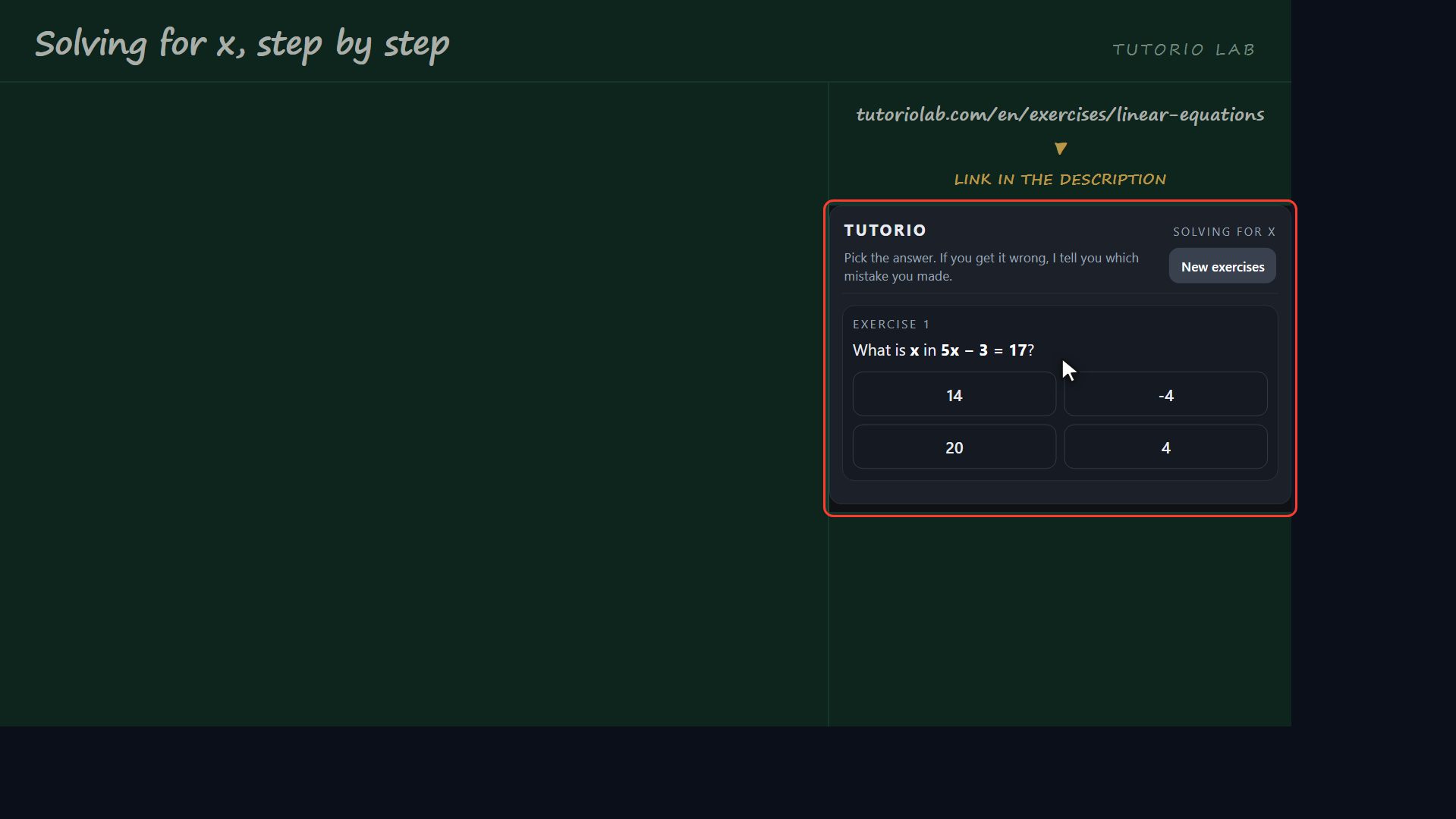
And I want you to take a good look at this on your right here, because it is ours and it is free. It is an exercise page: tutoriolab.com, slash e n, slash exercises, slash linear equations. Every time you go in you get different equations, so you can practise as many times as you like without repeating. And what really matters: when you get one wrong it does not just throw an incorrect at you and leave you where you were. It tells you what mistake you made, by name, and it shows you the worked calculation.
x on both sides
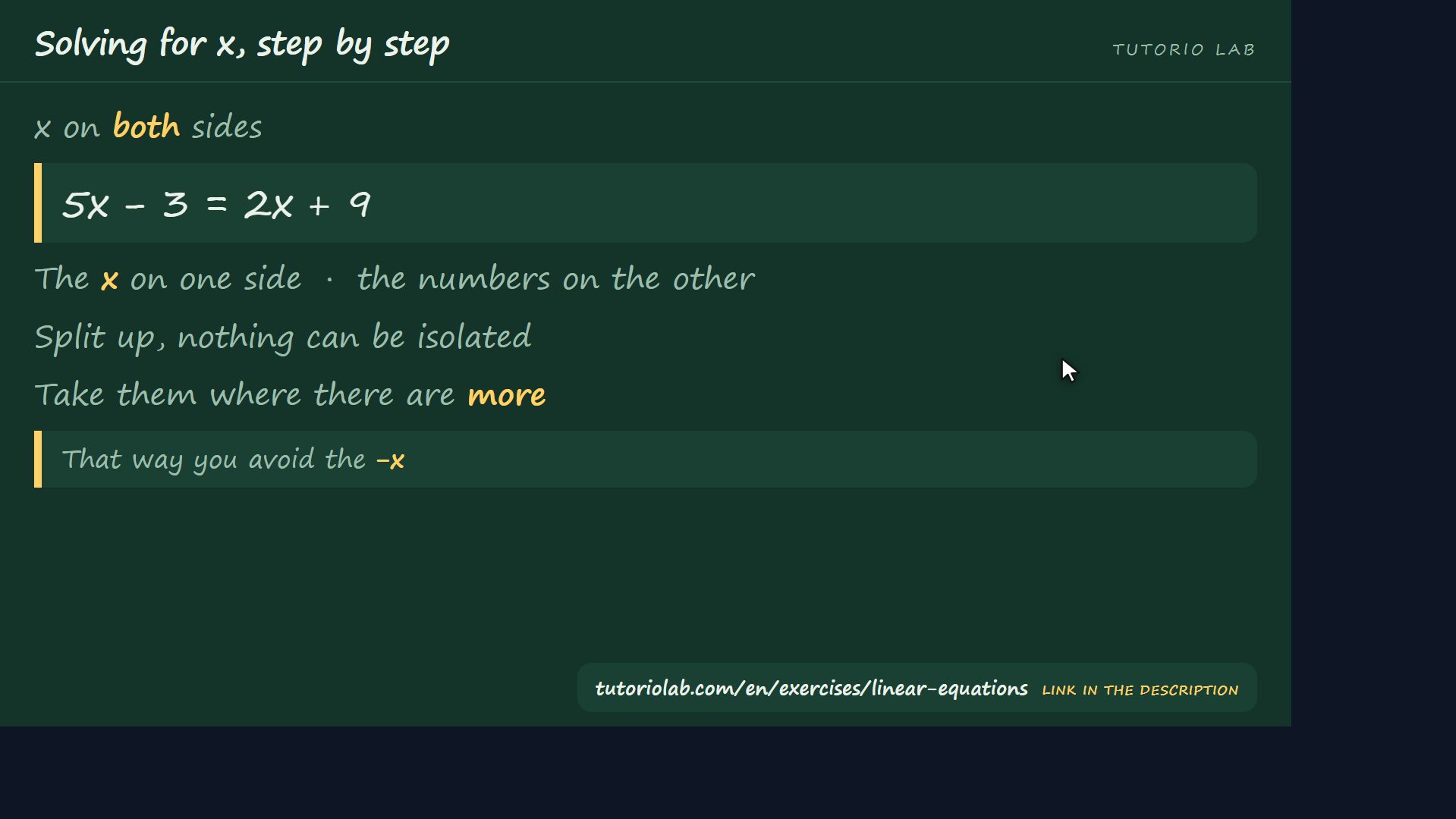
Now the first case that sticks: what happens when the x appears on both sides of the equals sign. For example: five x minus three, equals two x plus nine. Here there are x on the left and x on the right, and you cannot isolate anything while they are split up. The rule is short and there is no mystery to it: all the x on one side, and all the loose numbers on the other. Which side do you take the x to? It does not matter, but I recommend taking them where there are more, so you do not end up with a negative number in front.
Group and solve
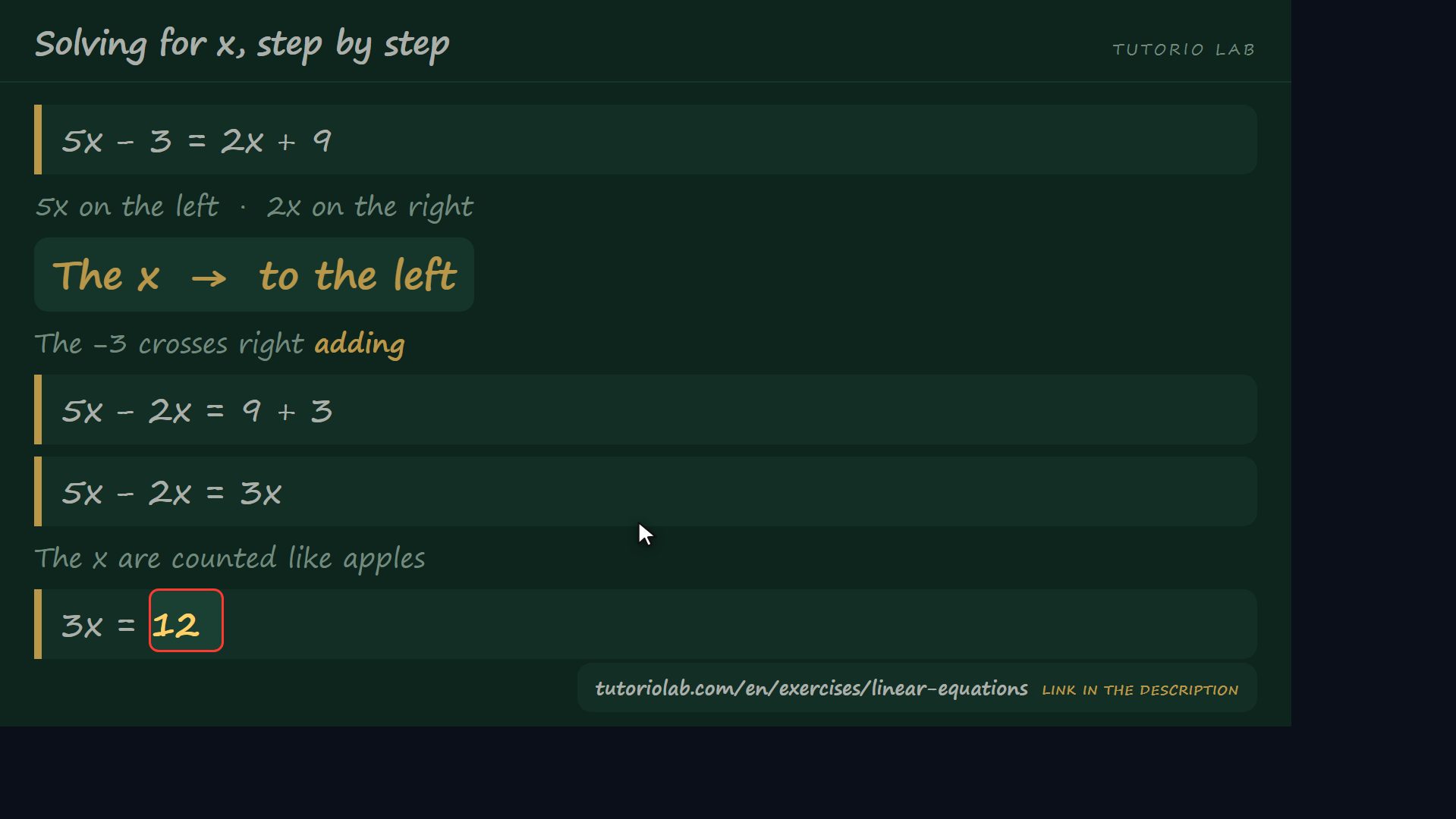
Let us do it. We have five x on the left and two x on the right, so we take the x to the left, which is where there are more. The two x is adding on the right, so it crosses to the left subtracting. And the minus three is subtracting on the left, so it crosses to the right adding. We are left with: five x minus two x, equals nine plus three. Now we group each side. Five x minus two x is three x, just as five apples minus two apples is three apples. And nine plus three is twelve. Three x equals twelve. And that is one of the earlier ones: the three crosses over dividing, and x is worth four.
With a bracket
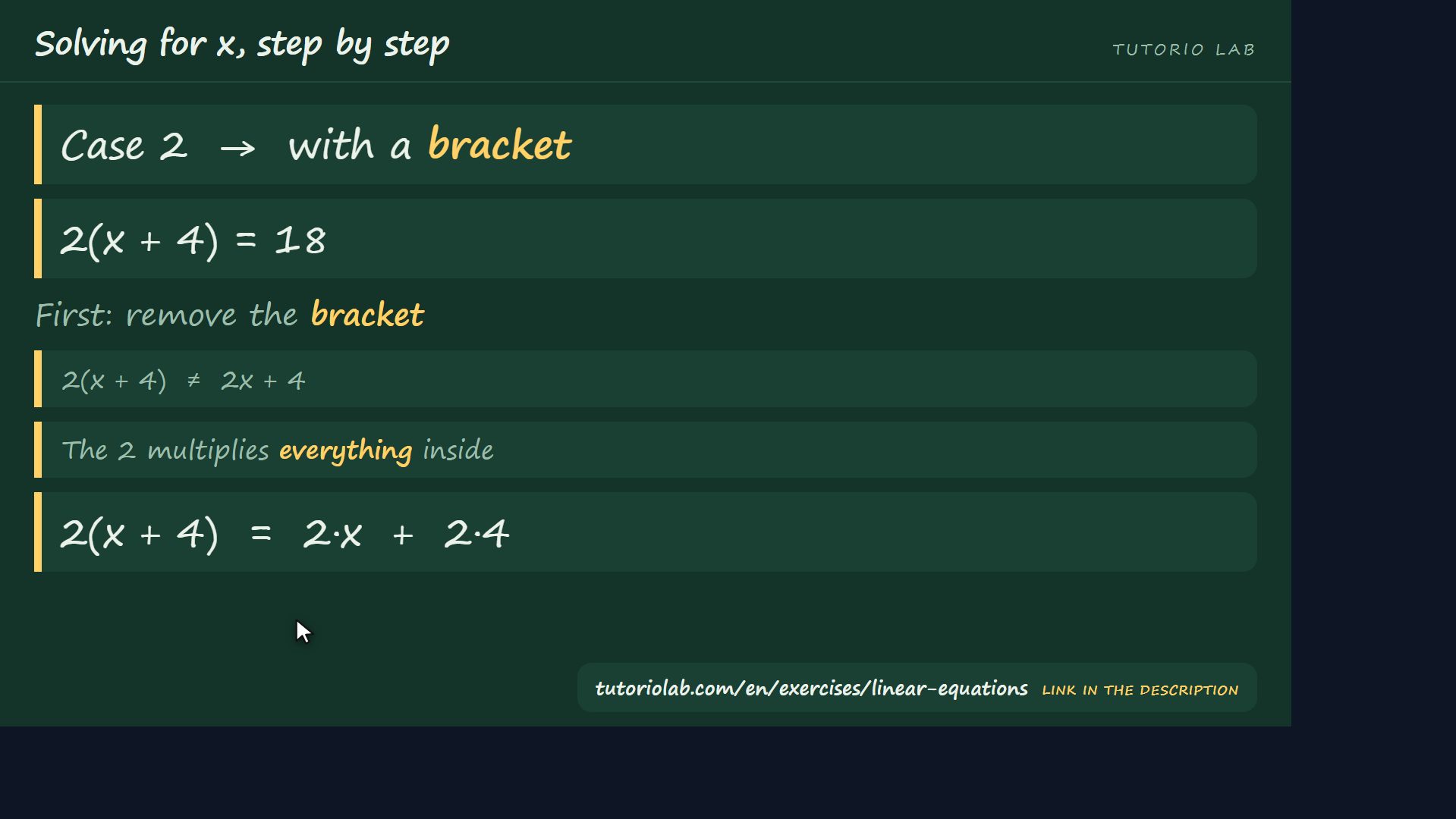
Second case that gets searched for a lot: when there is a bracket. For example, two times, open bracket, x plus four, close bracket, equals eighteen. The first thing is to remove that bracket, and here is the most common mistake in this whole section: that two outside multiplies EVERYTHING inside, not just the first piece. That is called the distributive property, which sounds awful and means exactly that: it gets shared out among all of them.
Share out and solve
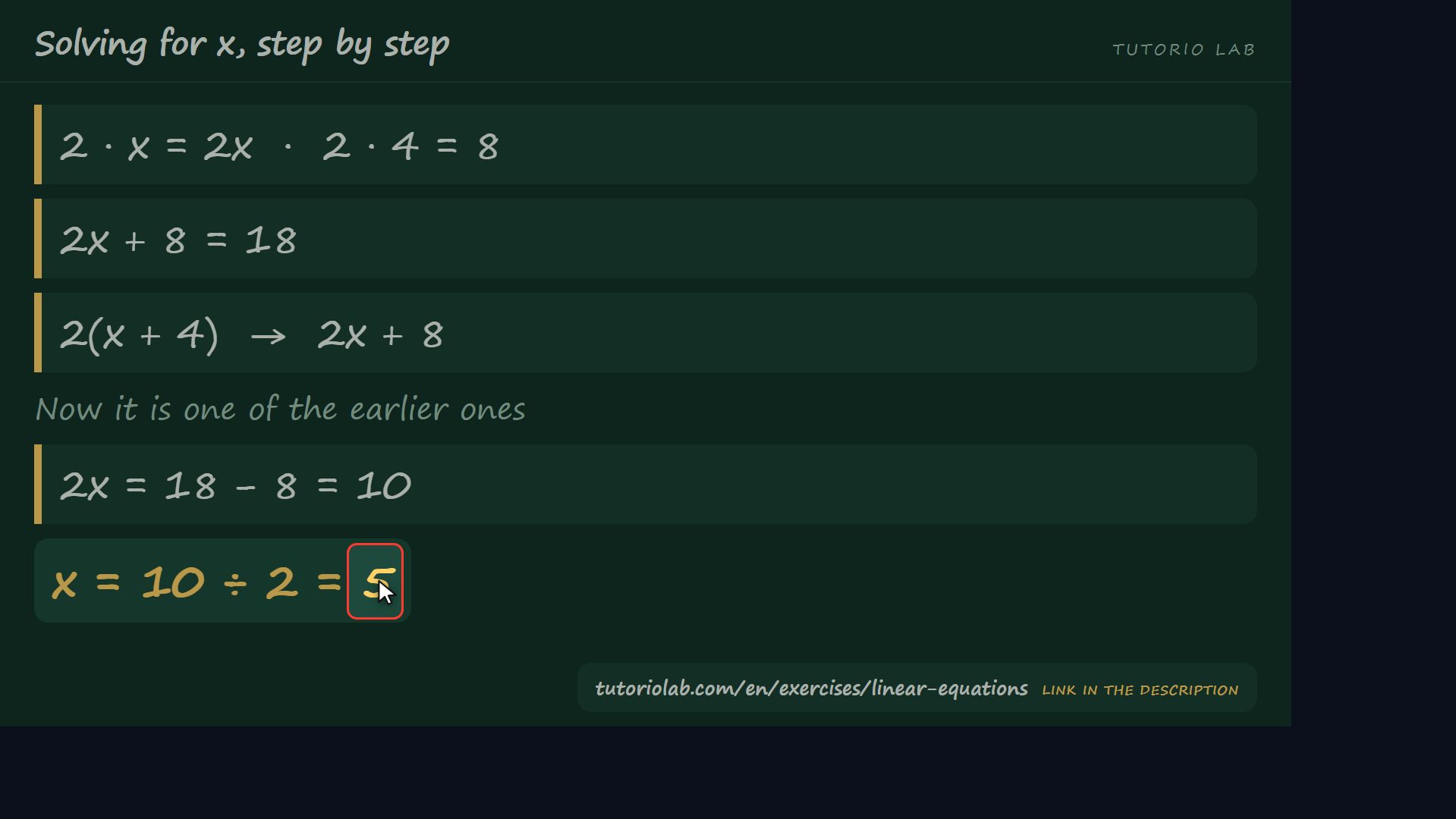
Let us share it out. Two times x is two x. And two times four is eight. So the bracket becomes two x plus eight, and the equation is left as: two x plus eight equals eighteen. And from here it is one of the normal ones, of the kind we did at the start. The eight is adding, so it crosses over subtracting: two x equals eighteen minus eight, which is ten. And the two is multiplying, so it crosses over dividing: x equals ten over two, five.
With a fraction
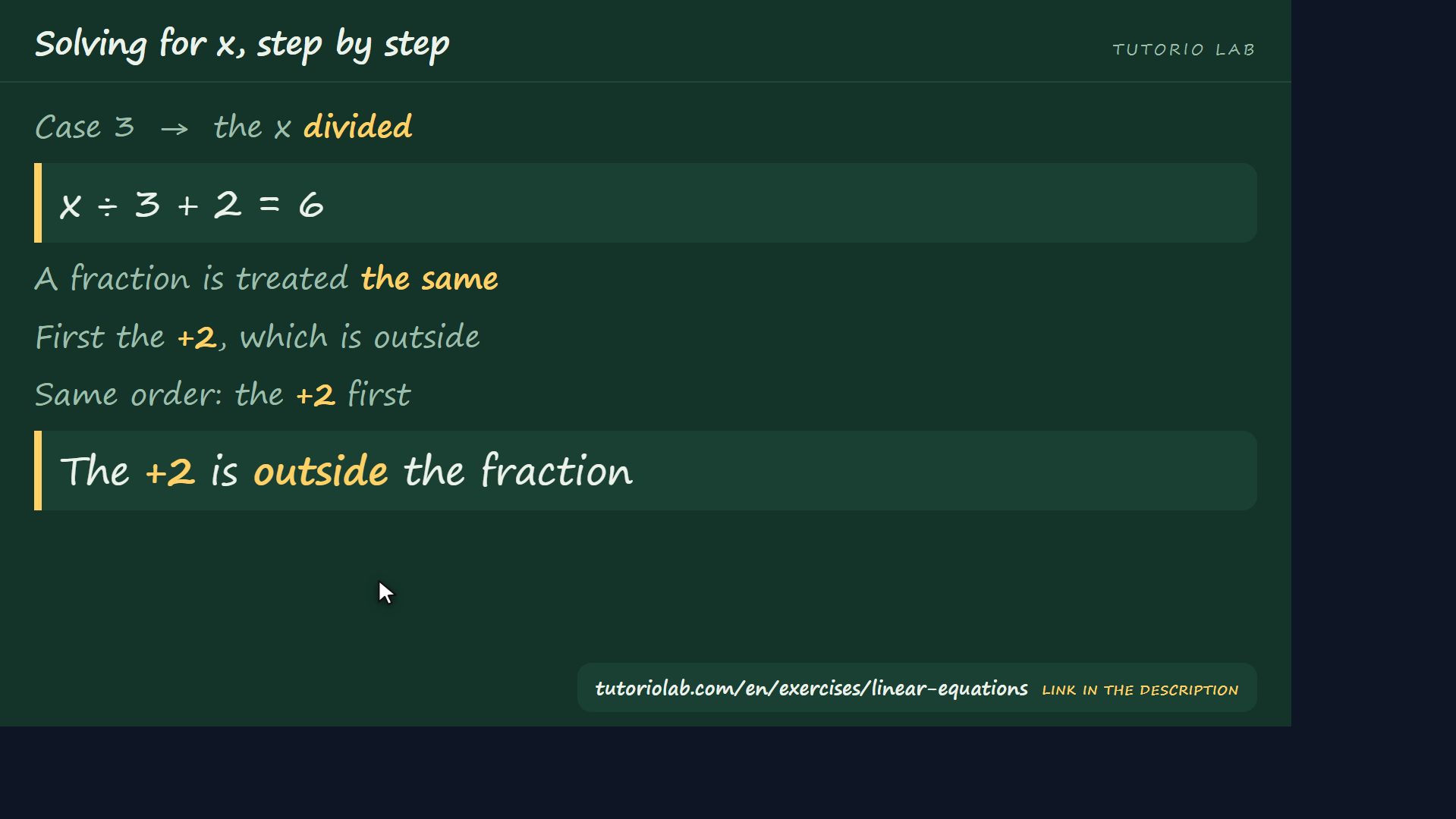
And the third case, which also gets searched for a fair bit: when the x is divided by a number. For example: x over three, plus two, equals six. A lot of people freeze when they see the fraction, and there is no reason to: it is treated the same as everything else. Follow the usual order. First we remove what adds or subtracts, which here is the plus two, and that two is outside the fraction, adding.
Removing the fraction
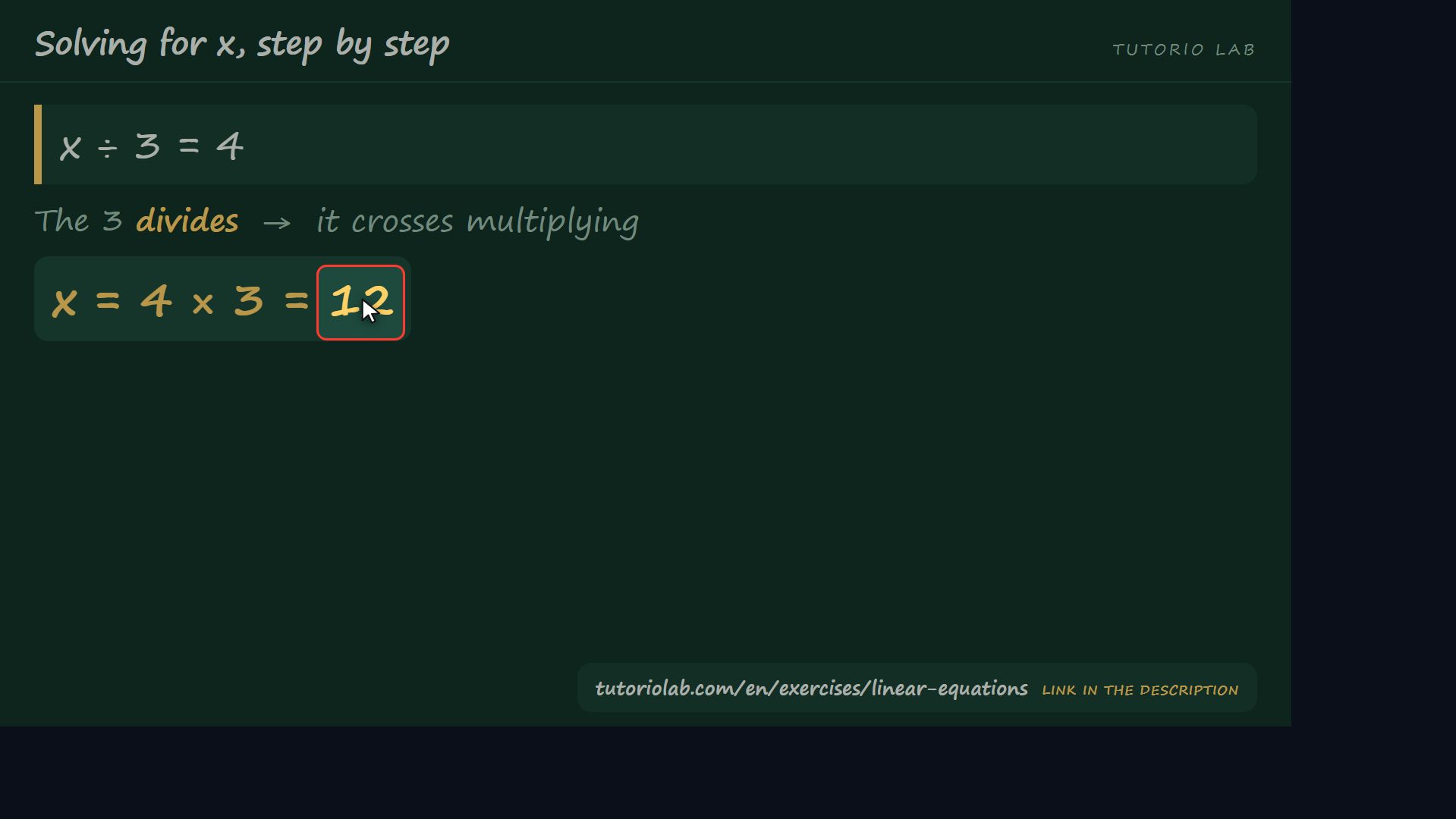
The two crosses to the other side subtracting: x over three, equals six minus two, which is four. Now we are left with the fraction alone. And look at what the three is doing: it is dividing the x. So we do the opposite: it crosses to the other side multiplying. x equals four times three, which is twelve. And we check it quickly: twelve over three is four, plus two is six. It matches.
An exam word problem
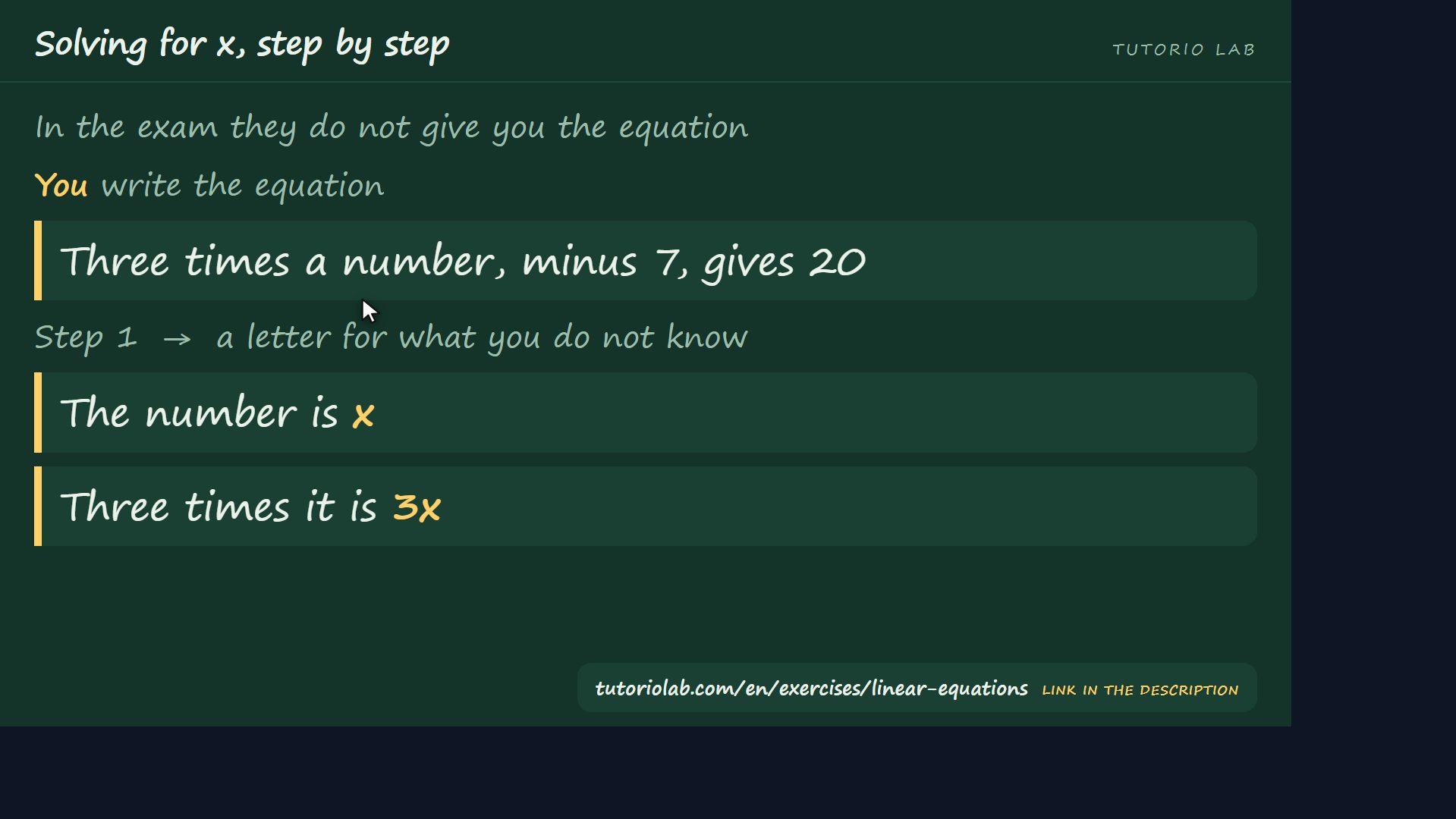
And we finish with what really comes up in exams, which is almost never an equation already written down: it is a word problem that you have to turn into an equation yourself. This one: three times a number, minus seven, gives twenty. What is the number? The first step, and it is the one that costs most, is to put a letter on what you do not know. What we do not know is the number, so the number is x. And now we translate the sentence piece by piece: three times a number means three multiplied by that number, that is three x.
Translate and solve
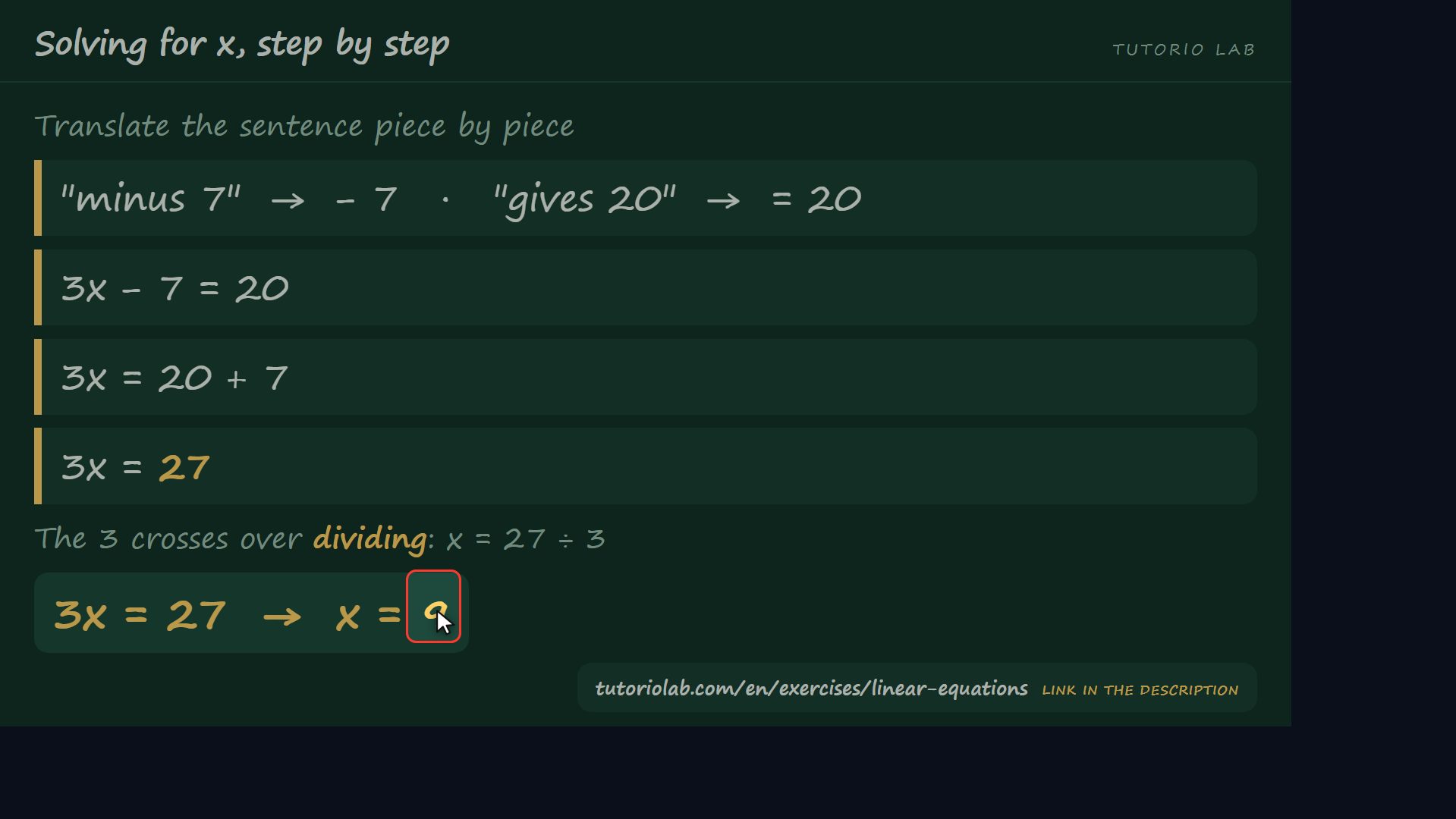
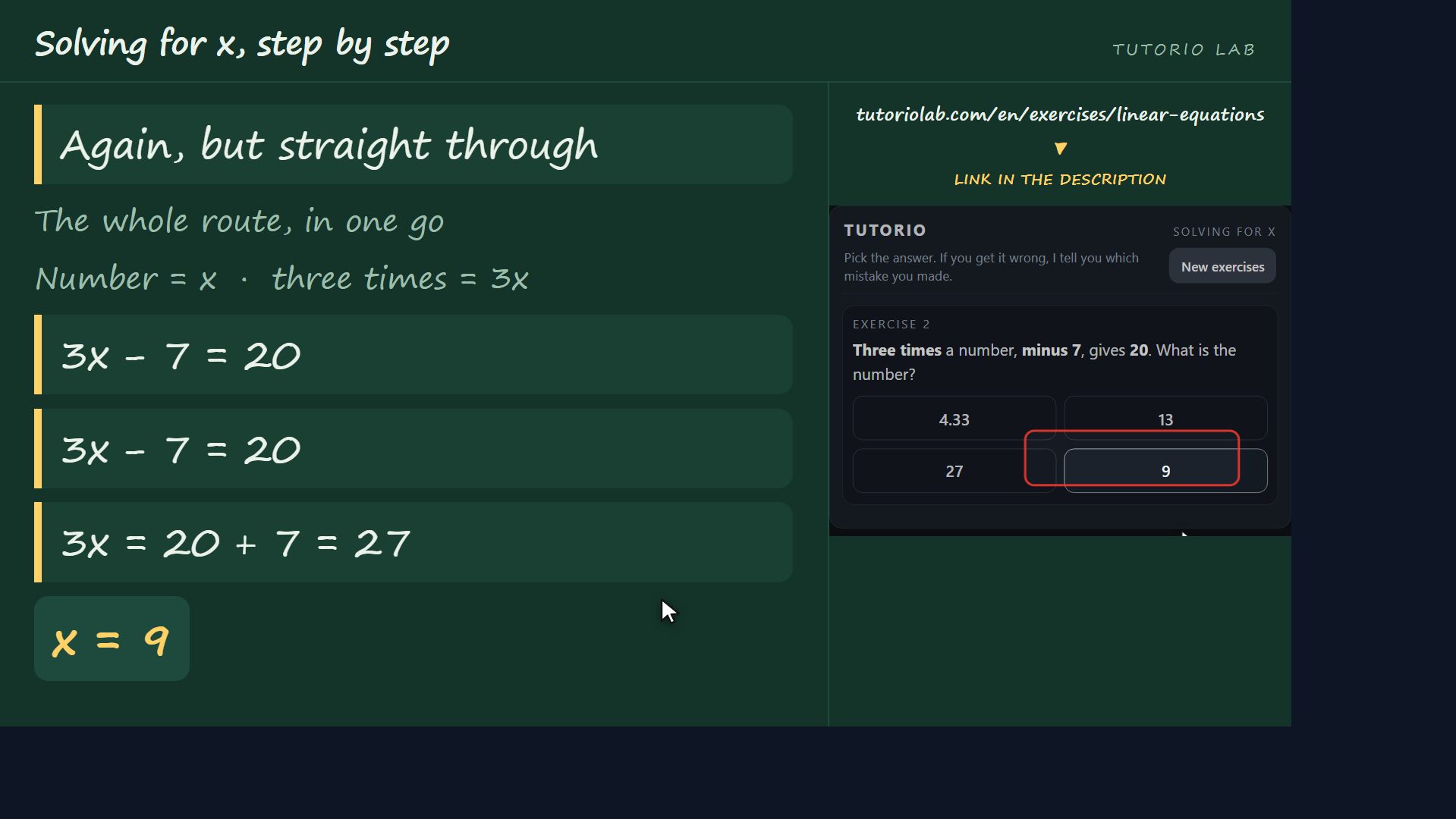
We carry on translating. Minus seven is literally minus seven. And gives twenty means equals twenty. So the whole sentence, in the language of mathematics, is: three x minus seven equals twenty. And that one we already know how to solve. The minus seven crosses over adding: three x equals twenty plus seven, twenty-seven. The three crosses over dividing: x equals twenty-seven over three, nine. The number was nine. And we check it against the wording, which is what you always have to do in word problems: three times nine is twenty-seven, minus seven is twenty. Exactly right.
Exercise 2, step by step
Second and last exercise, and it is that same problem. I want you to see the whole route again in one go, without stopping, so the structure sticks in your head. You put a letter on what you do not know: the number is x. You translate the sentence piece by piece: three times is three x, minus seven is minus seven, and gives twenty is equals twenty. You set up the equation: three x minus seven equals twenty. And you solve it with the usual two steps: the seven crosses over adding, twenty-seven; the three crosses over dividing, nine. And look at the twenty-seven trap, which is the best one: the twenty-seven really does appear in the working and it is correct, but it is three times the number, not the number. It is the mistake of stopping one step too early.
The three steps
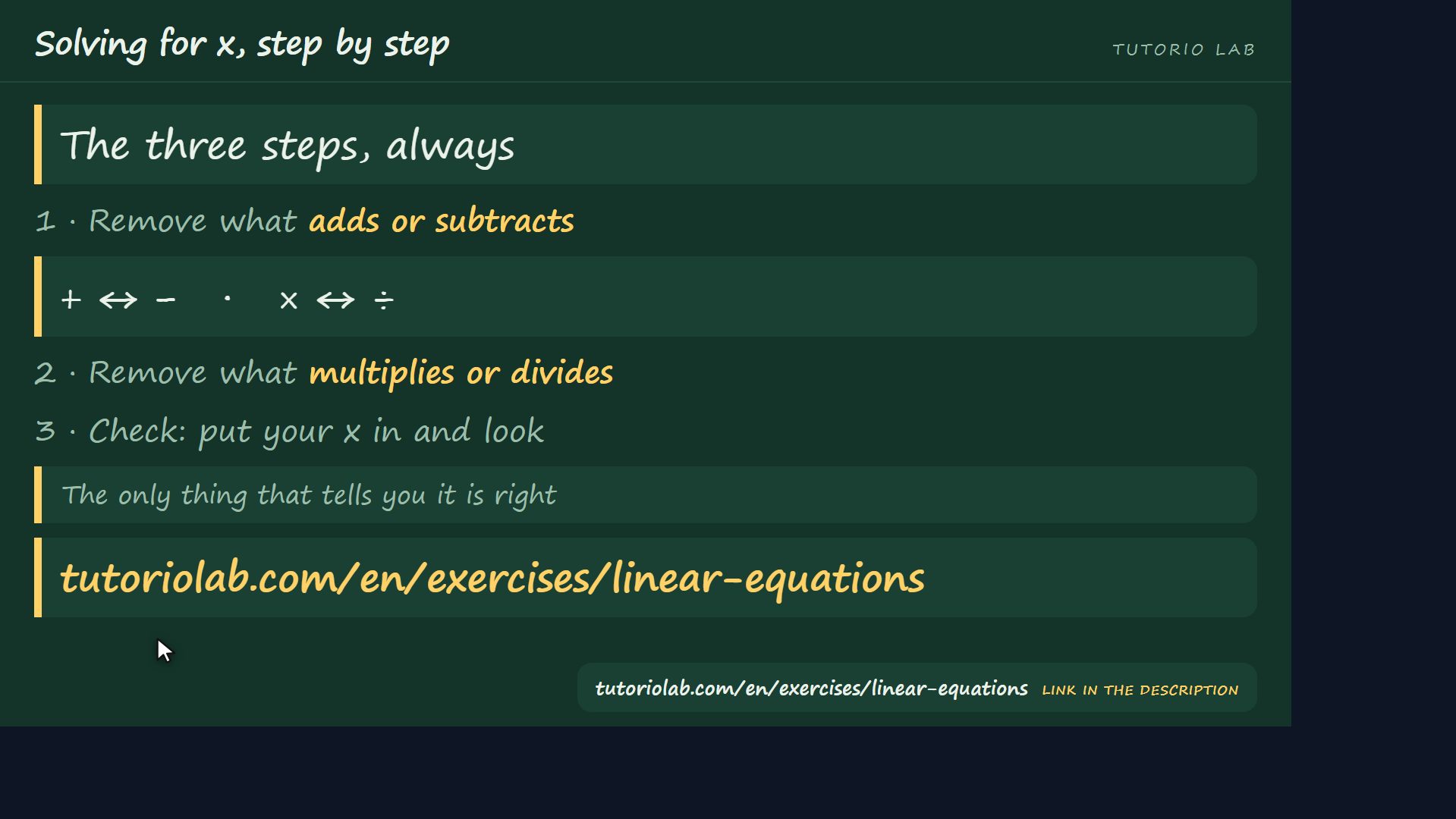
Let us go over the three steps, which are always going to be the same, with brackets, with fractions or with x on both sides. One: first remove what is adding or subtracting, crossing it to the other side with the sign changed. Two: then remove what is multiplying or dividing, doing the opposite. And three: always check by putting your result into the original equation, which is the only thing that tells you it is right without asking anybody. Practise it at tutoriolab.com, slash e n, slash exercises, slash linear equations.
If this helped, subscribe.

Common questions
How do you solve for x?
Remove what is adding or subtracting first, crossing it to the other side with the sign changed; then remove what is multiplying or dividing, doing the opposite. With 3x + 5 = 20: 3x = 20 − 5 = 15, and x = 15 ÷ 3 = 5.
Why does a number change sign when it crosses the equals sign?
Because the equation is a balance: what you take off one side you have to take off the other. Saying that it crosses over with the sign changed is a short way of saying that you are removing it from both sides at once. That is why + becomes − and × becomes ÷.
What do you do when the x is on both sides?
All the x to one side and all the numbers to the other, changing sign as they cross. Take the x to the side that has more of them, so you do not end up with a negative in front. 5x − 3 = 2x + 9 becomes 3x = 12, so x = 4.
How do you remove a bracket in an equation?
The number outside multiplies EVERYTHING inside, not just the first term: 2(x + 4) = 2x + 8, never 2x + 4. That is the distributive property, and forgetting the second term is the most common mistake in this whole topic.
How do I know whether my answer is right?
Put your number back into the ORIGINAL equation, in the place where the x was, and see whether the equality holds. For x = 5 in 3x + 5 = 20: 3·5 + 5 = 20. It matches. In word problems you check against the wording instead.
Are there exercises to practise?
Yes, and they are free: tutoriolab.com/en/exercises/linear-equations. You get new equations every time — simple ones, with x on both sides and with brackets — and when you get one wrong it tells you which mistake you made and shows you the worked calculation.