
Quadratic equations, from zero
Every quadratic can be arranged as ax² + bx + c = 0 and solved with one formula: x = (−b ± √(b² − 4ac)) ÷ 2a. The sign goes attached to the number — in x² − 5x + 6 = 0 the b is −5, not 5 — and −b then becomes +5, which is where most people go wrong. The part inside the root is the DISCRIMINANT (Δ = b² − 4ac) and it tells you the number of solutions before you calculate: positive gives two, zero gives one repeated, negative gives none real. If a term is missing the formula is unnecessary: with no c take a common factor (2x² − 8x = 0 → x = 0 and x = 4) and with no b isolate and take the root, remembering it has two signs (x² = 9 → x = 3 and x = −3). And always check: your solution put back into the equation has to give zero.
Quadratic equations, from zero and skipping nothing.
What a quadratic equation is
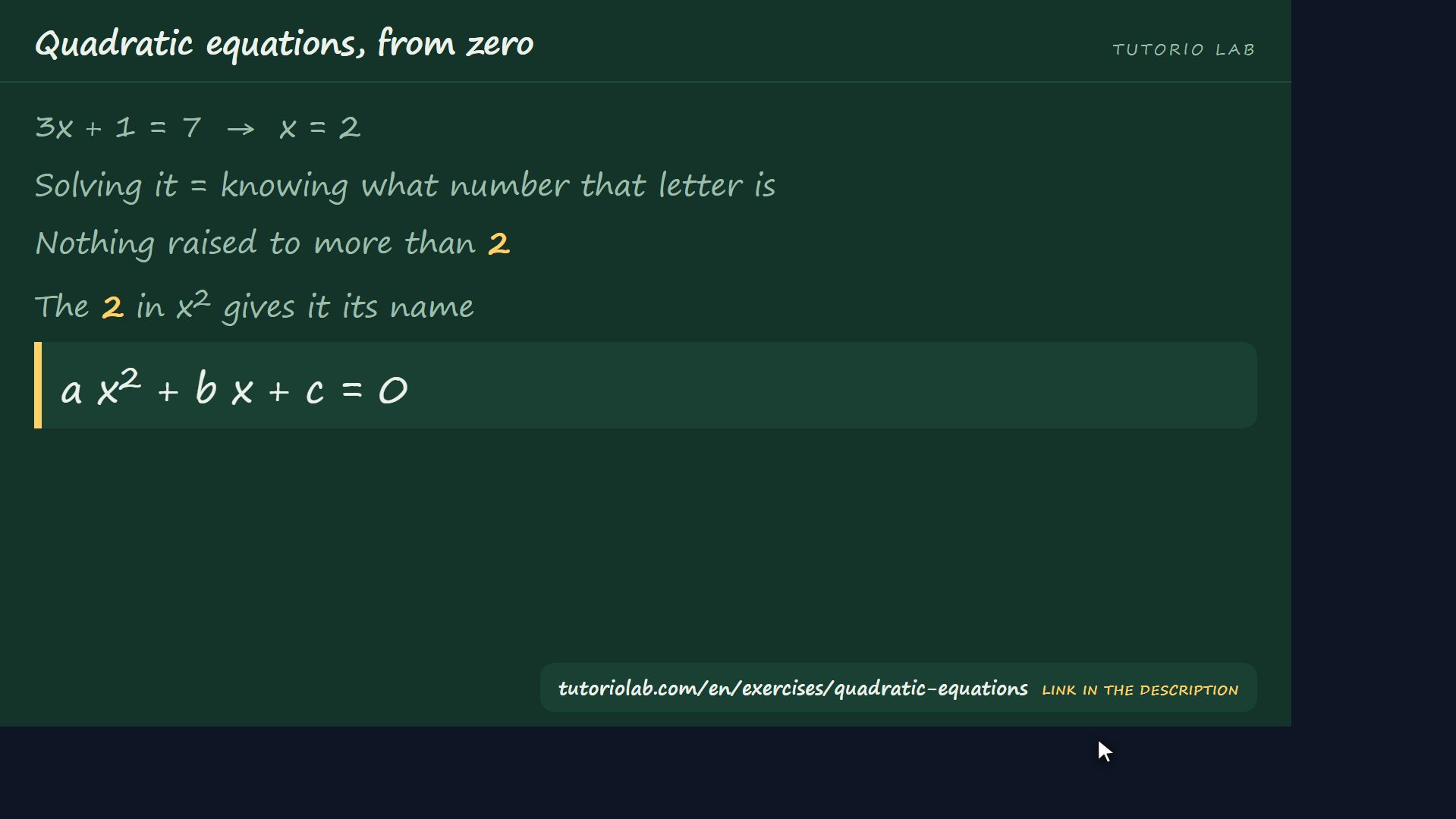
Let us start with the very basics, because I do not want to assume anything. An equation is an equality with a letter in it, and solving it is finding out what number is hiding behind that letter. When the letter appears squared, and there is nothing raised to more than that, we say the equation is second degree. That is where the name comes from: from the little two on top. And all of them, without exception, can be arranged in this form: a x squared, plus b x, plus c, equals zero.
Who a, b and c are
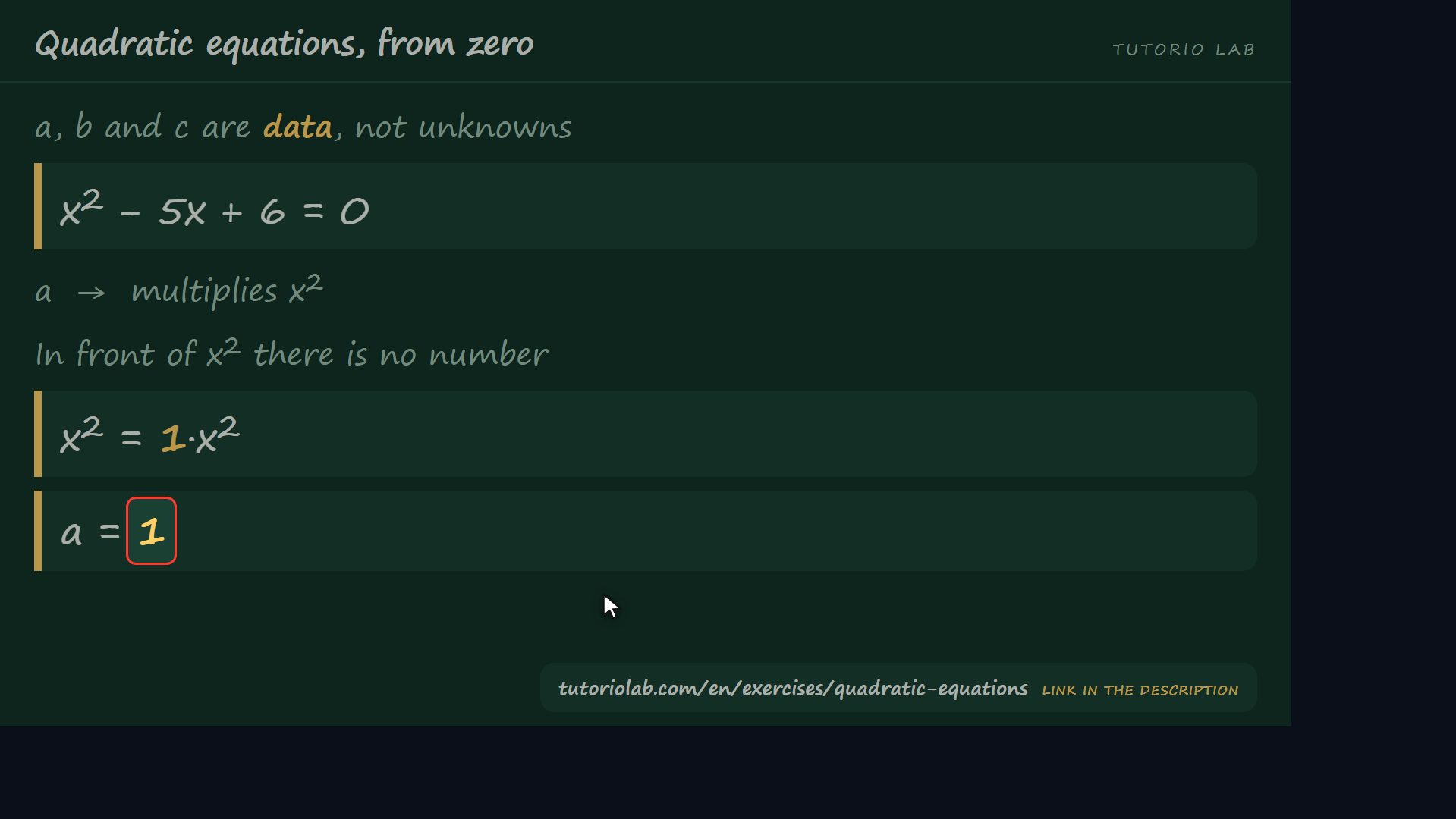
Now let us talk about those three letters, because they are not unknowns: they are the numbers you are already given, and you have to know which is which before touching anything. Here is the equation that is going to be with us all video: x squared, minus five x, plus six, equals zero. The a is the number that multiplies the x squared. And here something happens that confuses a lot of people: in front of the x squared there is no number written. Look carefully, because when there is no number it means there is a one, since x squared means the same as one times x squared. The a is worth one. The b is the number that multiplies the x on its own, and here it says minus five. And now the most important thing in the whole video: the sign goes attached to the number. The b is not five: it is minus five, with its minus included. And the c is the number that stands loose, with no x beside it: here it is six.
The quadratic formula
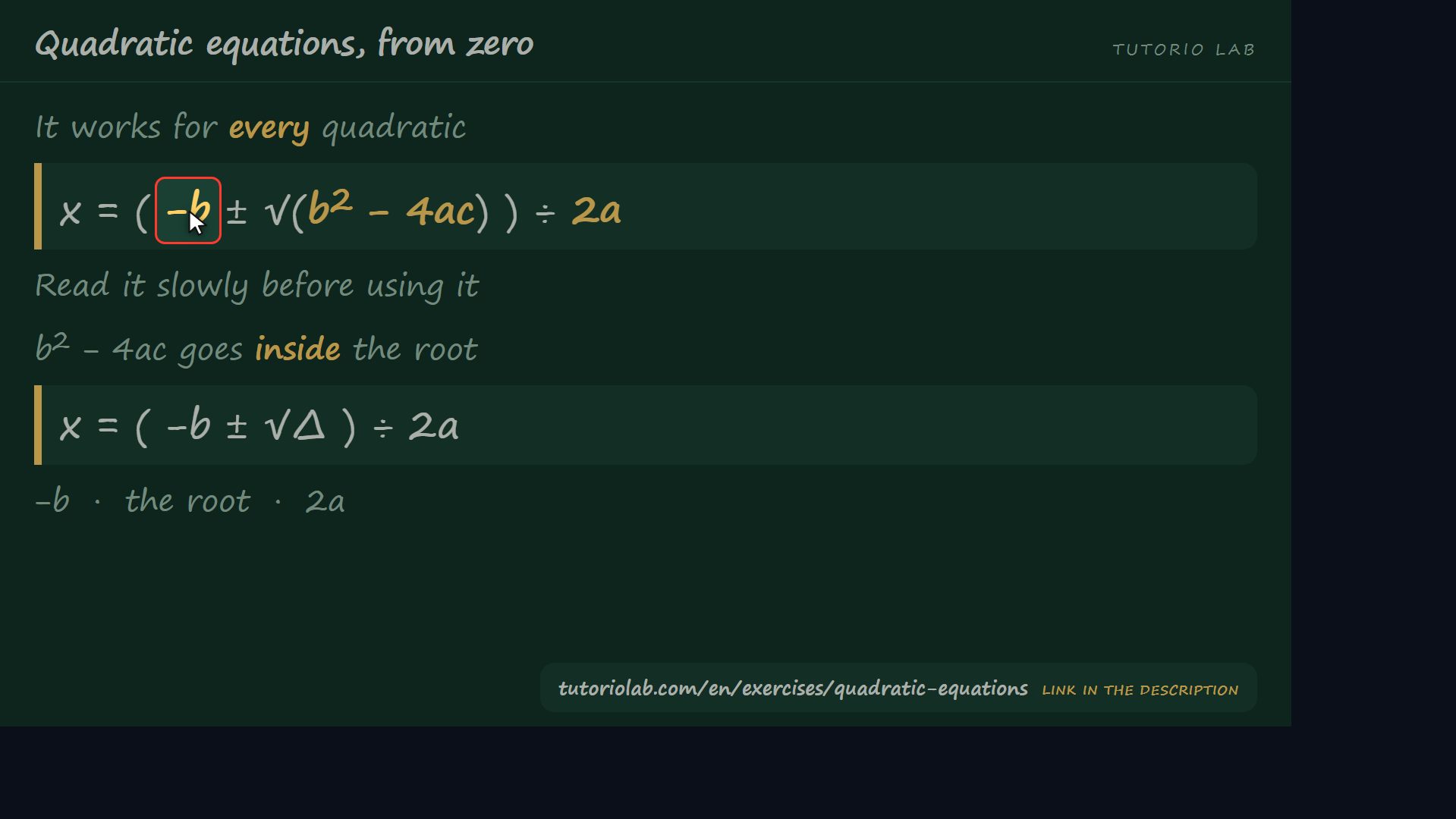
With those three numbers you can already use the quadratic formula, which is always the same, for any second degree equation in the world. It is this one, and we are going to read it slowly before using it, because if you do not understand it you will not be able to use it properly. x equals: minus b, plus or minus the square root of, b squared minus four a c, and all that divided by two a. Let us look at its three parts separately. Here, minus b. Here inside the root, b squared minus four a c. And here underneath, dividing, two a. And that plus or minus in the middle does not mean we are unsure: it is an instruction. It means the calculation is done twice, one adding and one subtracting, and that is why two solutions come out and not just one.
Putting the numbers in
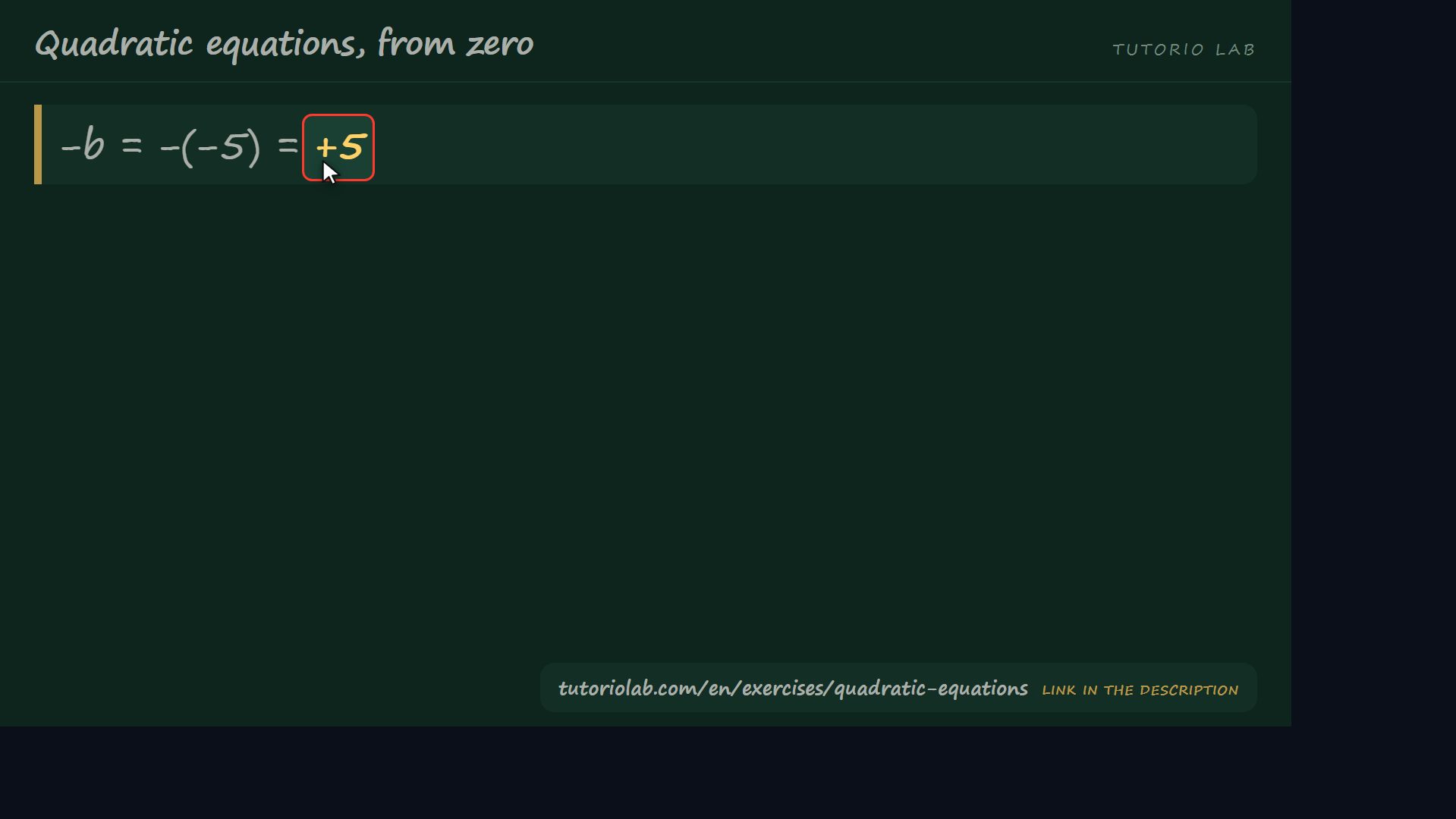
Let us put our numbers in, one by one, without rushing. We start with minus b. Our b is worth minus five, so minus b is minus, minus five. And here is the most common mistake in the whole topic, so stop for a second and look at it properly: when you have two minus signs in a row, the result is positive. Minus, minus five, is plus five. If you stay here with minus five, everything you do afterwards will come out wrong no matter how well you do the rest of the calculation. It is the mistake I see most. And now the one underneath, the two a: the a is worth one, so two times one is two. The denominator of our fraction is two.
What is inside the root
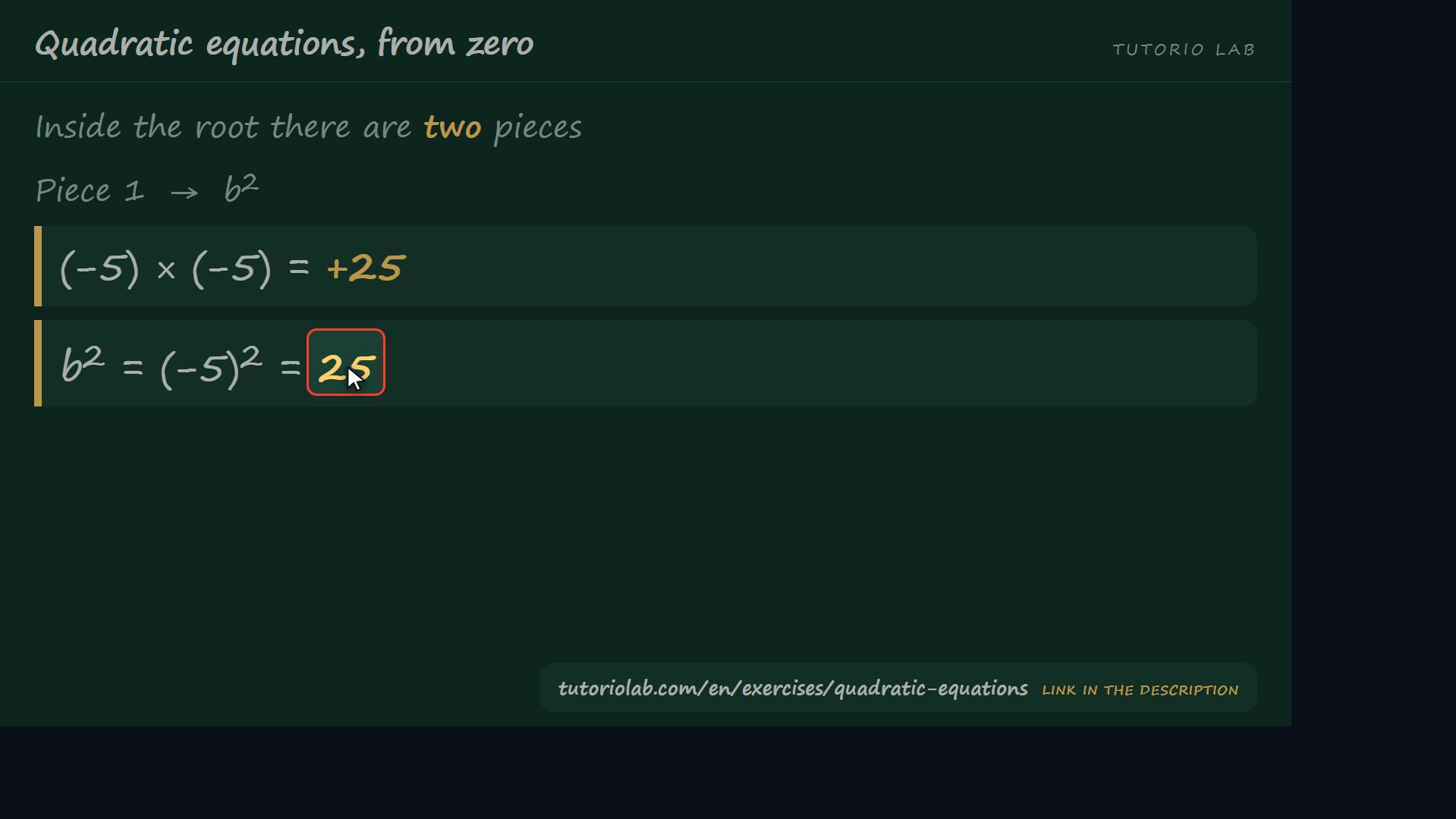
Now what is inside the root, which has two pieces and we are going to do them separately. The first piece is b squared. Our b is worth minus five, so b squared is minus five squared, that is, minus five multiplied by minus five. Two negative numbers multiplying again: the result is positive. Twenty-five. The second piece is four a c, which means four times a times c, the three of them multiplied: four times one times six. Four times one is four. Four times six is twenty-four. And now they are subtracted, in that order, the first minus the second: twenty-five minus twenty-four is one. Inside the root we are left with a one, and the square root of one is one, because one times one is one.
The two solutions
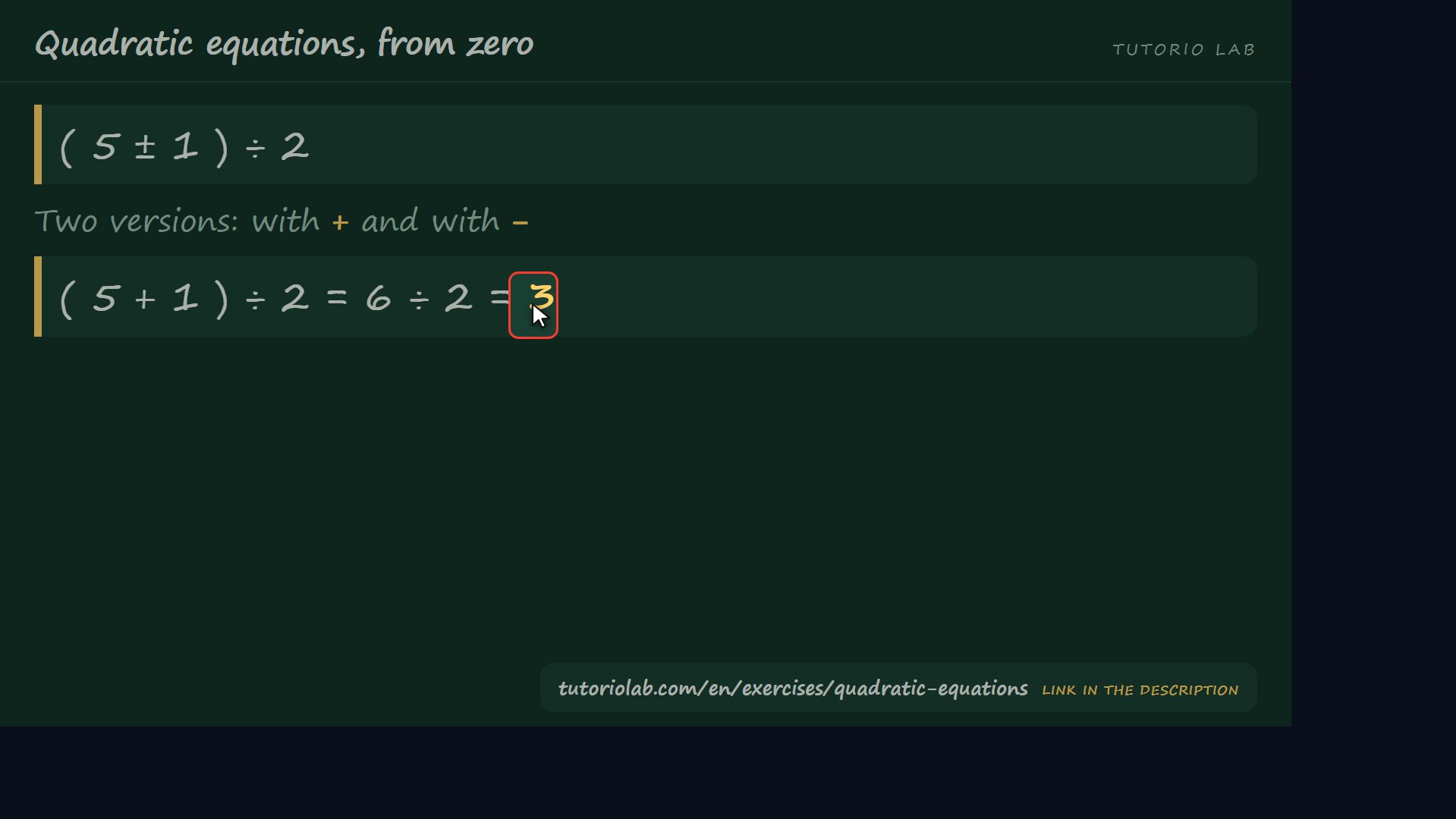
We already have all the pieces. The calculation left is: five, plus or minus one, divided by two. And now we do the two versions, which is what that plus or minus was asking for. First with the plus: five plus one is six, and six over two is three. That is one of the solutions. Now with the minus: five minus one is four, and four over two is two. That is the other. The two solutions of our equation are three and two. And notice that both came out whole and clean numbers: when they come out that round it is usually a good sign that you are on track.
Check it yourself
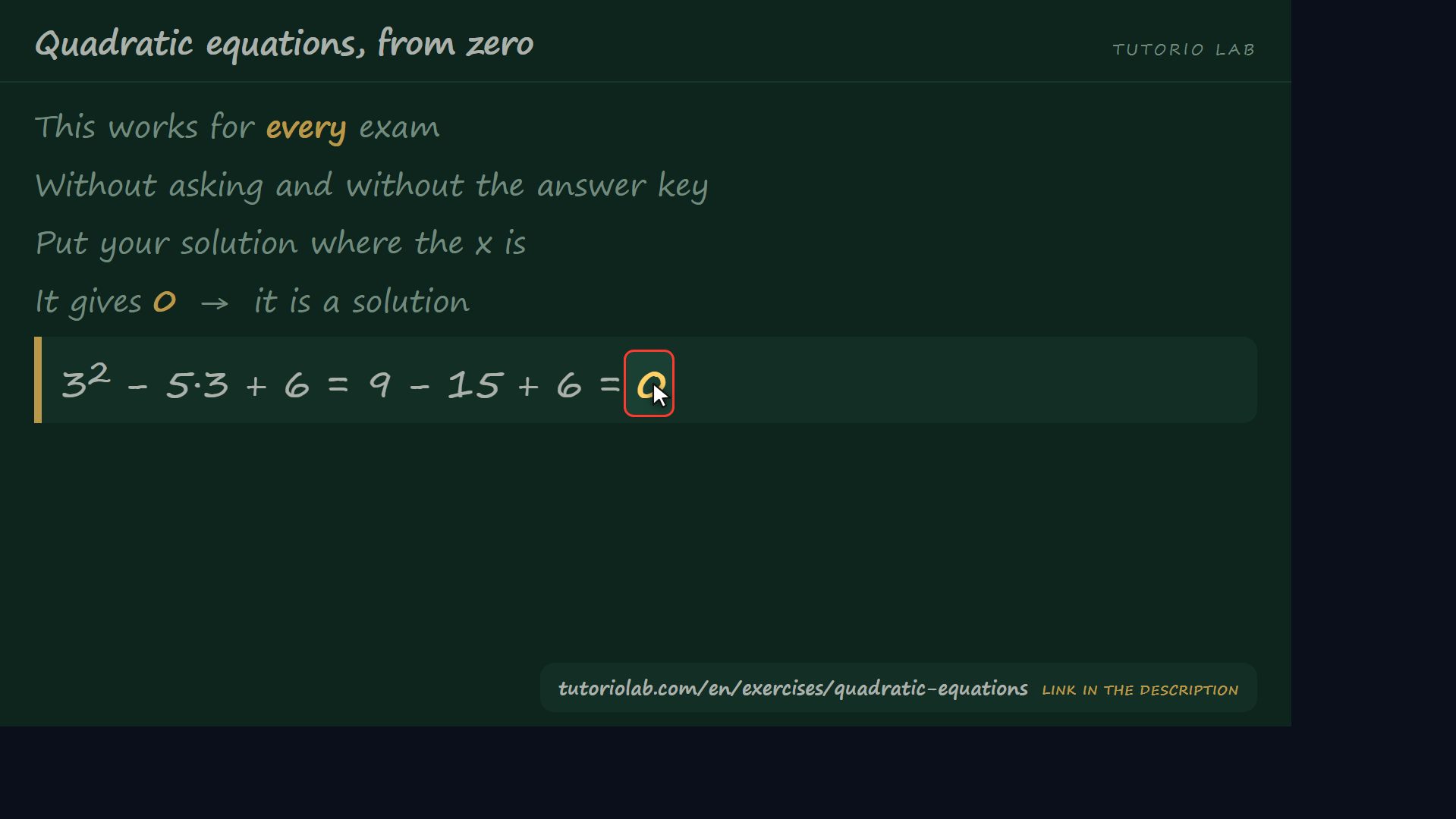
And now I am going to show you something almost nobody explains and that will serve you in every exam of your life: how to know on your own whether you have done it right, without asking anybody and without looking at the answer key. It is very simple. You take your solution, put it into the original equation in the place where the x is, and do the arithmetic. If it gives zero, that solution is correct. Let us try with the three. Three squared is nine. Minus five times three is fifteen, so it goes minus fifteen. And then plus six. So: nine, minus fifteen, plus six. Nine minus fifteen is minus six, and minus six plus six is zero. It gives zero. Now we try the two: four, minus ten, plus six, which is also zero. Both are solutions.
Exercise 1, step by step
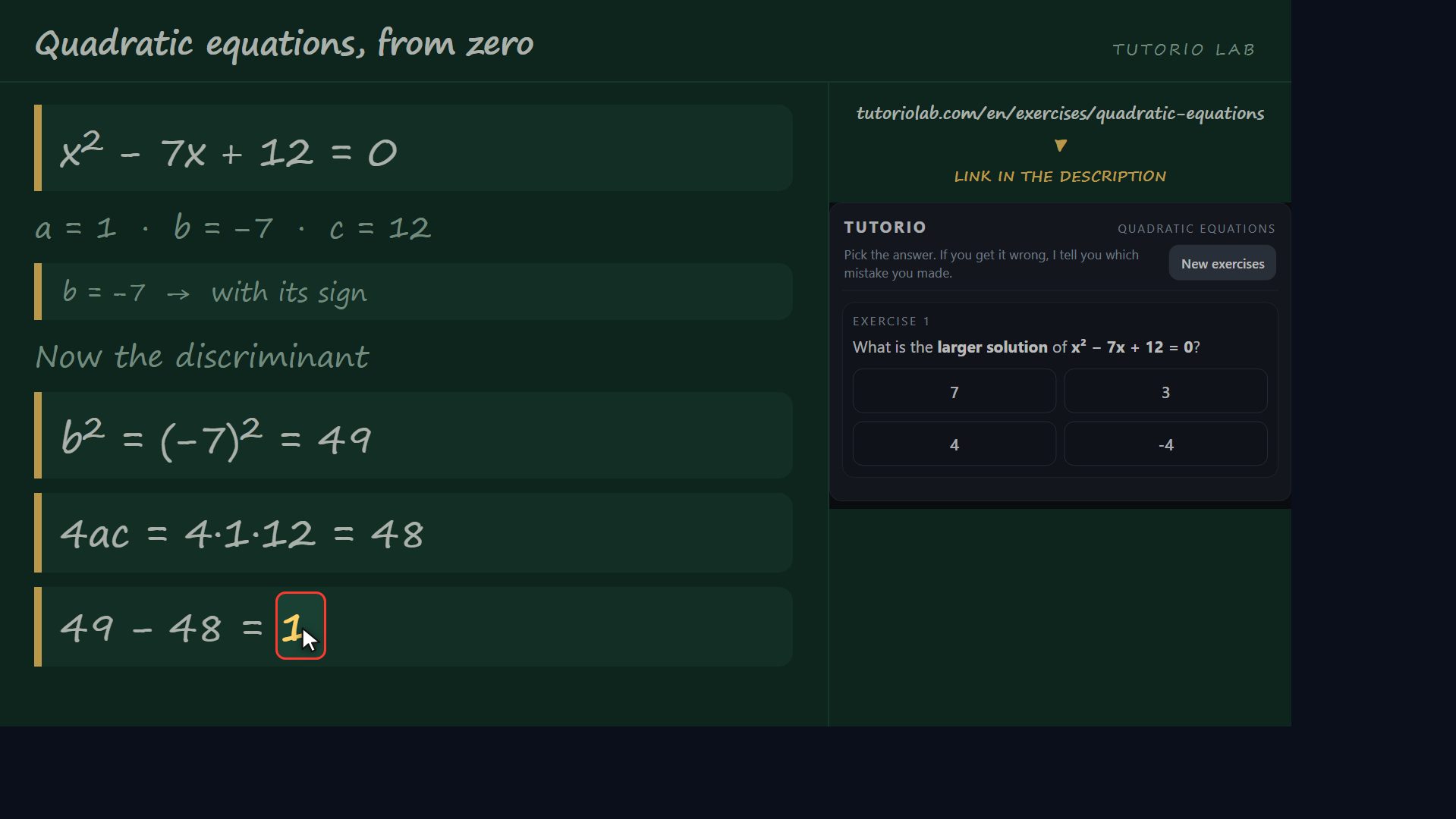
Let us do the first exercise, and we are going to solve it together on the board before touching anything. x squared, minus seven x, plus twelve, equals zero, and they ask for the larger solution. First the letters, as always: the a is worth one, because in front of the x squared there is no number written; the b is worth minus seven, with its sign attached; and the c is worth twelve. Now the discriminant. b squared is minus seven squared, and since it is two negatives multiplying it comes out positive: forty-nine. Four a c is four times one times twelve, which is forty-eight. Forty-nine minus forty-eight is one, and the root of one is one. Minus b, with b being minus seven, is plus seven. With the plus: seven plus one is eight, over two, four. With the minus: seven minus one is six, over two, three. They ask for the larger of the two, so the answer is four. And now, yes, I mark it.
Practise for free
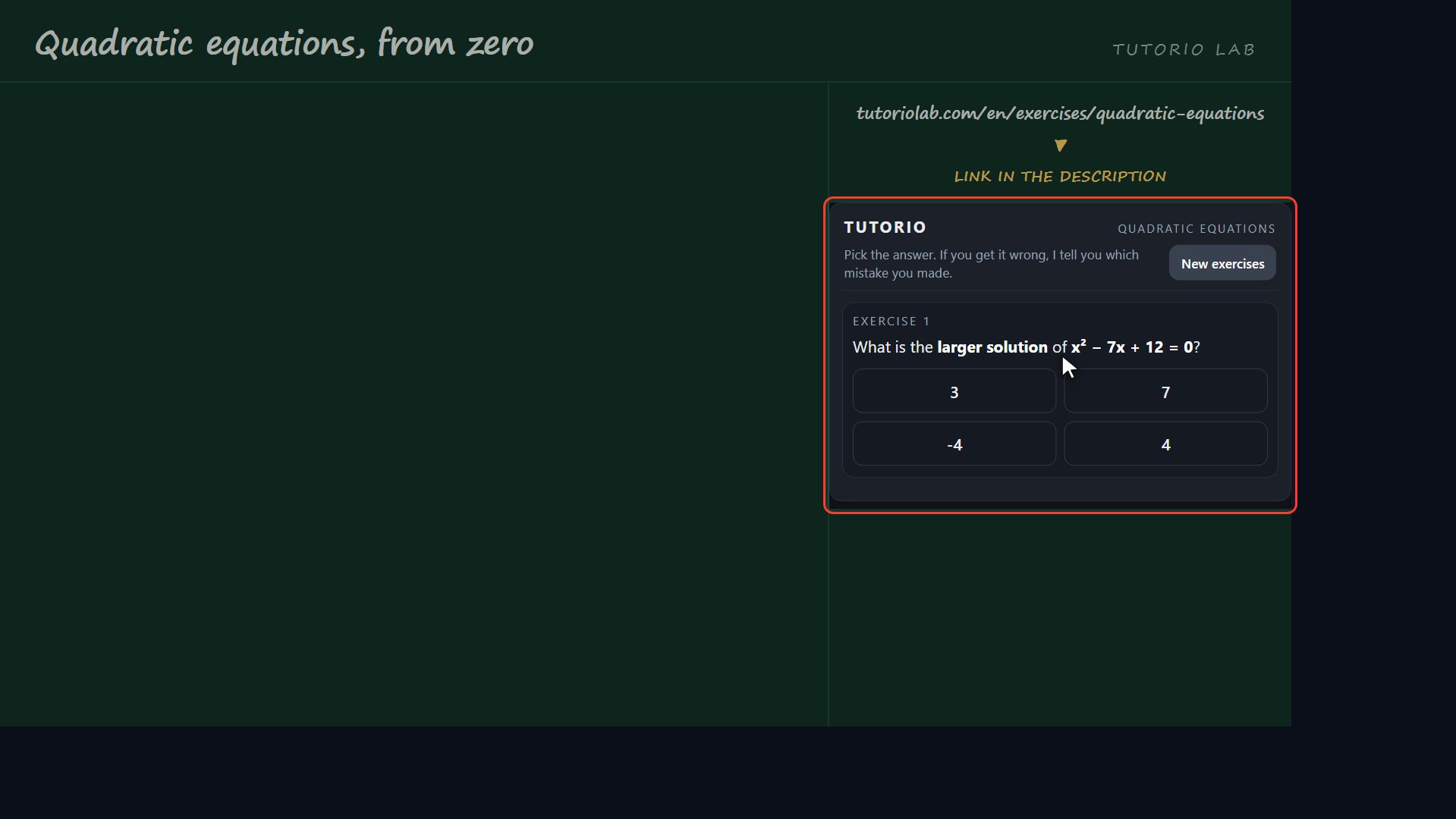
And I want you to take a good look at this on your right here, because it is ours and it is free. It is an exercise page: tutoriolab.com, slash e n, slash exercises, slash quadratic equations. Every time you go in you get different equations, so you can practise as many times as you like without repeating. And what really matters: when you get one wrong it does not just throw an incorrect at you and leave you where you were. It tells you what mistake you made, by name, and it shows you the worked calculation step by step.
What the discriminant is
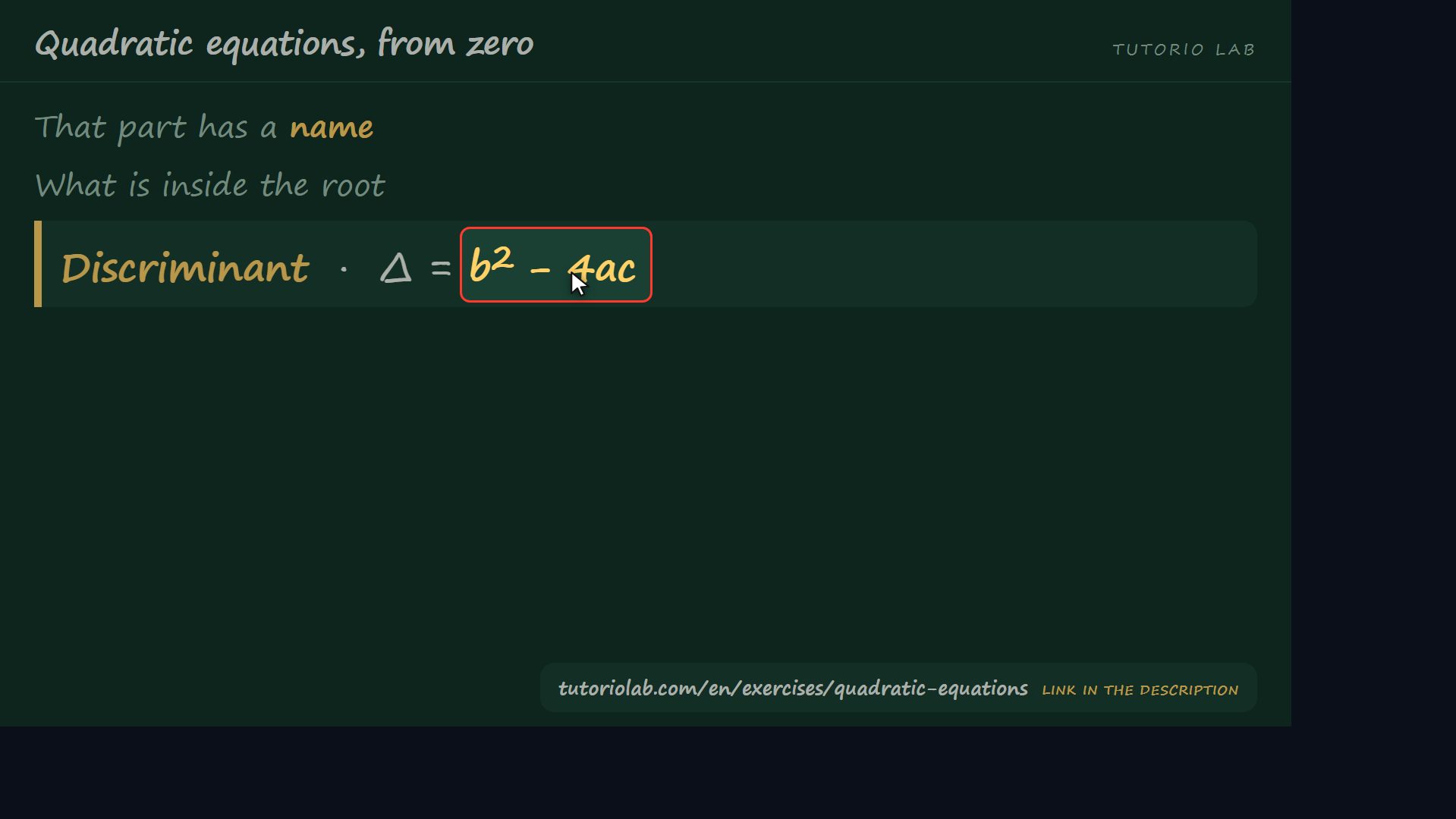
Now we are going to put a name on a part of the formula, because you are going to hear it mentioned a lot. What is inside the root, b squared minus four a c, is called the discriminant. It is written with a Greek letter that looks like a triangle and is called delta. And it is not a name given on a whim: that number, on its own, tells you how many solutions you are going to find before you start calculating them. That is why it is worth working it out first: ten seconds looking at it and you already know whether there is anything to look for or nothing at all.
The three cases
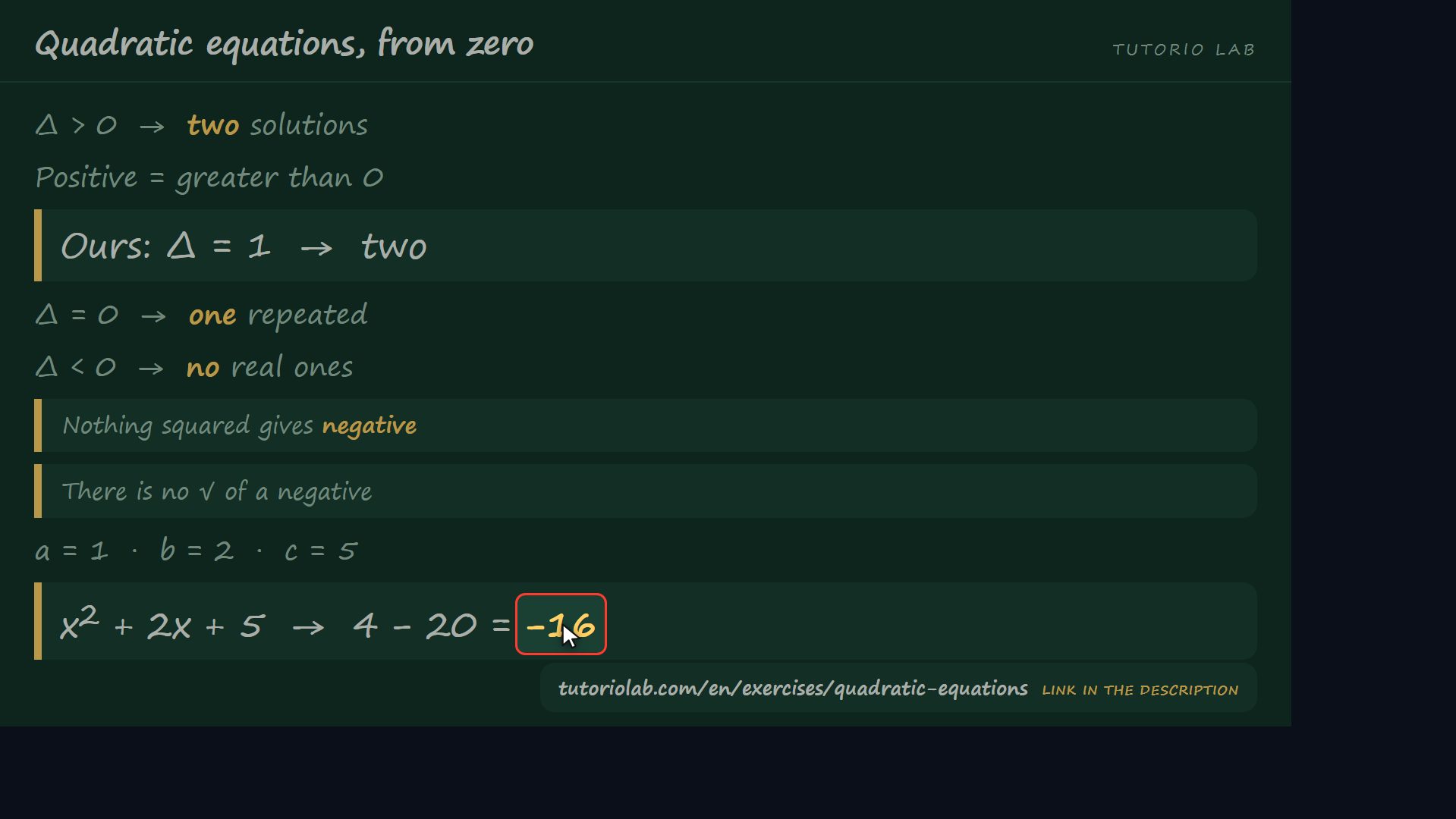
And there are three cases, no more. If the discriminant comes out positive, that is, greater than zero, then there are two different solutions: that is what happened to us, we got one. If it comes out exactly zero, then there is a single solution, and that one is called a repeated solution. And if it comes out negative, there is no real solution at all. The reason is simple and I want you to understand it instead of memorising it: you would have to take the square root of a negative number, and that does not exist, because any number multiplied by itself gives positive. Look at this example: x squared plus two x plus five. b squared is four; four a c is four times one times five, twenty; and four minus twenty gives minus sixteen. Negative. That equation has no solution, and we knew it without calculating anything else.
If the loose term is missing
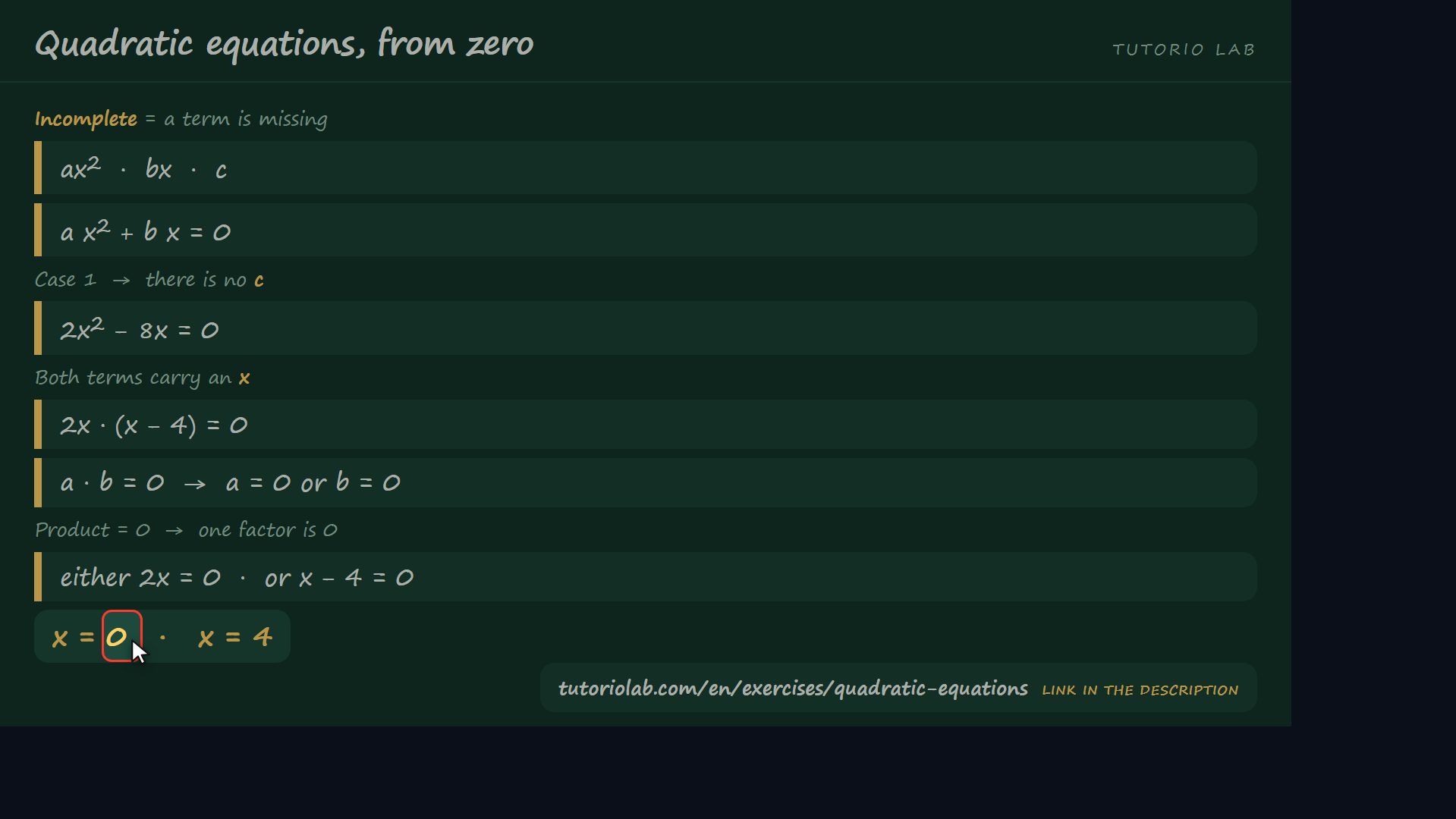
Now a case that gets searched for a great deal and that almost nobody explains properly: what happens when the equation is incomplete, that is, when one of the three terms is missing. And what I want you to see is that there the quadratic formula is unnecessary, because it is solved faster without it. First case: the loose term is missing, there is no c. For example, two x squared minus eight x equals zero. Notice that both terms carry an x, so we can take the x out as a common factor: two x, times, x minus four. And now we use something you have known since primary school: if you multiply two things and the result is zero, then one of the two has to be zero. So either the two x is zero, and then x is worth zero, or the x minus four is zero, and then x is worth four. Two solutions, zero and four, without having used the formula. And note this down: when the c is missing, zero is always going to be one of the solutions.
If the x on its own is missing
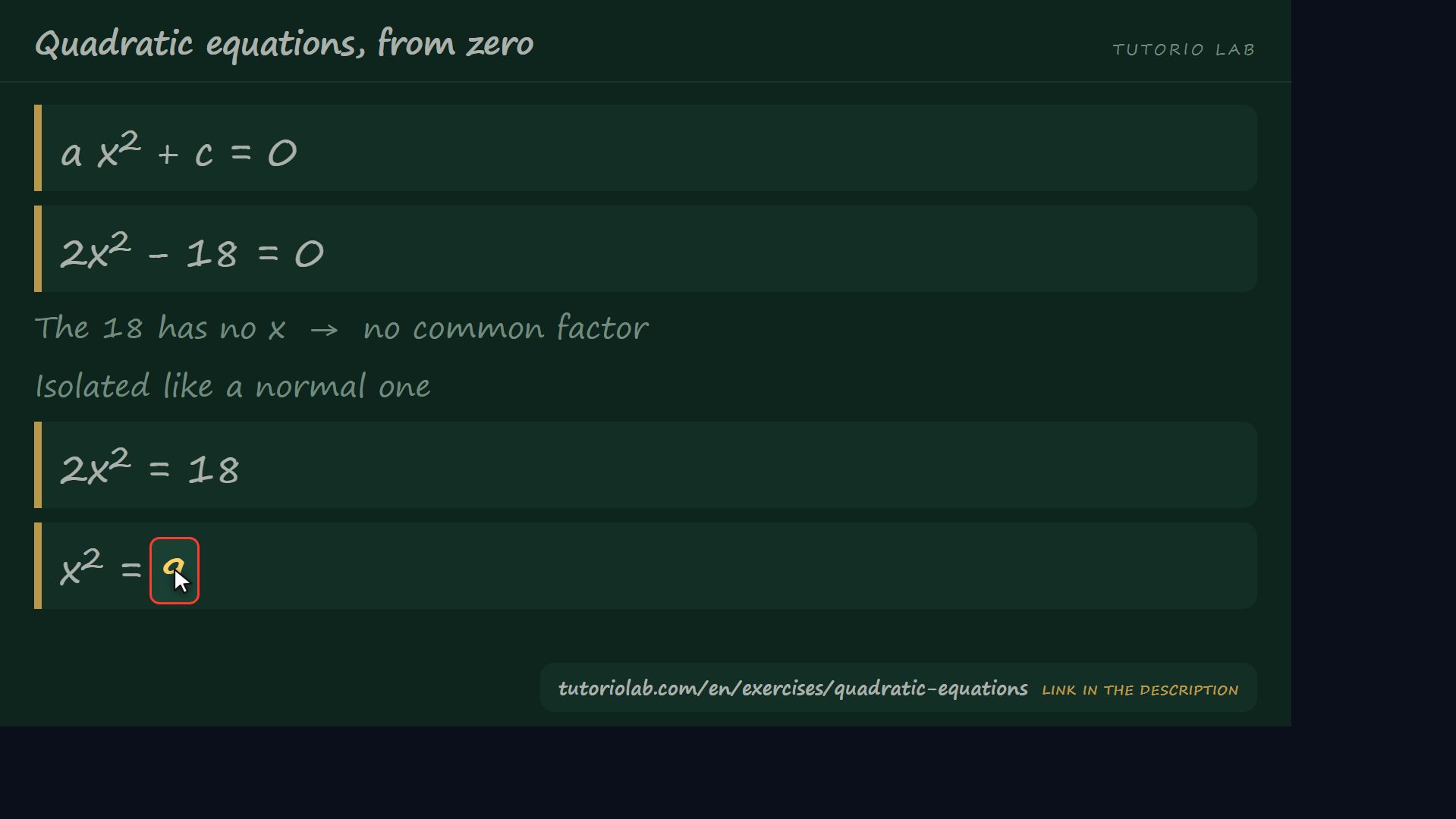
And now the second case: now the x on its own is missing, there is no b. For example, two x squared minus eighteen equals zero. Here we cannot take a common factor, because the eighteen does not carry any x. So it is isolated just like any normal equation. We move the eighteen to the other side, and when it crosses it changes sign, so over there it adds: two x squared equals eighteen. Now the two is multiplying, so it crosses to the other side dividing: x squared equals eighteen over two, which is nine. And all that is left is to take the square off the x, which is done by taking the root. And here is the trap that costs half a mark: the root of nine is three, yes, but it is also minus three. Because minus three times minus three also gives nine. There are two solutions: three and minus three.
An exam word problem
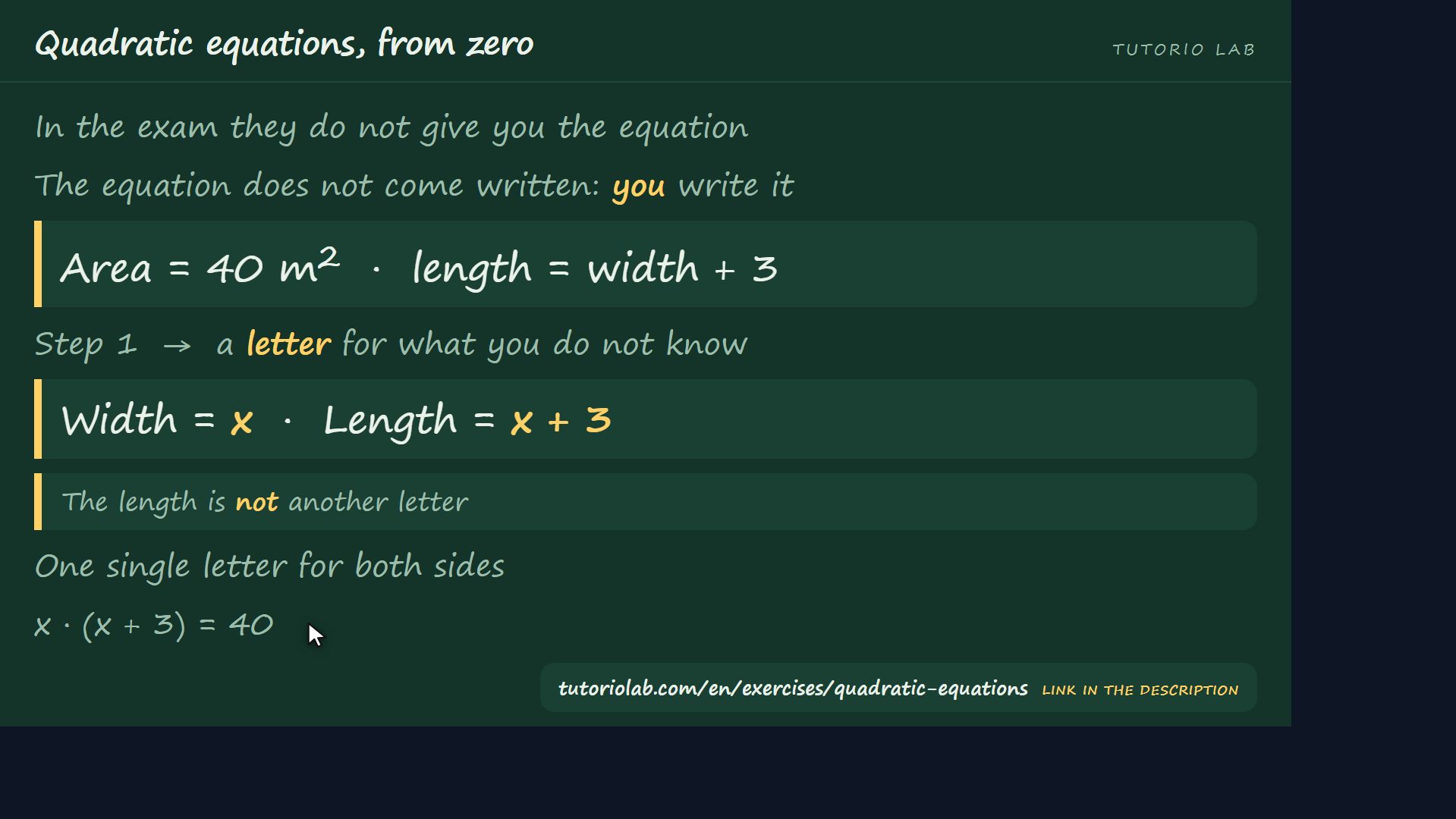
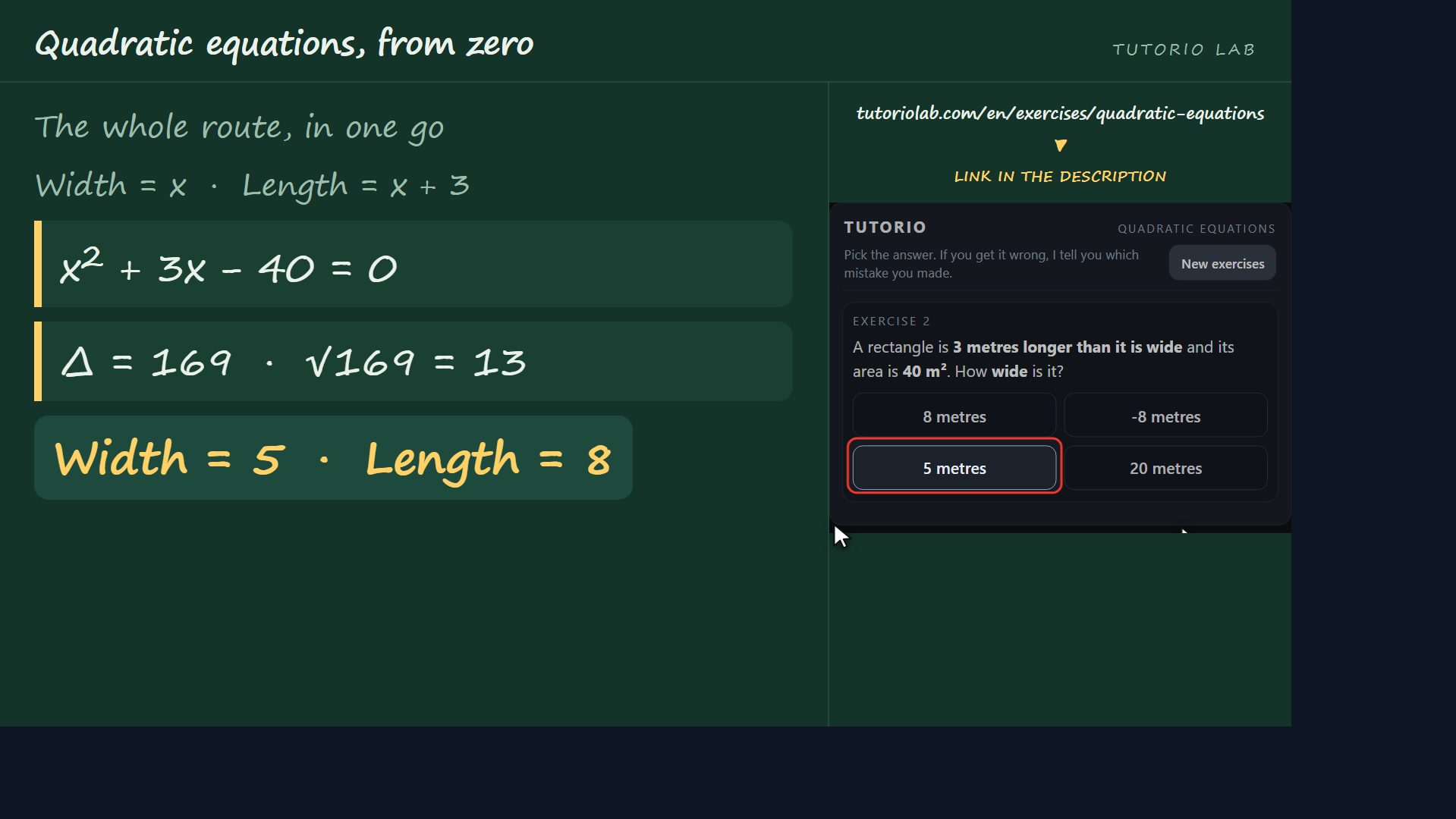
And now let us go to what really comes up in exams, which is almost never an equation already written down: it is a word problem that you have to turn into an equation yourself. This one: a rectangle is three metres longer than it is wide, and its area is forty square metres. How wide is it? The first step, and it is the one that costs most of all, is to put a letter on what you do not know. What they are asking us is the width, so we say the width is x. And now pay attention, because this is where a lot of people get lost: the length is not another new letter. The wording tells us the length is three metres more than the width, so the length is x plus three. With a single letter we already have both sides described.
Setting up the equation
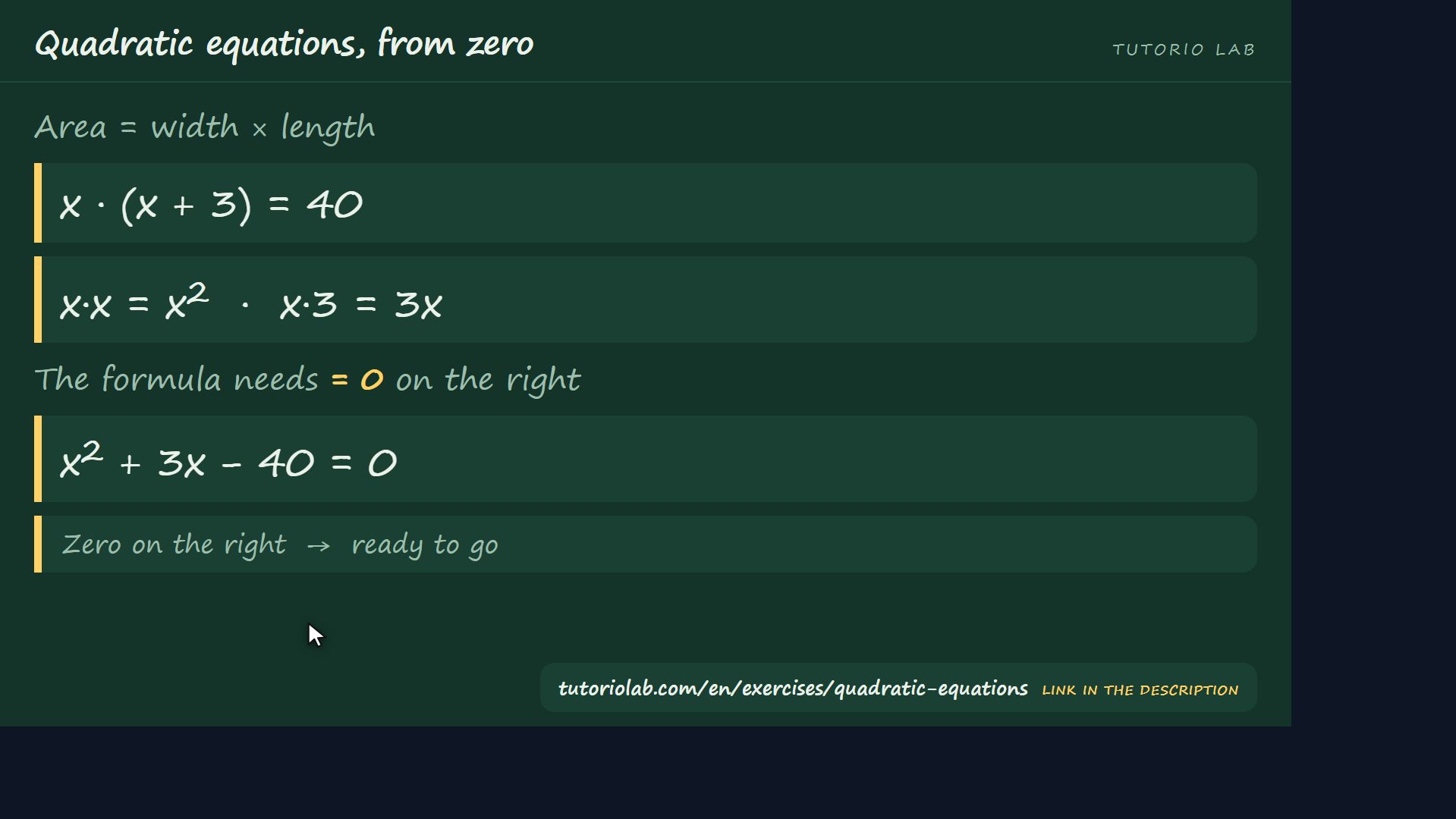
Now we set up the equation. The area of a rectangle is the width multiplied by the length, and we are told it is forty: x, times, x plus three, equals forty. We multiply out the bracket: x times x is x squared, and x times three is three x. We are left with x squared plus three x equals forty. And now it has to be arranged, because the formula only works if there is a zero on the right: we move the forty to the other side subtracting. x squared plus three x minus forty equals zero. It is ready for the formula now.
Solving it and choosing
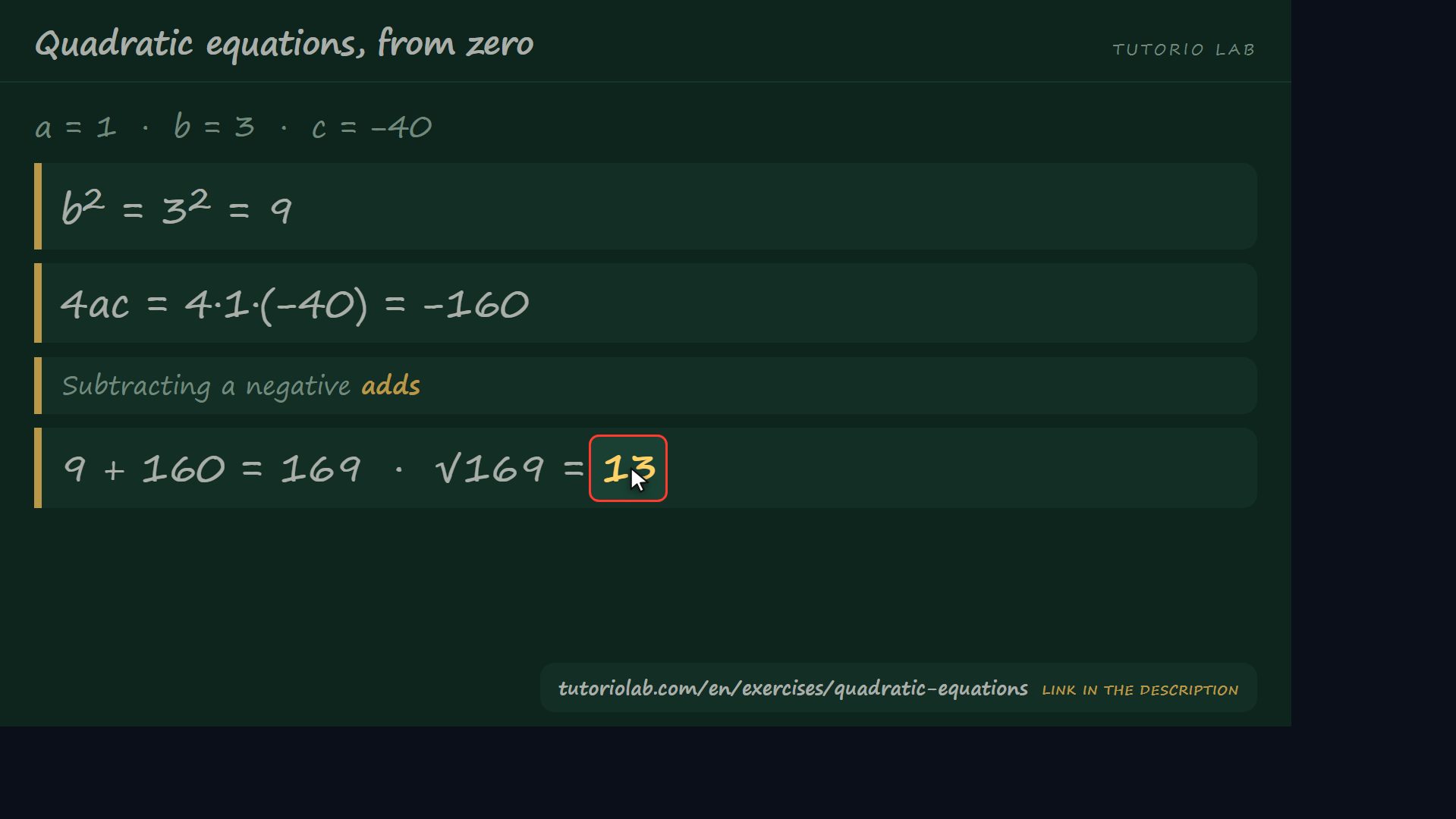
We take out the letters: the a is worth one, the b is worth three and the c is worth minus forty. To the discriminant. Three squared is nine. And four a c is four times one times minus forty, which gives minus one hundred and sixty. And careful here, because it is another place where people go wrong a lot: subtracting a negative number is really adding. Nine plus one hundred and sixty, one hundred and sixty-nine. The root of one hundred and sixty-nine is thirteen, and that one is worth knowing. The two solutions come out like this: minus three plus thirteen, over two, five; and minus three minus thirteen, over two, minus eight. And here comes what separates someone who has understood the problem from someone who has only done arithmetic: a side of a rectangle cannot measure minus eight metres, so that solution is discarded. The width is five. And we check it: if the width is five, the length is eight, and five times eight is forty.
Exercise 2, step by step
Second and last exercise, and it is that same problem. I want you to see the whole route again in one go, without stopping, so the complete structure sticks in your head. You put a letter on the width. The length is x plus three, because the wording says so. You multiply out to remove the bracket. You arrange the equation leaving the zero on the right. You work out the discriminant and take its root. And of the two solutions that come out, you keep the one that makes sense in the problem. The width is five metres. And now look at the eight trap, which is the best of all the ones here: the eight comes out of the equation and is a perfectly correct number, but it is the length, not the width. It is the classic mistake of answering without going back to read exactly what you were being asked.
The four steps
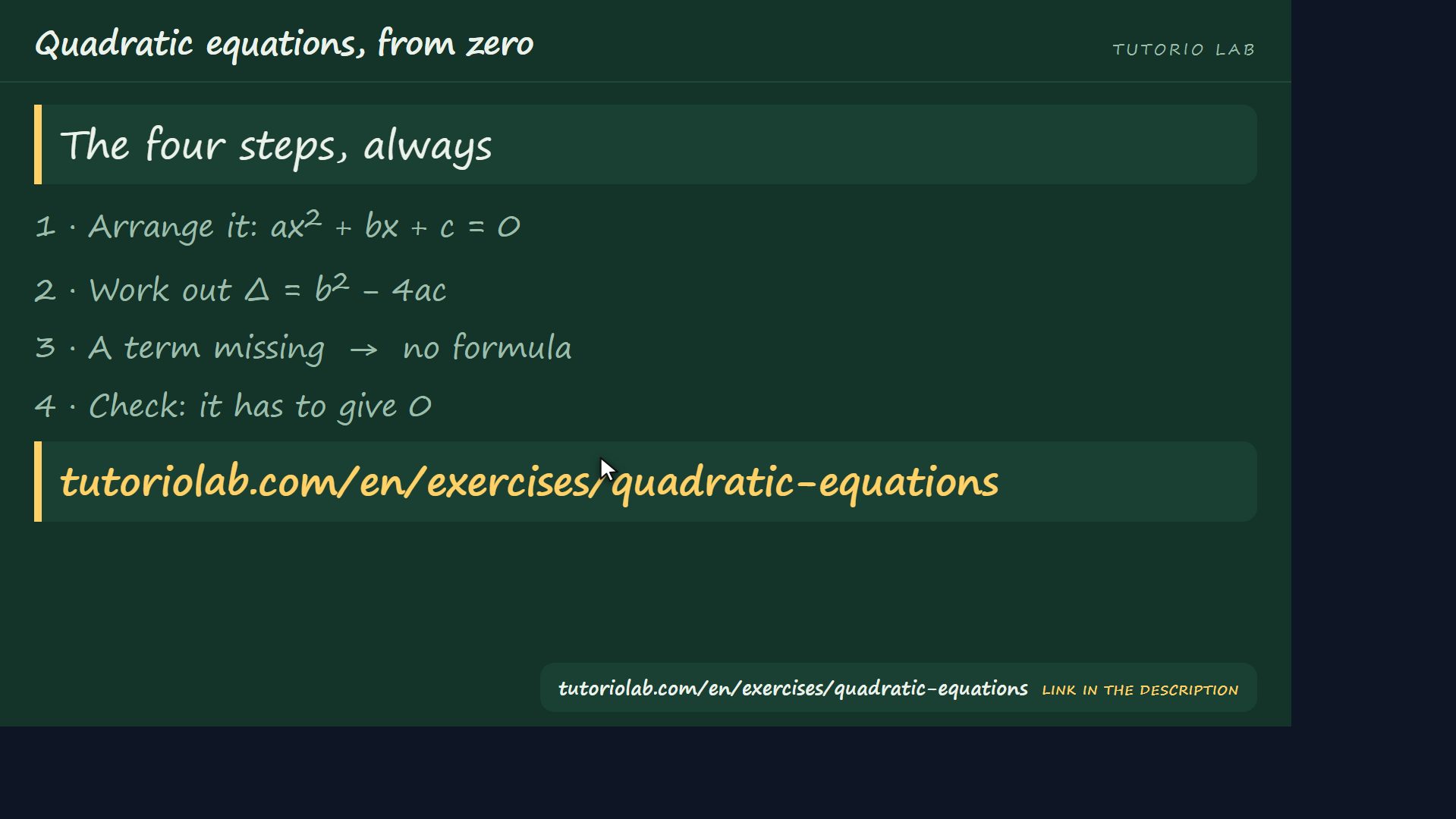
Let us go over the four steps, which are always going to be the same. One: arrange the equation leaving the zero on the right, and write down the three letters with their signs attached. Two: work out the discriminant, b squared minus four a c, and look at its sign to know how many solutions you are going to have. Three: if the equation is missing a term, do not use the formula, take a common factor or isolate directly, which is considerably faster. And four: always check by putting your solution into the equation, which has to give you zero. Practise it at tutoriolab.com, slash e n, slash exercises, slash quadratic equations.
If this helped, subscribe.

Common questions
What is the quadratic formula?
x = (−b ± √(b² − 4ac)) ÷ 2a. It works for every second degree equation once it is arranged as ax² + bx + c = 0. The ± is an instruction: the calculation is done twice, once adding and once subtracting, which is why two solutions come out.
What are a, b and c?
They are the numbers you are given, not unknowns. In x² − 5x + 6 = 0: a = 1 (there is no number in front of x², and no number means a one), b = −5 with its minus attached, and c = 6. The sign always travels with the number.
What does the discriminant tell you?
How many solutions there are, before you calculate them. Δ = b² − 4ac: if it is positive there are two, if it is exactly zero there is one repeated, and if it is negative there are none real, because no number squared gives a negative.
What do you do if the equation is incomplete?
The formula is unnecessary. With no c, take the x out as a common factor: 2x² − 8x = 0 → 2x(x − 4) = 0 → x = 0 and x = 4. With no b, isolate and take the root: 2x² − 18 = 0 → x² = 9 → x = 3 and x = −3. Both are faster than the formula.
How do I know which solution to keep in a word problem?
The one that makes sense. A side of a rectangle cannot be −8 metres, so that solution is discarded. And read the question again before answering: in the 40 m² problem the 8 is correct but it is the length, while what was asked for was the width, 5.
Are there exercises to practise?
Yes, and they are free: tutoriolab.com/en/exercises/quadratic-equations. You get new equations every time — complete ones, incomplete ones and the discriminant — and when you get one wrong it tells you which mistake you made and shows you the worked calculation.