
LCM and GCF: which one are they asking for
The greatest common factor is the biggest number that fits exactly into both; the lowest common multiple is the smallest that contains both. With 12 and 18: GCF 6 and LCM 36. With prime factors (12 = 2²·3 and 18 = 2·3²), the GCF takes the shared factors with the smaller exponent and the LCM takes them all with the larger one, and the same 6 and 36 come out. Check: GCF × LCM = the two numbers multiplied (6 × 36 = 12 × 18 = 216). To know which one a problem is asking for: if the answer has to be bigger, it is the LCM; if smaller, the GCF.
LCM and GCF. And above all, which of the two they are asking you for.

Exercise 1: the GCF of 12 and 18
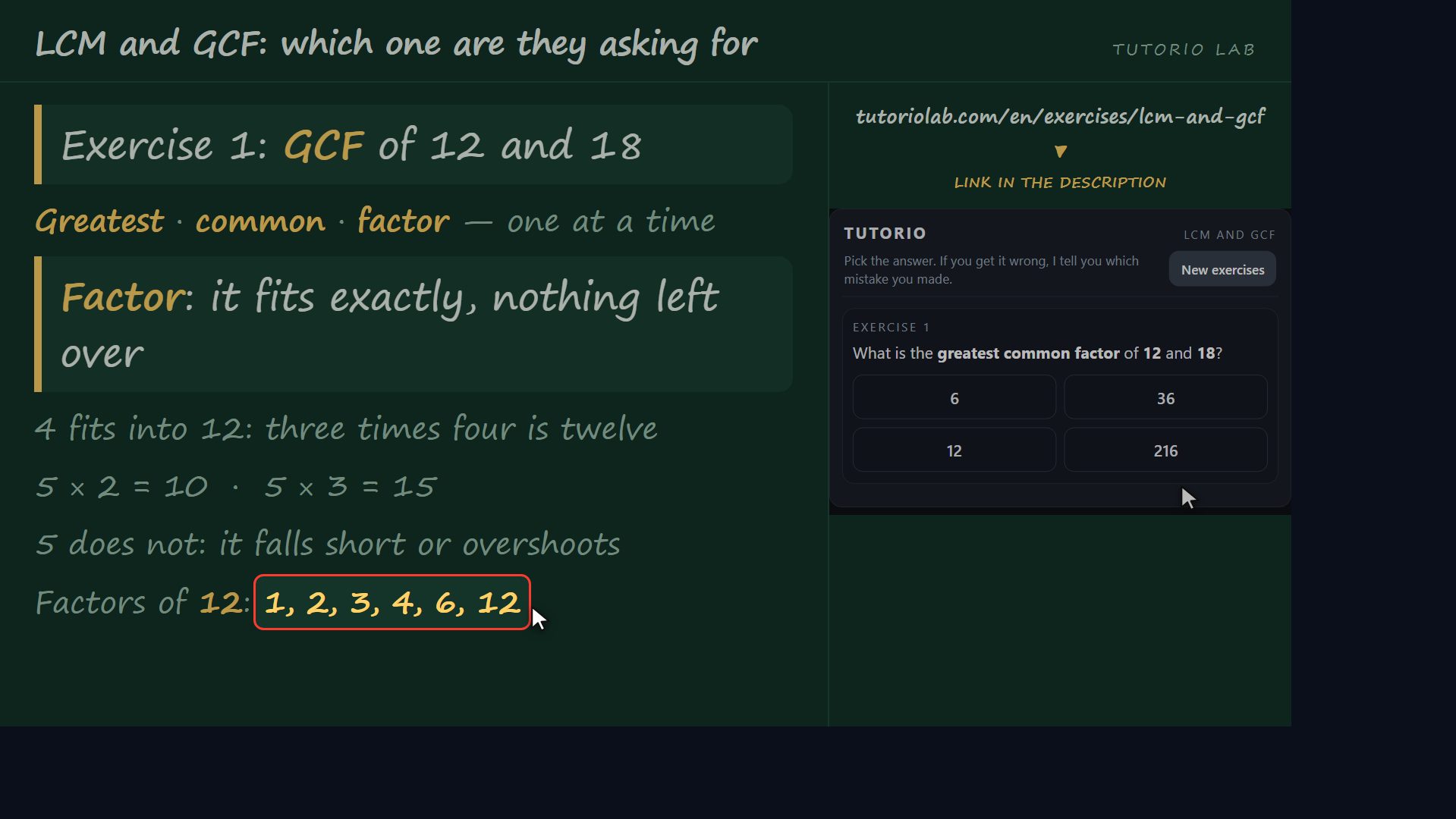
We start with an exercise, not with theory. On your right you have the tool we are going to work with all video, and it asks us for the greatest common factor of twelve and eighteen. Let us take it in parts, and start with the middle word. A factor of a number is another number that fits into it exactly, with nothing left over. Four is a factor of twelve, because three times four is twelve, exactly. Five is not, because two times five is ten and three times five is fifteen: it falls short or it overshoots. So the factors of twelve are these six: one, two, three, four, six and twelve. And those of eighteen are these: one, two, three, six, nine and eighteen. Notice that the four is not here, because four does not fit exactly into eighteen. Now the word common, which means it is in both lists. Look: the one is in both. The two, as well. The three, as well. And the six, as well. The four is not, because it is only above. The nine is not either, because it is only below. And finally, greatest: the biggest of those four. The six. Greatest common factor of twelve and eighteen, six. And what matters is not the six: it is that the name was telling you what to do at every step.
Exercise 2: the LCM of 12 and 18
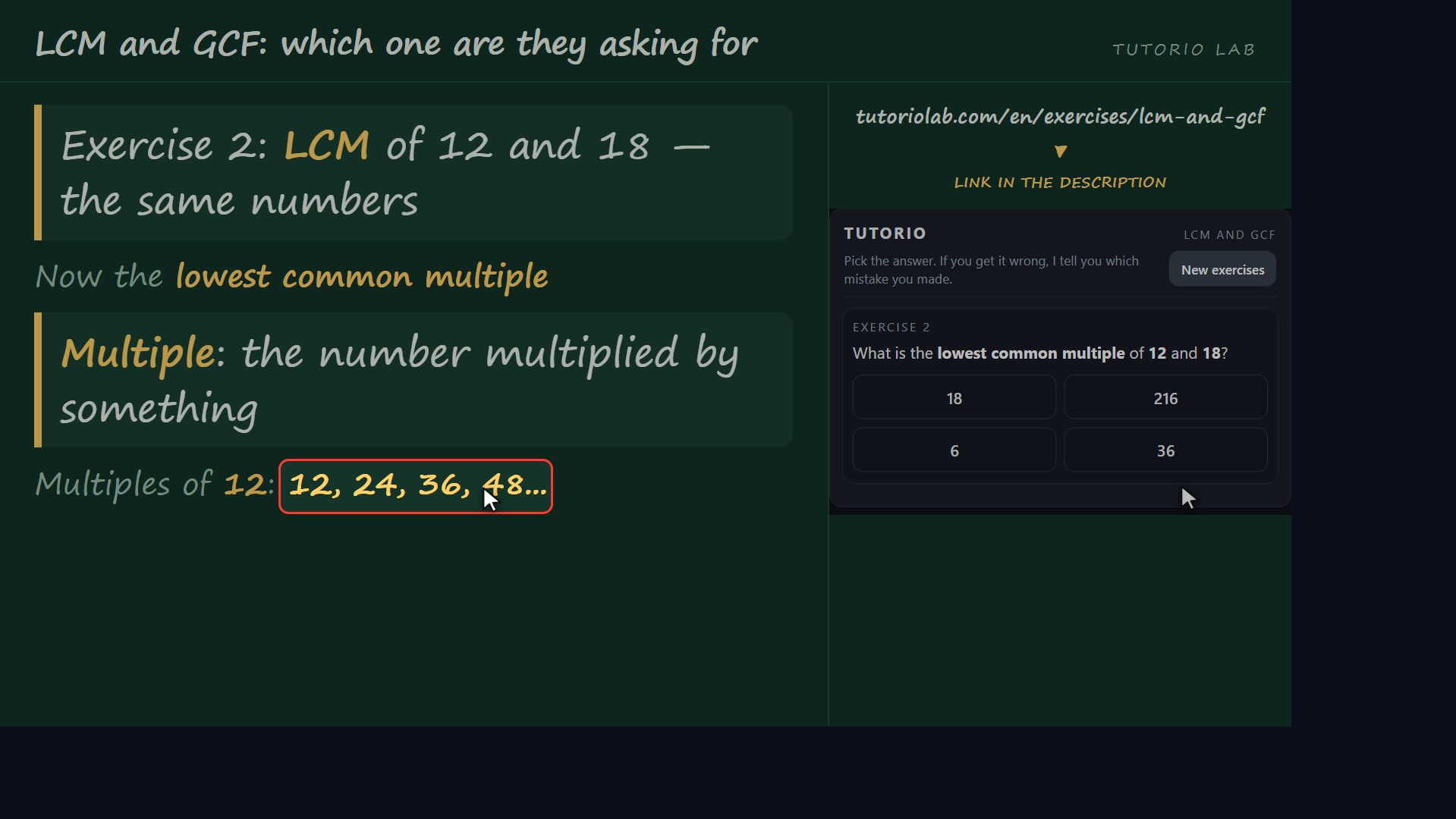
Second exercise, and pay attention because they are exactly the same two numbers: now they ask us for the lowest common multiple of twelve and eighteen. In parts again. A multiple of a number is that number multiplied by something: by one, by two, by three, by whatever. The multiples of twelve are twelve, twenty-four, thirty-six, forty-eight, and they go on for ever. Those of eighteen are eighteen, thirty-six, fifty-four, and they go on for ever too. Common, the same as before: the one that is in both lists. And there it is, the thirty-six, which appears above and appears below. And lowest means the smallest of the common ones. If we kept writing we would find seventy-two, which is also in both, and a hundred and eight; but the first one to appear is thirty-six. Now stop for a second and look at what has just happened. The same two numbers. Two different questions. Six and thirty-six. And there is a reason for one being small and the other big: the factor has to fit inside them, so it cannot overshoot. The multiple has to contain them, so it cannot fall short. If you take a single idea away from this video, let it be that one.
Practise it yourself
And one moment before we go on. That tool you can see on the right is ours and it is free: tutoriolab.com, slash e n, slash exercises, slash l c m and g c f. Use it. There is no way this will stick better than by practising it, because reading it gets forgotten and doing it does not. And every time you go in you get different exercises.

Why counting does not always work
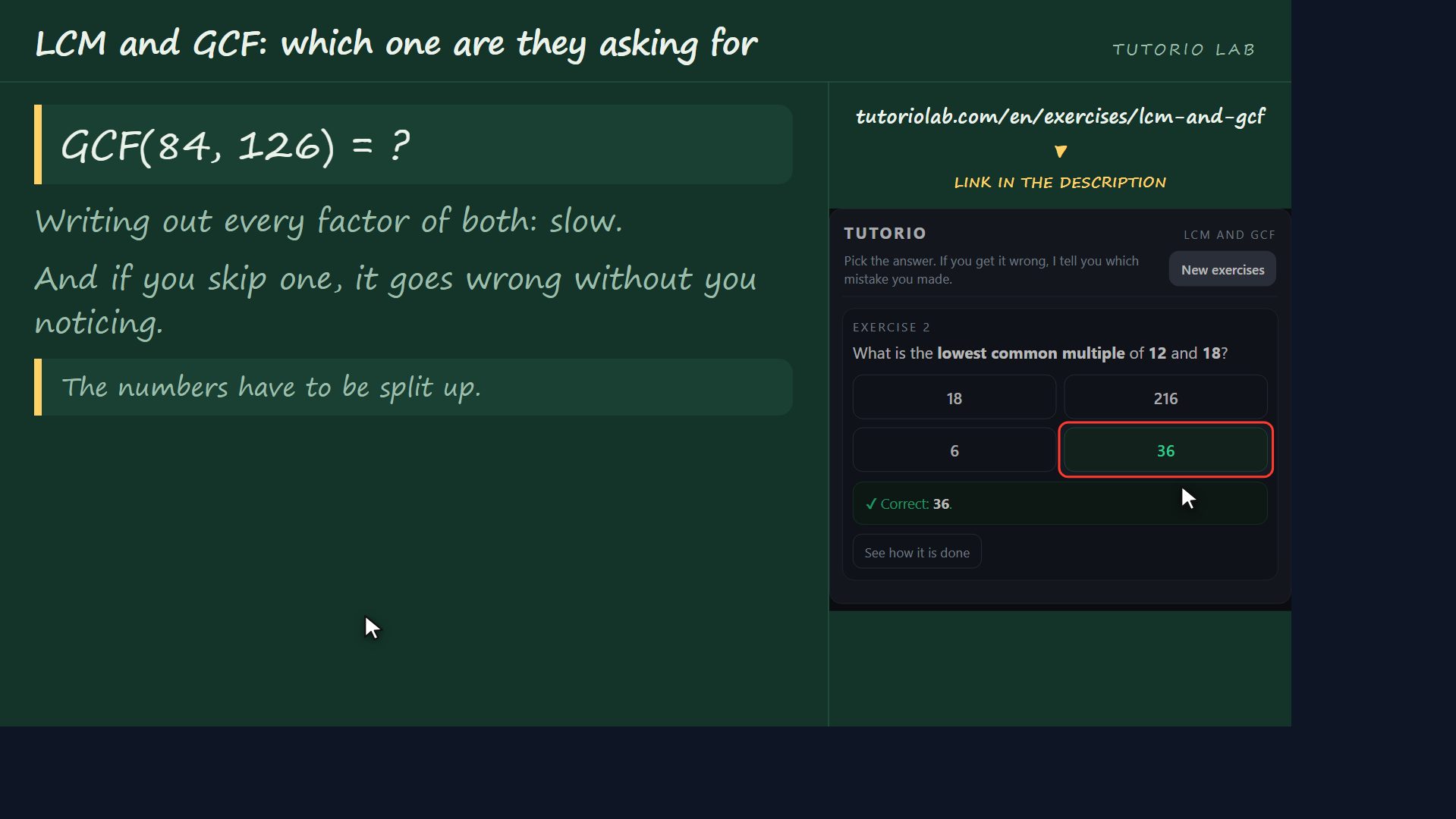
With twelve and eighteen, counting works. Try doing it with eighty-four and a hundred and twenty-six and you will see the problem: writing out every factor of both takes quite a while, and you only have to skip one for the answer to come out wrong without you noticing. A method is needed that does not depend on writing whole lists. And there is one, but first you have to learn to split the numbers.
Splitting the numbers
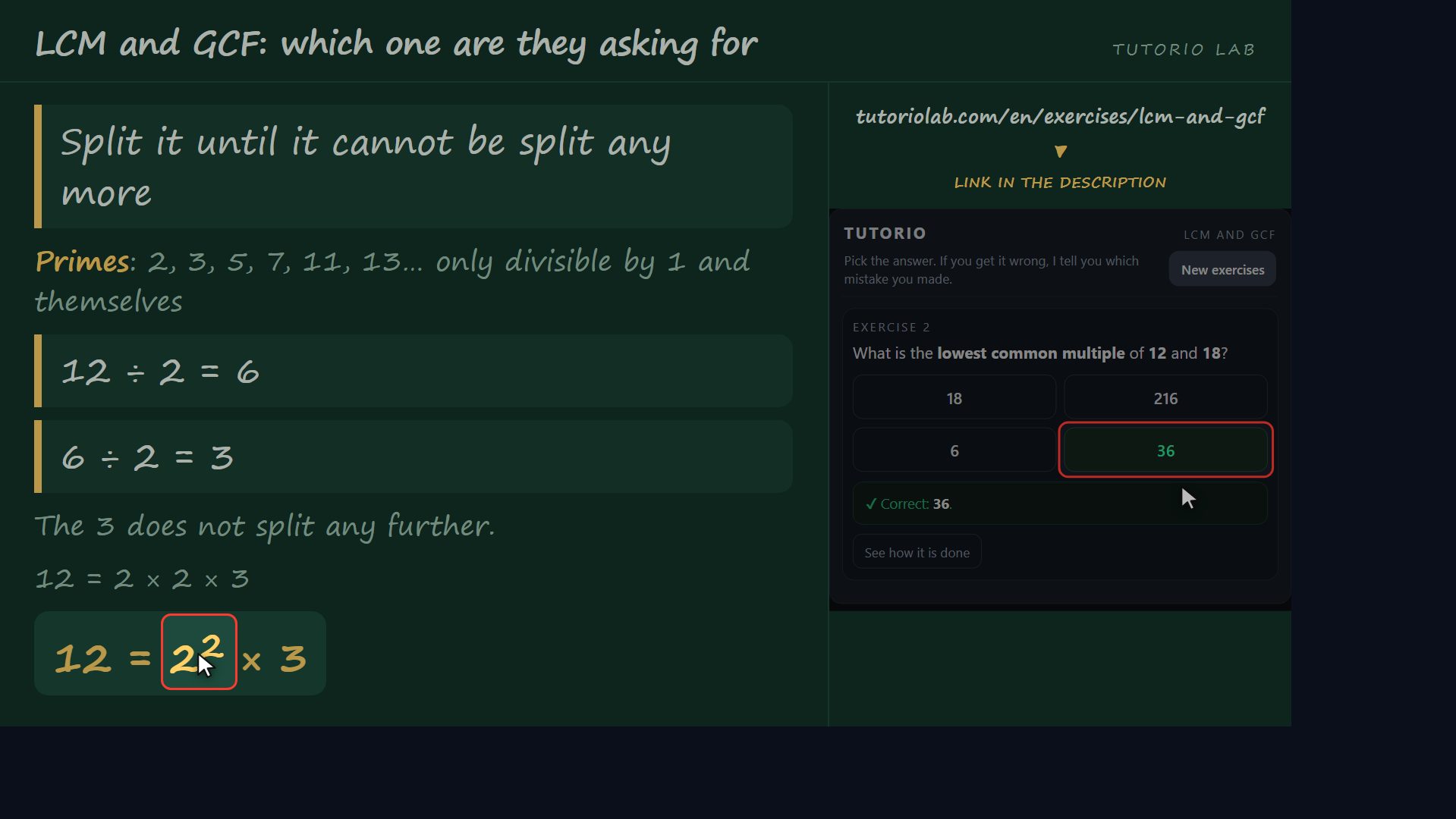
Splitting a number into prime factors sounds much worse than it is: it is writing it as a multiplication of numbers that can no longer be split. Let us do the twelve. Can it be divided by two? Yes: six. And the six by two? Yes: three. And the three? No longer, because the three can only be divided by one and by itself. So twelve is two, times two, times three. And when a number repeats it is written short, with a little number on top that is called an exponent: two squared, times three. That little two on top is not another two that multiplies: it is the count of how many times the two is there. Now let us do the eighteen. Eighteen by two, nine. The nine can no longer be divided by two, but it can by three: it gives three. And three by three, one. So eighteen is two, times three, times three: two, times three squared. Here the one that repeats is the three. And this is the nice part: every number splits in one single possible way, there are not two ways. That is why that breakdown is its fingerprint.
The GCF rule
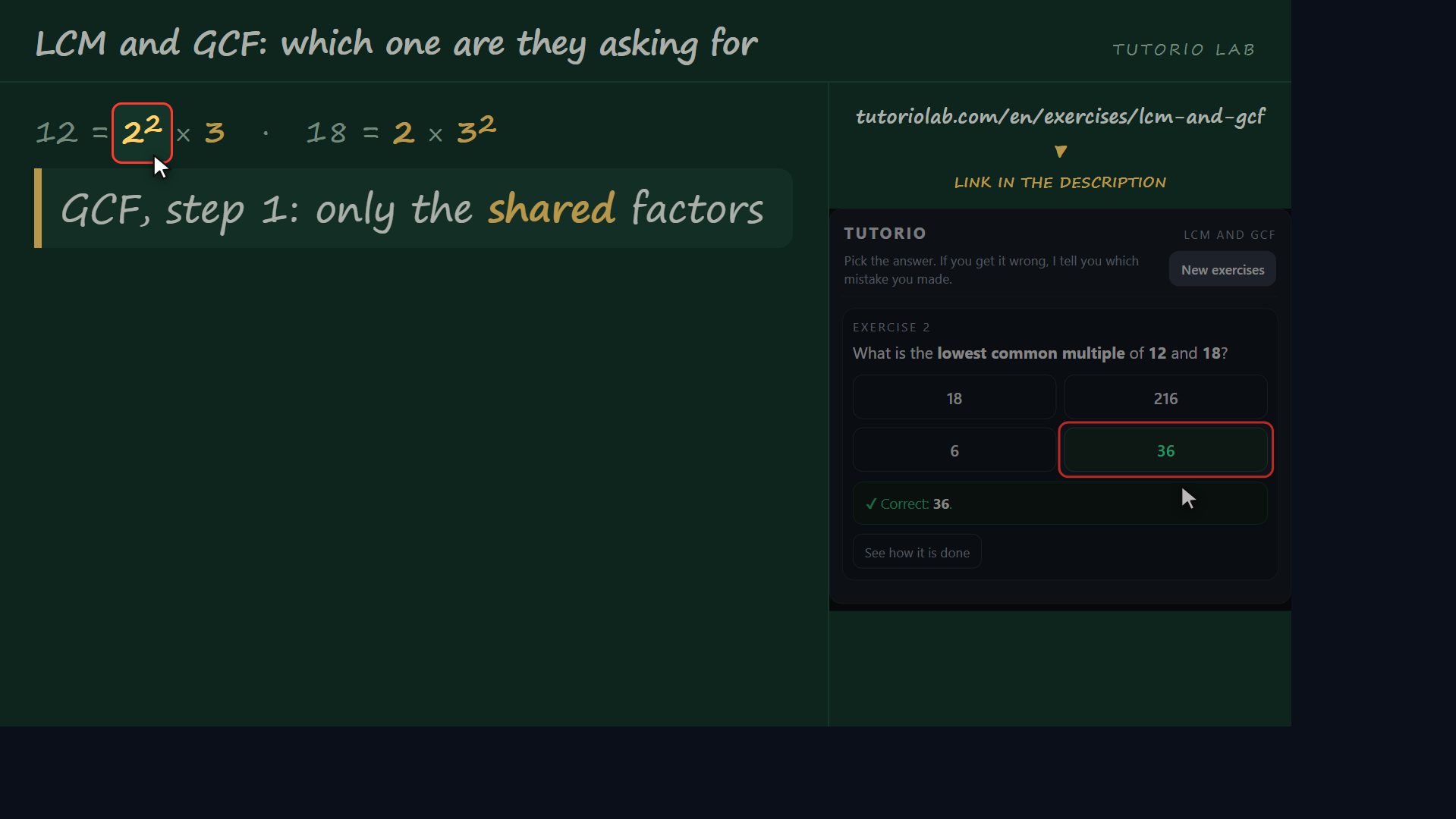
With the two fingerprints in front of us, the greatest common factor comes out in two steps. Step one: you take only the factors that are in both. The two is in both. The three is in both. Step two: of each one, the smallest exponent. The two is squared in the twelve and is on its own in the eighteen, so I keep the small one: one two. The three is on its own in the twelve and squared in the eighteen, so I keep the small one again: one three. Two times three, six. And look carefully at that six: it is exactly the same one that came out two minutes ago counting factors by hand. The fast method and the slow one give the same, and that is why you can trust it. And the reason for the small exponent is this: the greatest common factor has to fit inside both numbers. If I took two squared, it would not fit in the eighteen, which only has one two. You cannot spend more than what the poorest one has.
The LCM rule
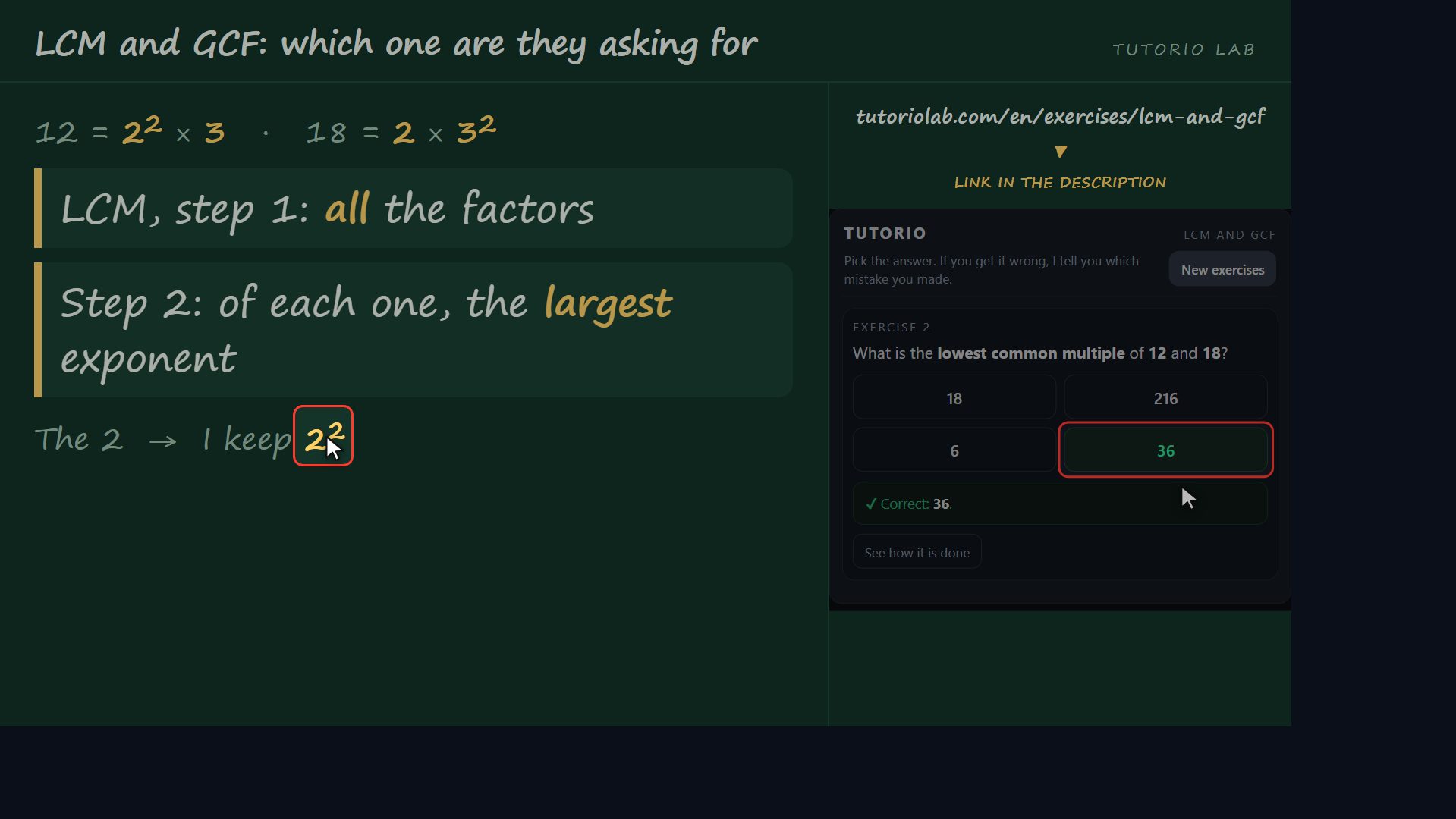
The lowest common multiple is the same rule the other way round. Step one: you take all the factors, whether they are in both fingerprints or in only one. Step two: of each one, the largest exponent. The two is squared in the twelve and on its own in the eighteen: I keep the squared one. The three is on its own in the twelve and squared in the eighteen: I keep the squared one. Two squared times three squared: four times nine, thirty-six. And again the same: thirty-six is exactly what came out writing multiples by hand. And the reason for the large exponent: the multiple has to contain both numbers whole. If I took only one three, the eighteen would not fit inside, because the eighteen needs two threes to exist. There is the whole difference between the two rules: in the factor the poor one rules, in the multiple the rich one rules.
The check
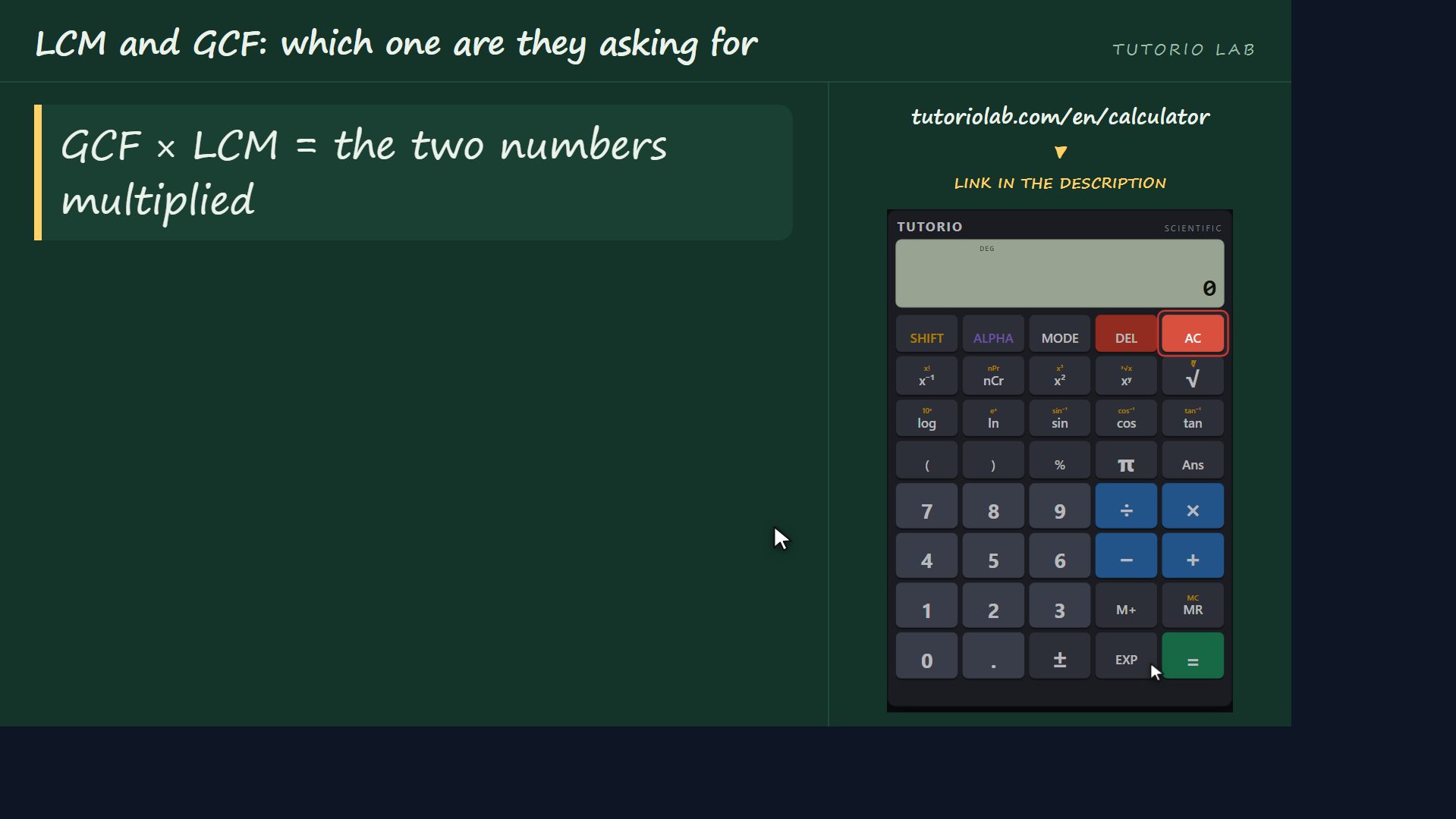
And there is a lovely check that almost nobody teaches. The greatest common factor multiplied by the lowest common multiple has to give exactly the same as multiplying the two starting numbers. Let us go to the calculator and see it with ours. First the six times the thirty-six, which are the factor and the multiple we have just got with prime factors. And it gives two hundred and sixteen. Now the two starting numbers, the twelve and the eighteen, multiplied one by the other, to see what comes out. And it gives two hundred and sixteen again. It matches. And it is no coincidence: between them they share out exactly the same factors, one keeps the small exponents and the other with the large ones, so multiplying them brings everything back. If those two numbers did not come out the same, one of the two you have worked out is wrong, and you know it before handing anything in.
Exercise 3: the GCF of 24 and 36
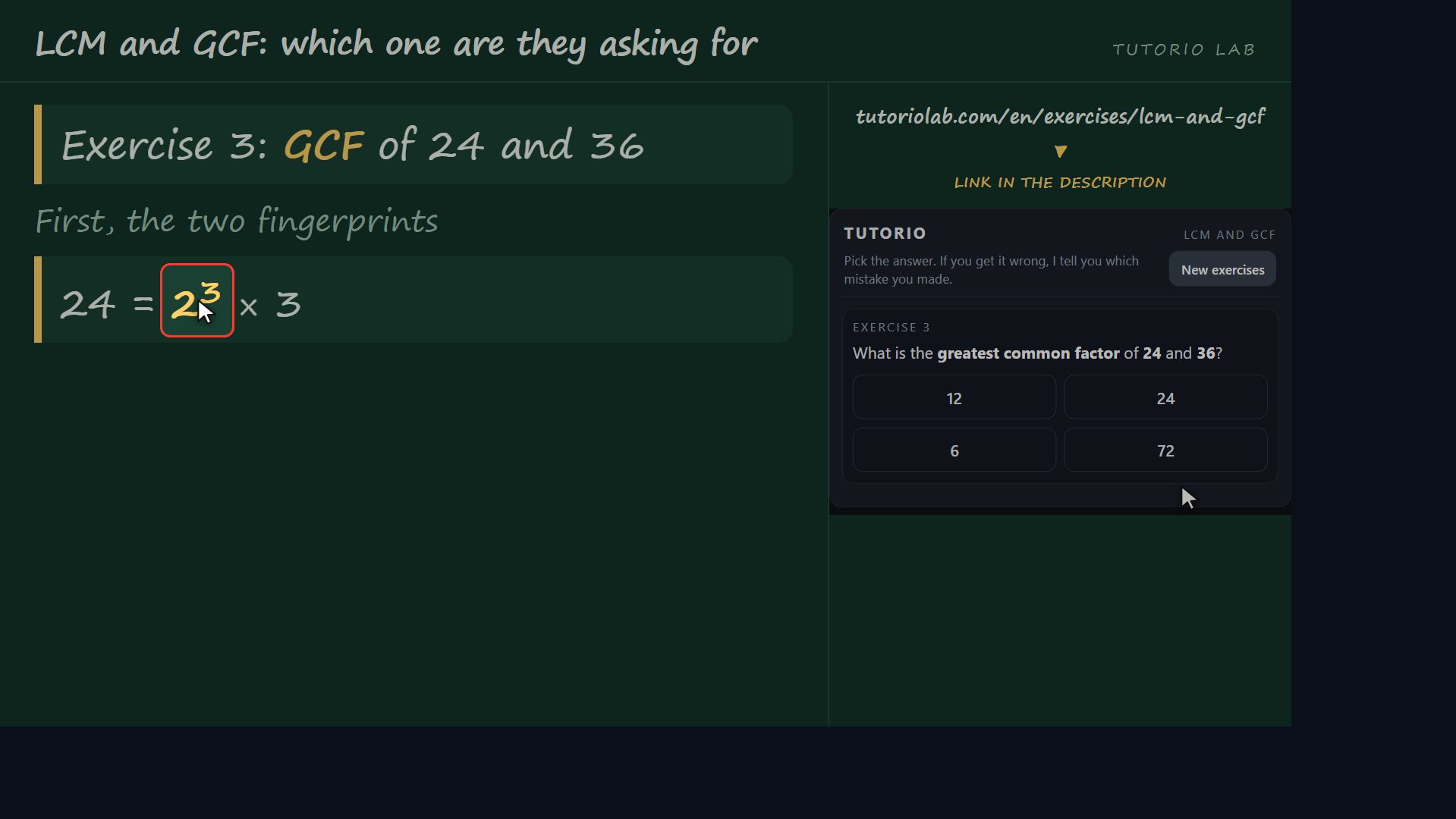
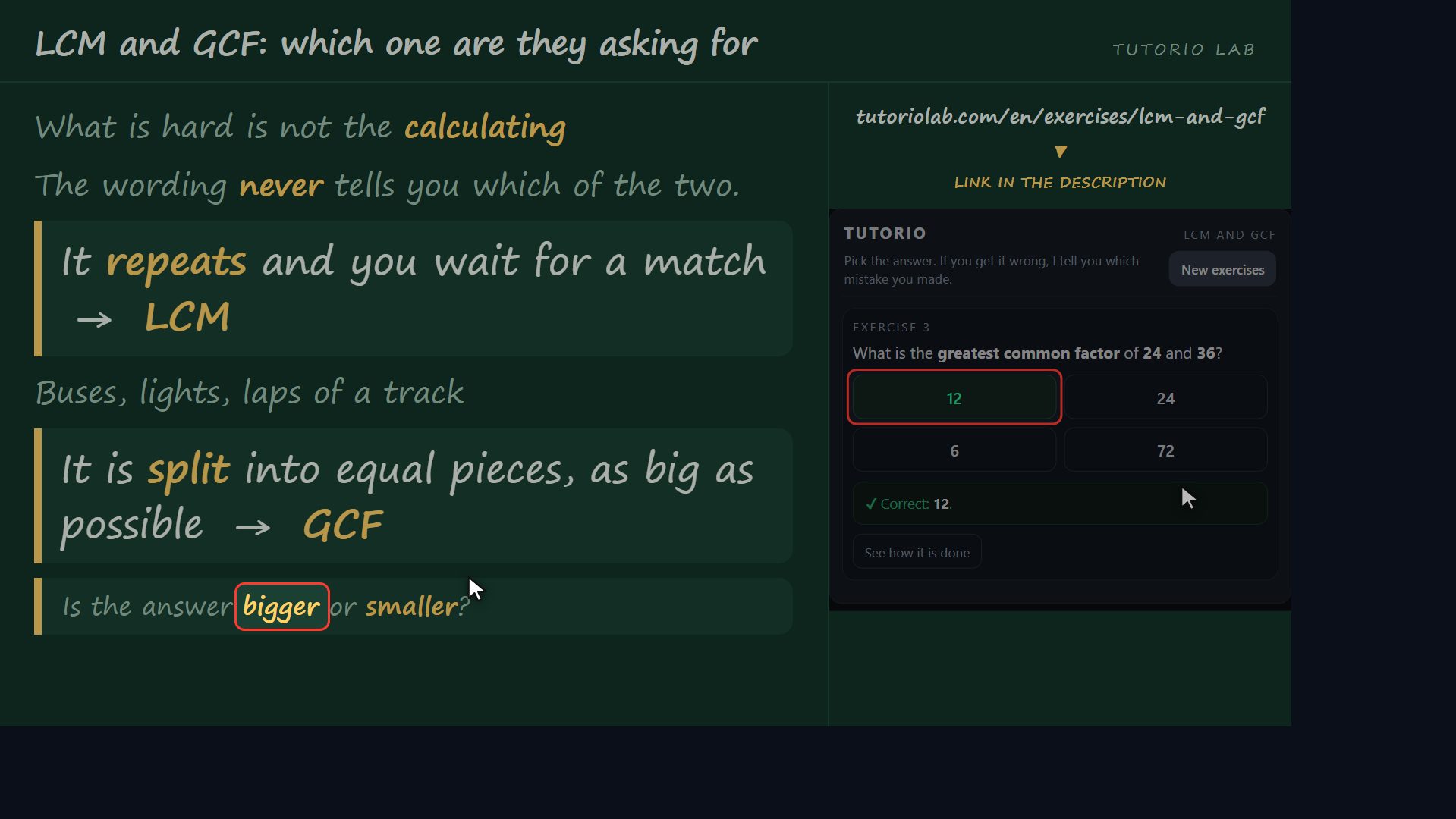
Third exercise, with other numbers and now with the fast method, so that you see that you can do it. They ask us for the greatest common factor of twenty-four and thirty-six. First the fingerprints. Twenty-four: by two, twelve; by two, six; by two, three. Three twos and a three: two cubed times three. Thirty-six: by two, eighteen; by two, nine; the nine by three, three; and three by three, one. Two squared times three squared. And now the factor rule: only the shared ones, with the smallest exponent. The two is cubed and squared: I keep the squared one. The three is alone and squared: I keep the lone one. Two squared times three, four times three, twelve. And check it in your head, which takes a second: twelve fits into twenty-four exactly twice, and into thirty-six, exactly three times. And no number bigger than twelve manages it.
Which one are they asking for
And now what really costs, which is not calculating. It is reading a problem and knowing which of the two it is asking you for, because the wording never says it in those words. The rule is short. If there is something that repeats and you have to wait for things to coincide, it is the lowest common multiple: buses that come, lights that flash, laps of a track. If there is something that is split into equal pieces and as big as possible, it is the greatest common factor: cutting a ribbon, sharing into bags, making groups. And there is a trick for checking it without remembering the rule: ask yourself whether the answer has to come out smaller or bigger than the numbers in the problem. If it has to come out smaller than the numbers, it is a factor. If it has to be bigger, it is a multiple.
Exercise 4: the most common mistake
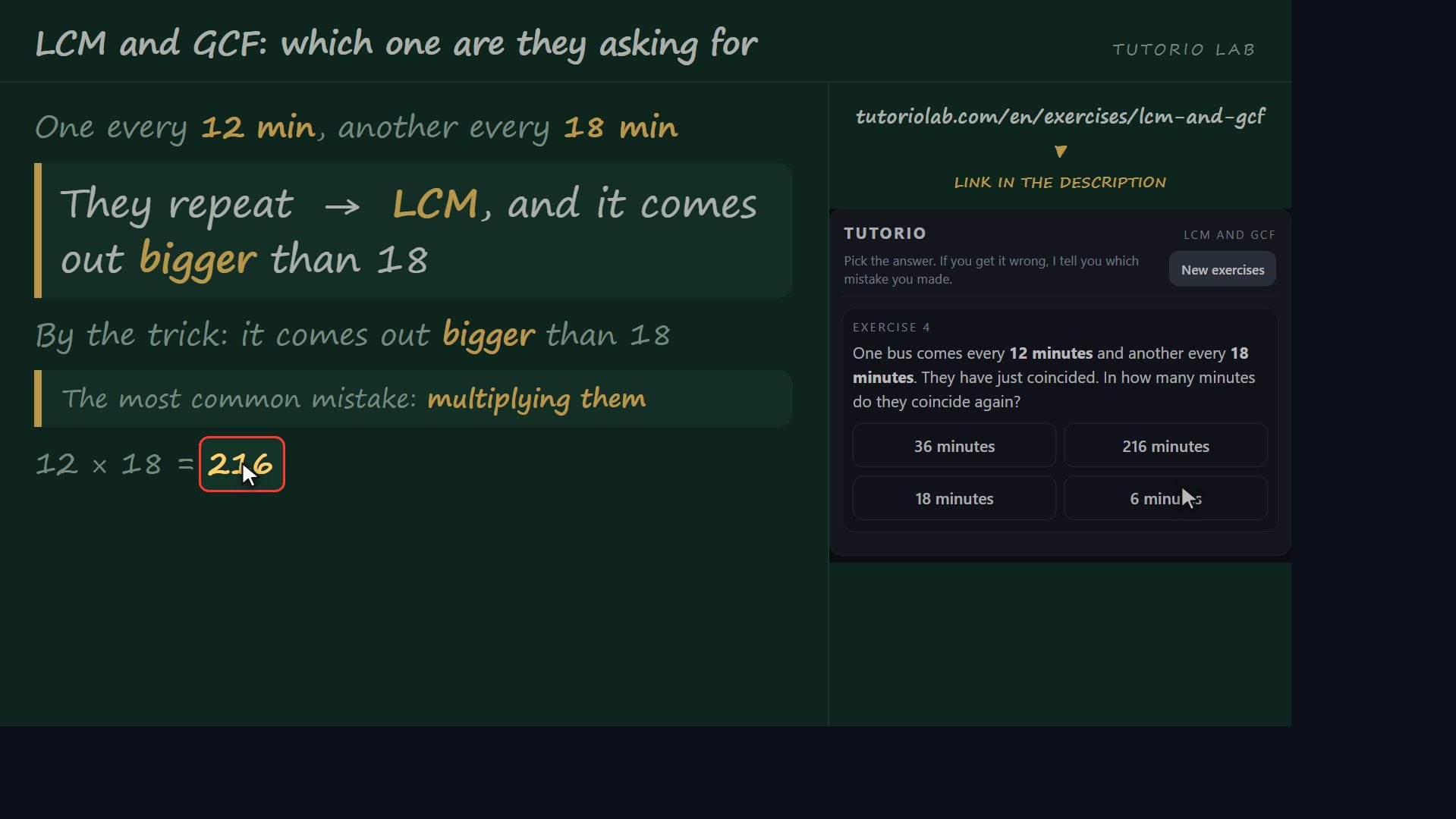
Fourth and last, and I am going to do it wrong on purpose. One bus comes every twelve minutes and another every eighteen, and they have just coincided at the stop. When do they coincide again? They repeat and we are waiting for them to meet, so it is the lowest common multiple. And by the trick from before: the answer has to be bigger than eighteen, because we have to wait. Now, the most common mistake of all: multiplying them. Twelve times eighteen, two hundred and sixteen. I pick it. And look what it answers: that two hundred and sixteen is indeed a multiple of both, but that it is not the lowest, because they coincide much sooner. It does not say incorrect and leave me where I was: it tells me what I did wrong. The answer is thirty-six, which we had already worked out. And check it: thirty-six over twelve is three whole trips of the first, and thirty-six over eighteen is two whole trips of the second. Both arrive exactly, with no decimals. That is coinciding.
Review
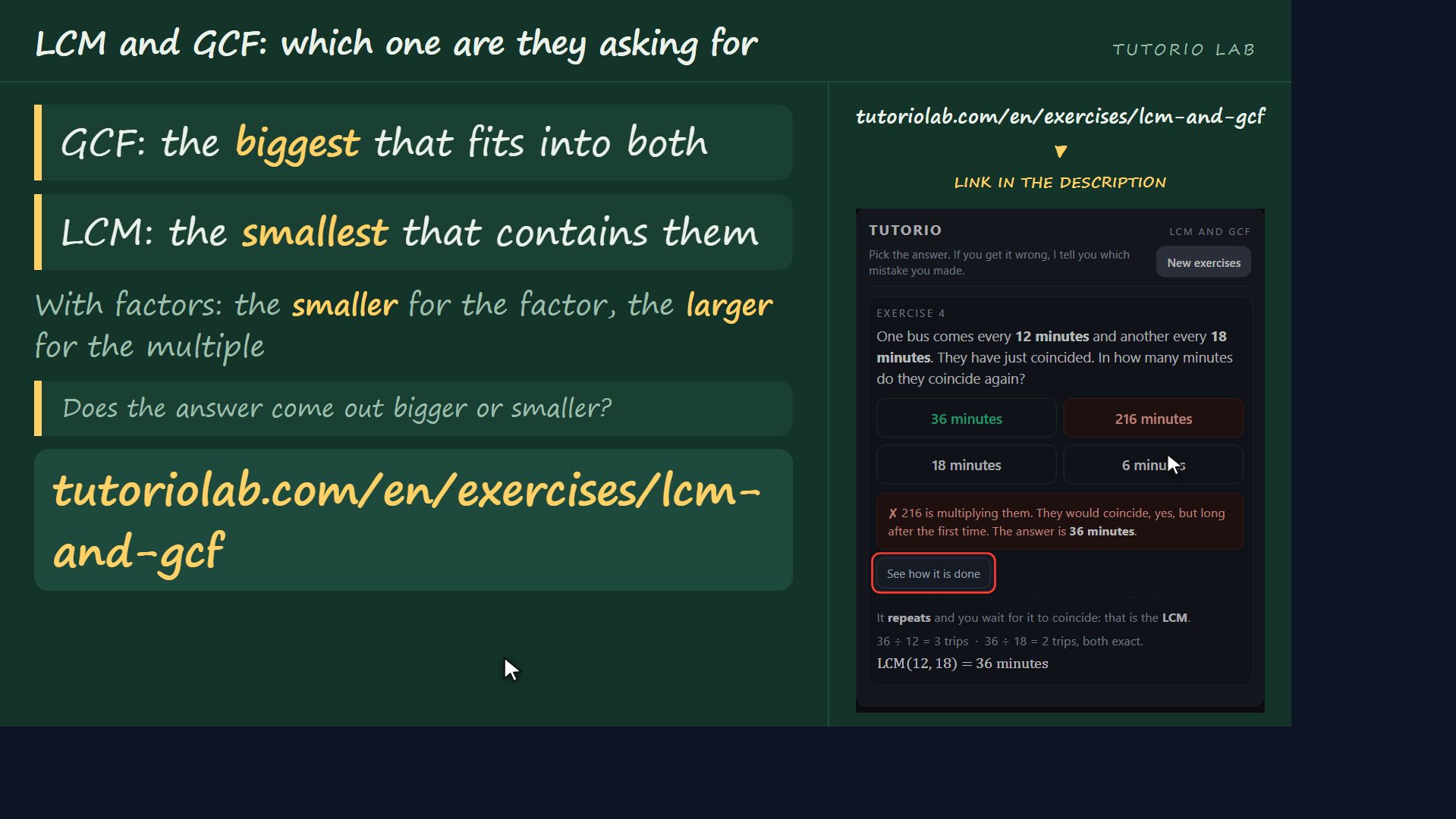
Let us review. Factor: it fits inside, and the greatest common factor is the biggest that fits into both. Multiple: it contains them, and the lowest common multiple is the smallest that contains both of them. With prime factors, the factor takes the shared ones with the small exponent and the multiple takes them all with the large one. And to know which one you are being asked for, ask yourself whether the answer comes out bigger or smaller. Practise it at tutoriolab.com, slash e n, slash exercises, slash l c m and g c f: they come out different every time and they tell you which mistake you made.
If this helped, subscribe.

Common questions
What is the difference between LCM and GCF?
The GCF fits INSIDE both numbers, so it is small; the LCM CONTAINS both, so it is big. With 12 and 18 the GCF is 6 and the LCM is 36 — the same two numbers, two different questions.
How do you work them out with prime factors?
Split both numbers (12 = 2²·3, 18 = 2·3²). For the GCF take only the shared factors, each with the smaller exponent: 2·3 = 6. For the LCM take all the factors, each with the larger exponent: 2²·3² = 36.
Why does the GCF take the smaller exponent?
Because it has to fit inside both numbers. If you took 2² it would not fit in 18, which only has one 2. You cannot spend more than the poorest one has. The LCM is the opposite: it has to contain them, so the richest one rules.
How do I know which one a problem is asking for?
If something repeats and you wait for it to coincide — buses, lights, laps — it is the LCM. If something is split into equal pieces as big as possible — ribbon, bags, groups — it is the GCF. The quick trick: if the answer has to be bigger than the numbers it is a multiple, if smaller, a factor.
How can I check my answer?
GCF × LCM has to equal the two numbers multiplied. With 12 and 18: 6 × 36 = 216 and 12 × 18 = 216. If those two do not match, one of the two you worked out is wrong, and you know it before handing anything in.
Are there exercises to practise?
Yes, and they are free: tutoriolab.com/en/exercises/lcm-and-gcf. You get new numbers every time — GCF, LCM and word problems — and when you get one wrong it does not say "incorrect": it tells you which mistake you made and shows you the worked calculation.