Decimals: adding and multiplying
Adding and multiplying decimals follow OPPOSITE rules, and mixing them up is the most common mistake. To ADD: line up the decimal points one under the other, pad with zeros so both have the same number of decimals, and add column by column (12.45 + 3.80 = 16.25). To MULTIPLY: do NOT line anything up. Multiply as if there were no points (24 × 15 = 360) and then count how many decimals the two starting numbers had in total; that is how many places the point moves from the right (1 + 1 = 2, so 3.60). To multiply by 10, 100 or 1000, count the zeros and move the point that many places to the right, padding with zeros if digits run out (3.7 × 100 = 370). And adding zeros at the end of a decimal never changes its value.
Decimal numbers: adding and multiplying them, skipping nothing.

What a decimal number is
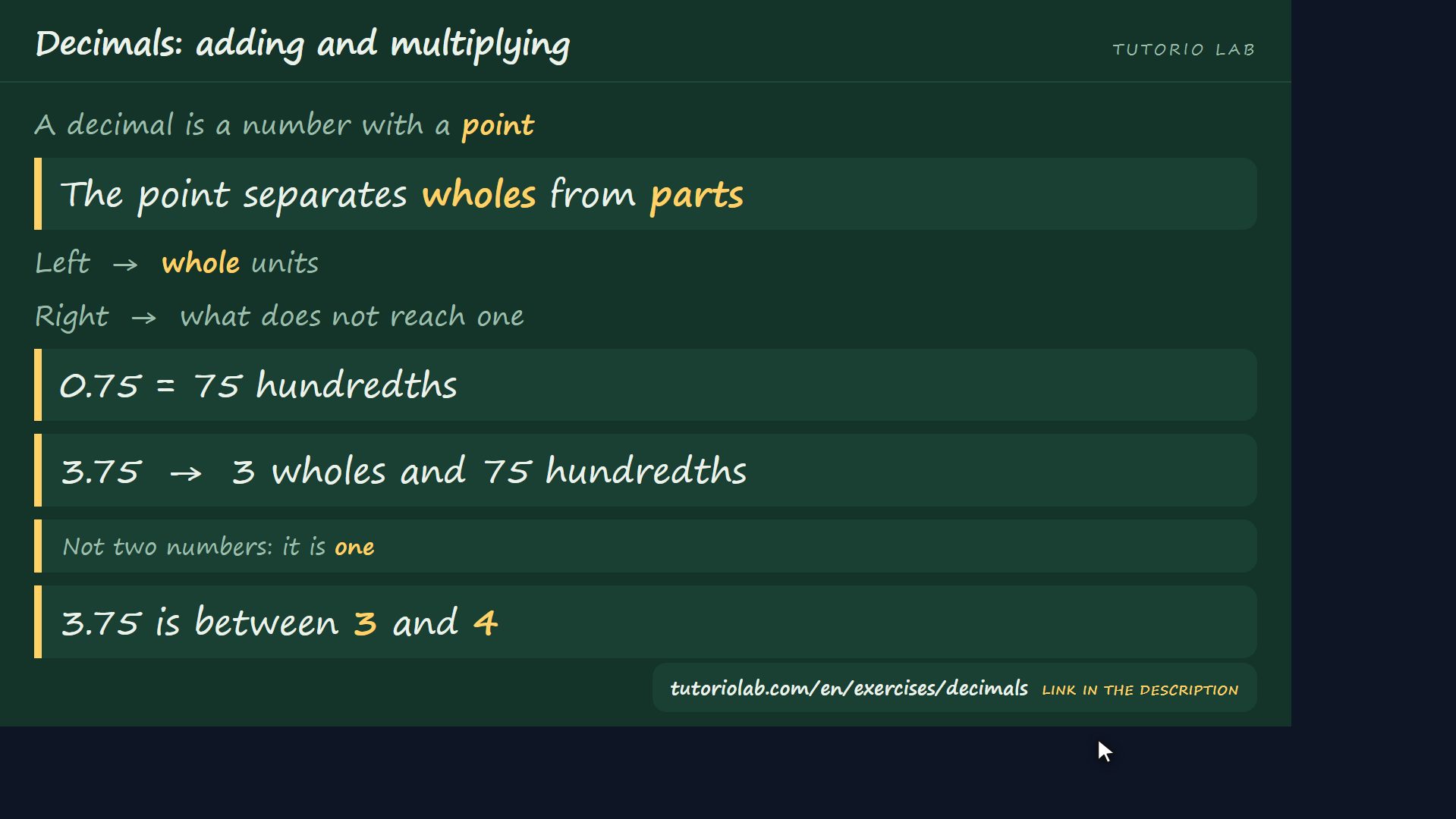
Let us start with the very basics, because I do not want to assume anything. A decimal number is a number that has a point, and that point separates two things: on the left are the whole ones, the complete units, and on the right is what is left over, the part that does not reach a whole unit. For example, three point seven five is three whole units and seventy-five hundredths more. And I want one thing to be clear from the start, because it is the most common misunderstanding: those are not two numbers stuck together. It is a single number, worth a little more than three and a little less than four.
What each place is worth
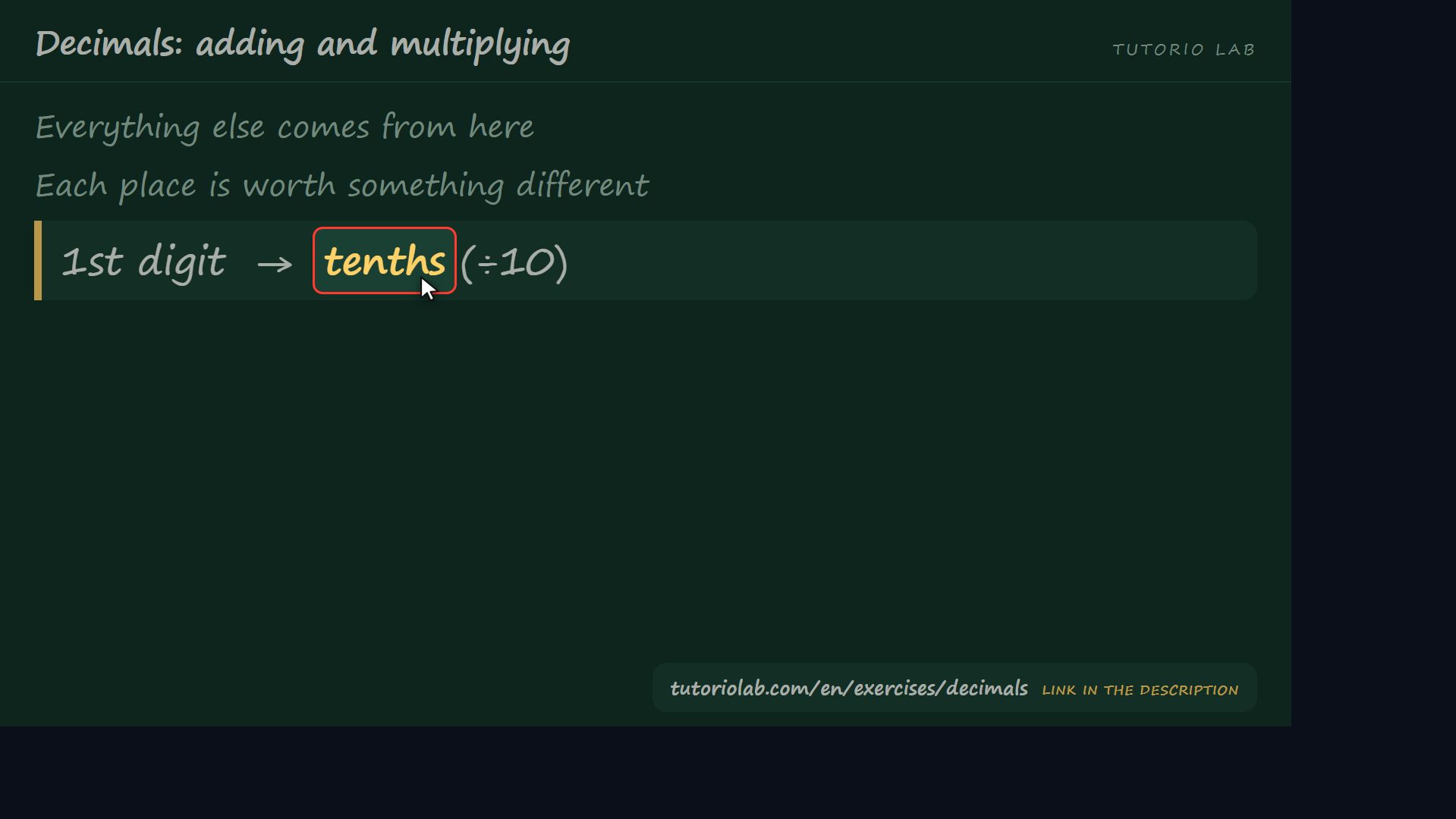
And now what really has to be understood, because everything else comes from here: each place after the point is worth something different. The first digit after the point is the tenths, that is, parts of ten. The second is the hundredths, parts of a hundred. And the third is the thousandths, parts of a thousand. That is why zero point five and zero point zero five are not worth the same, even though both have a five: in the first one the five is five tenths, and in the second it is five hundredths, which is ten times less. And there is a consequence we are going to use a lot: adding zeros at the end, after the last digit, does not change the number. Three point eight is exactly the same as three point eighty.
Adding: line up the points
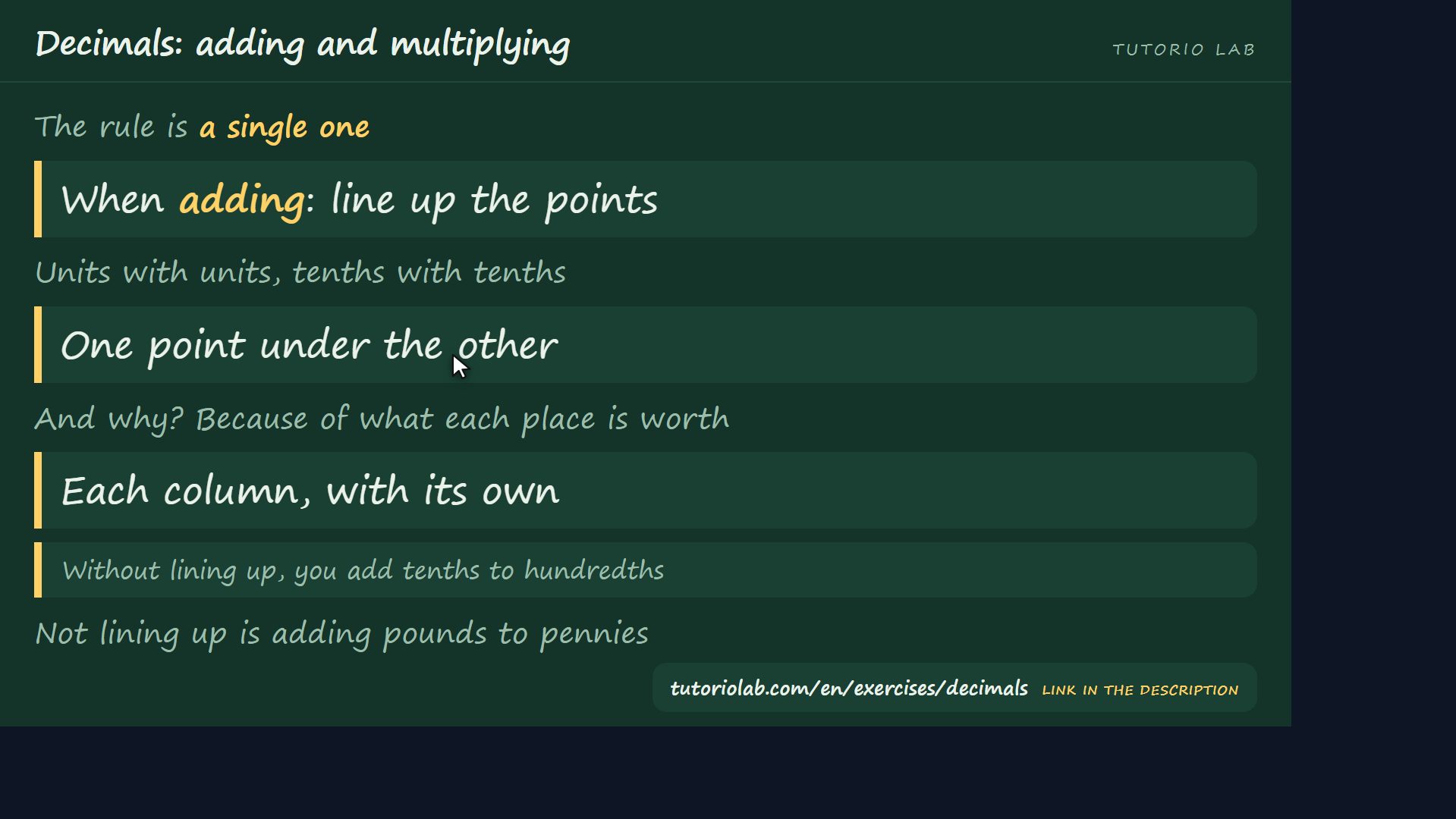
We start with adding, which is what gets searched for most. And the rule is a single one, very short: when adding decimals you line up the points. You put the two numbers one under the other so that the point on top sits right above the point underneath. And why? Well, because of what we have just seen: because that way the units go with the units, the tenths with the tenths and the hundredths with the hundredths. If you do not line them up, you end up adding tenths with hundredths, which is like adding pounds to pennies without noticing.
The addition, step by step
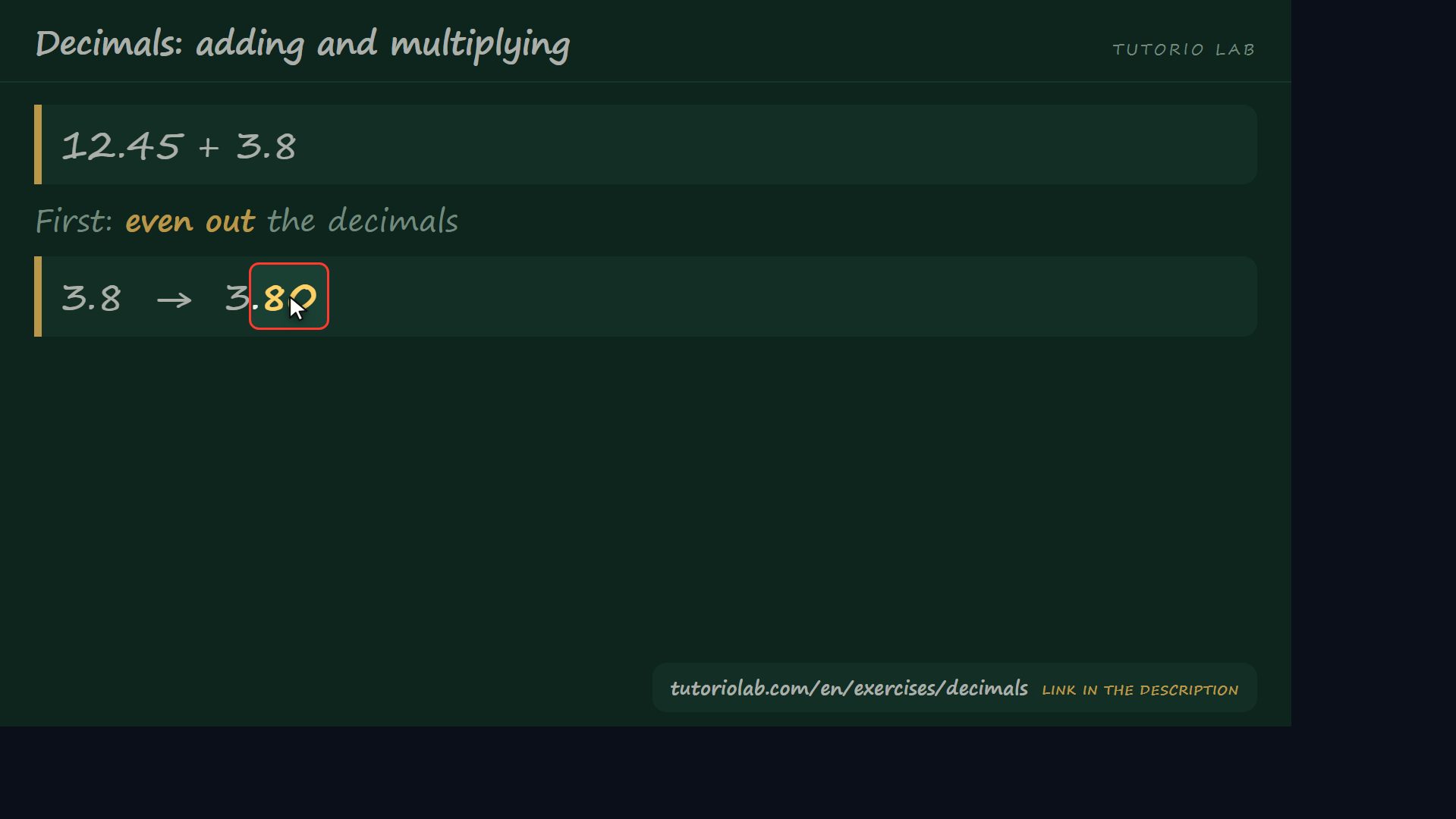
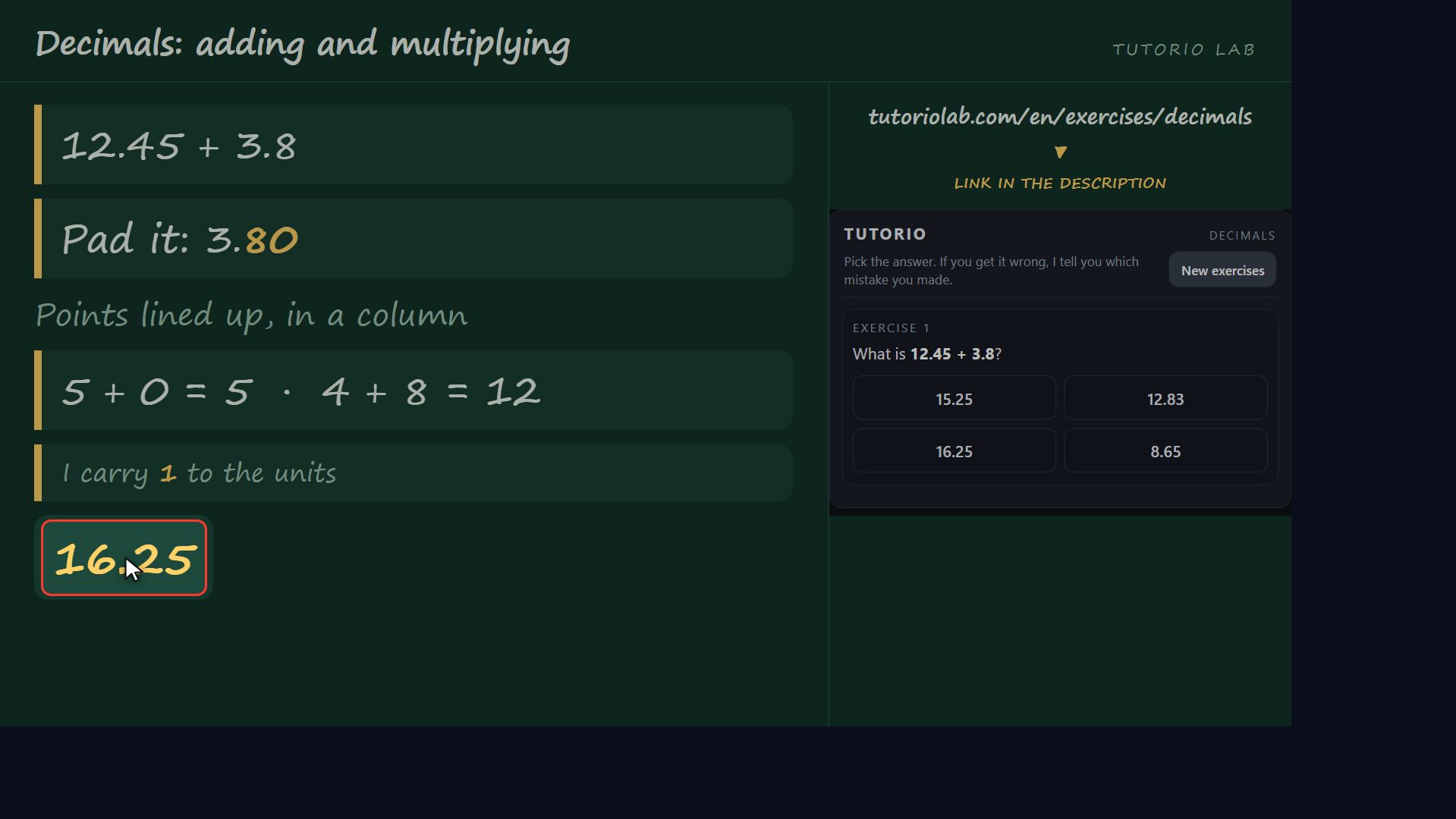
Let us do the example: twelve point four five plus three point eight. The first thing, and this helps a great deal, is to make the number of decimals equal. The first has two and the second has one, so we add a zero at the end of the second one: three point eighty. And we already know that does not change its value. Now we write them one under the other with the points lined up and we add column by column, starting from the right, just like an everyday addition. Five plus zero, five. Four plus eight, twelve: I write two and carry one. Now the units: two plus three is five, plus the one I was carrying, six. And the one from the tens comes down. Sixteen point two five. And the point comes down in its place, in the same column.
Exercise 1, step by step
Let us do the first exercise, and we will do it together on the board before touching anything. It is that same addition: twelve point four five plus three point eight. First we even out the decimals: the three point eight becomes three point eighty. We put them in a column with the points lined up. We add from right to left: five plus zero, five. Four plus eight, twelve, I write the two and carry one. Two plus three, five, plus the one I am carrying, six. And the one comes down. Sixteen point two five. And look at the twelve point eight three trap, which is the best of all: it comes from not lining up the points, from adding the eight with the four as if the eight were hundredths. I mark sixteen point two five.
Practise for free
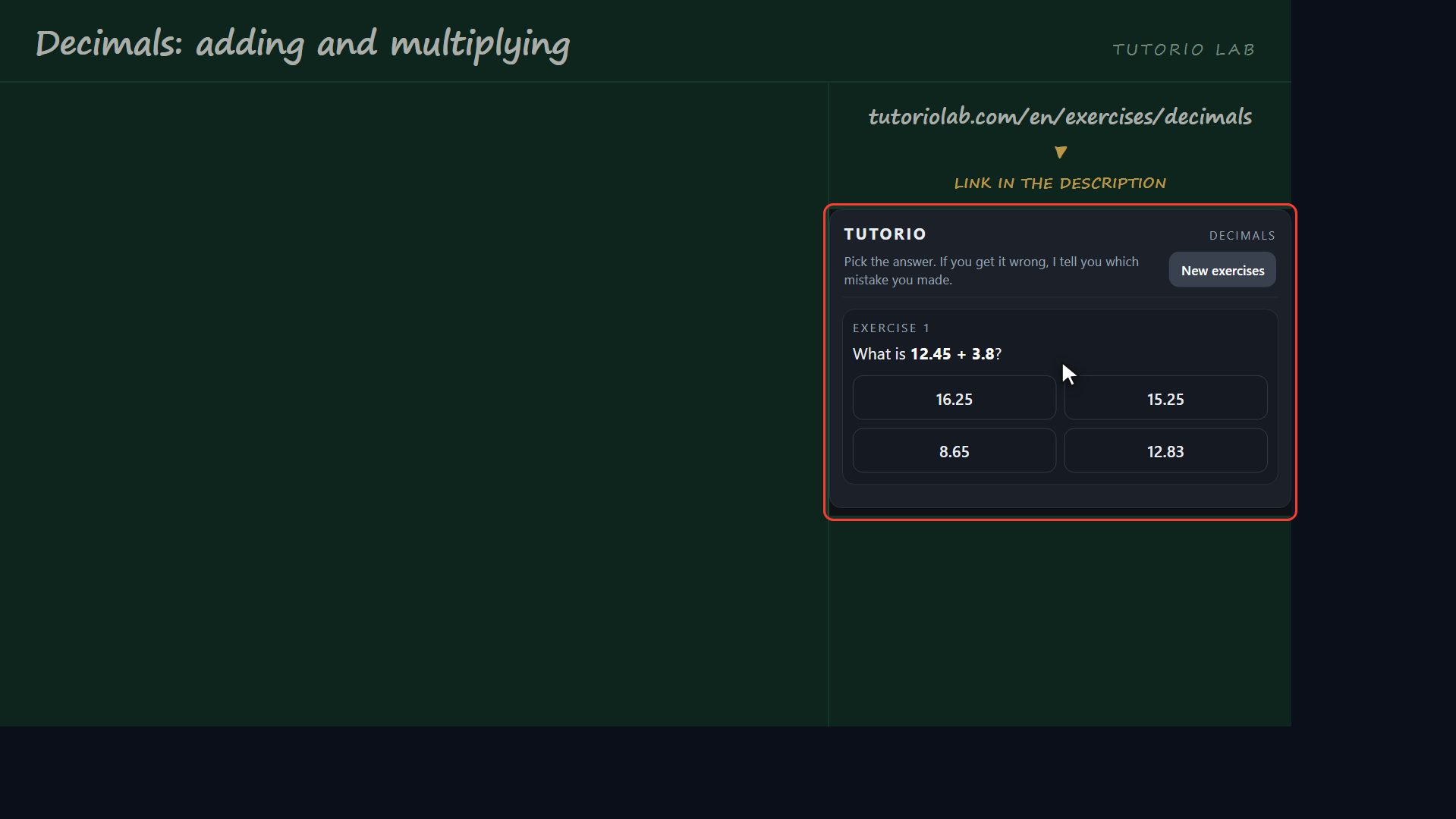
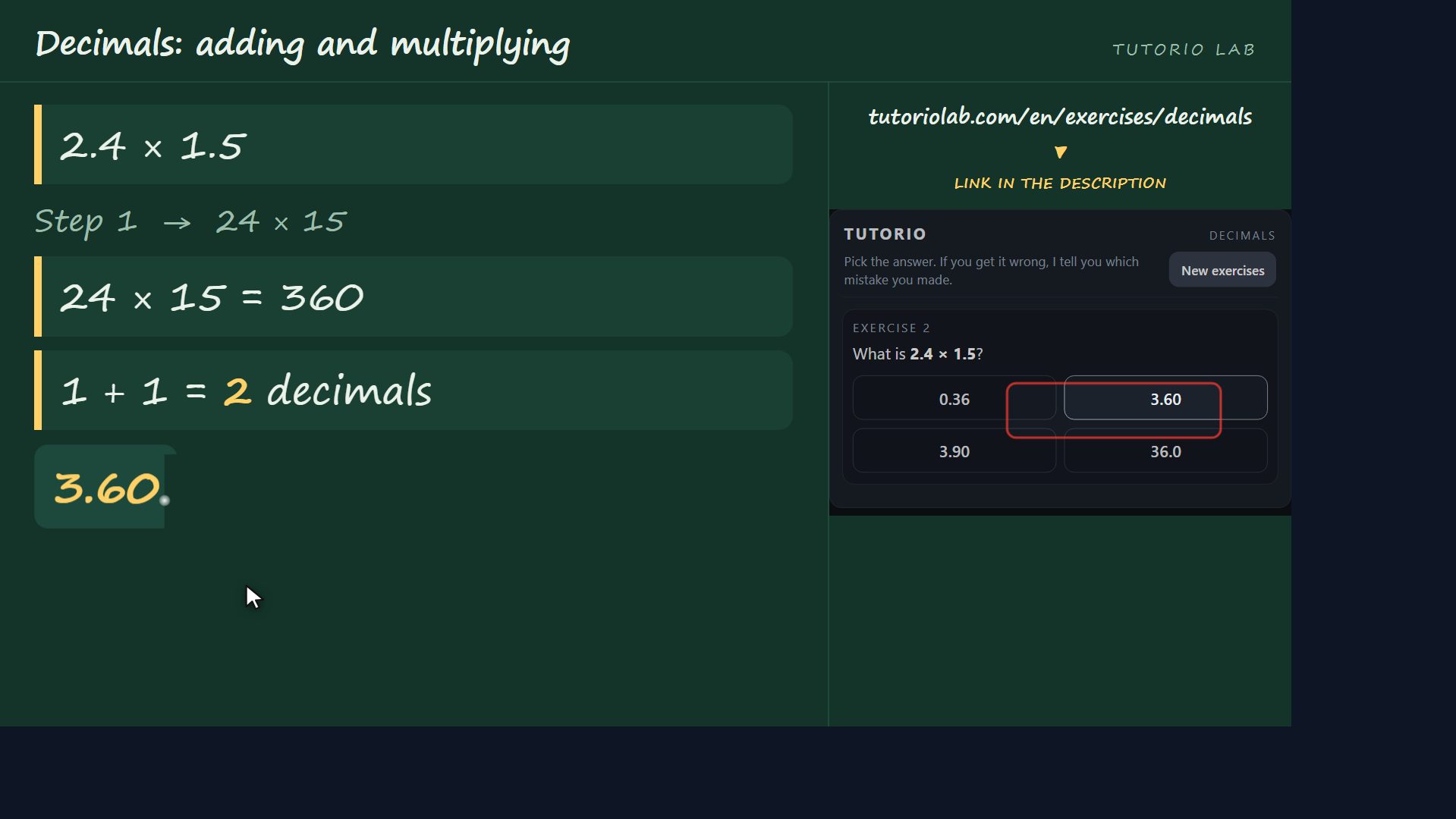
And I want you to take a good look at this on your right here, because it is ours and it is free. It is an exercise page: tutoriolab.com, slash e n, slash exercises, slash decimals. Every time you go in you get different numbers, so you can practise as many times as you like without repeating. And what really matters: when you get one wrong it does not just throw an incorrect at you and leave you where you were. It tells you what mistake you made, by name, and it shows you the worked calculation.
Multiplying: the opposite rule
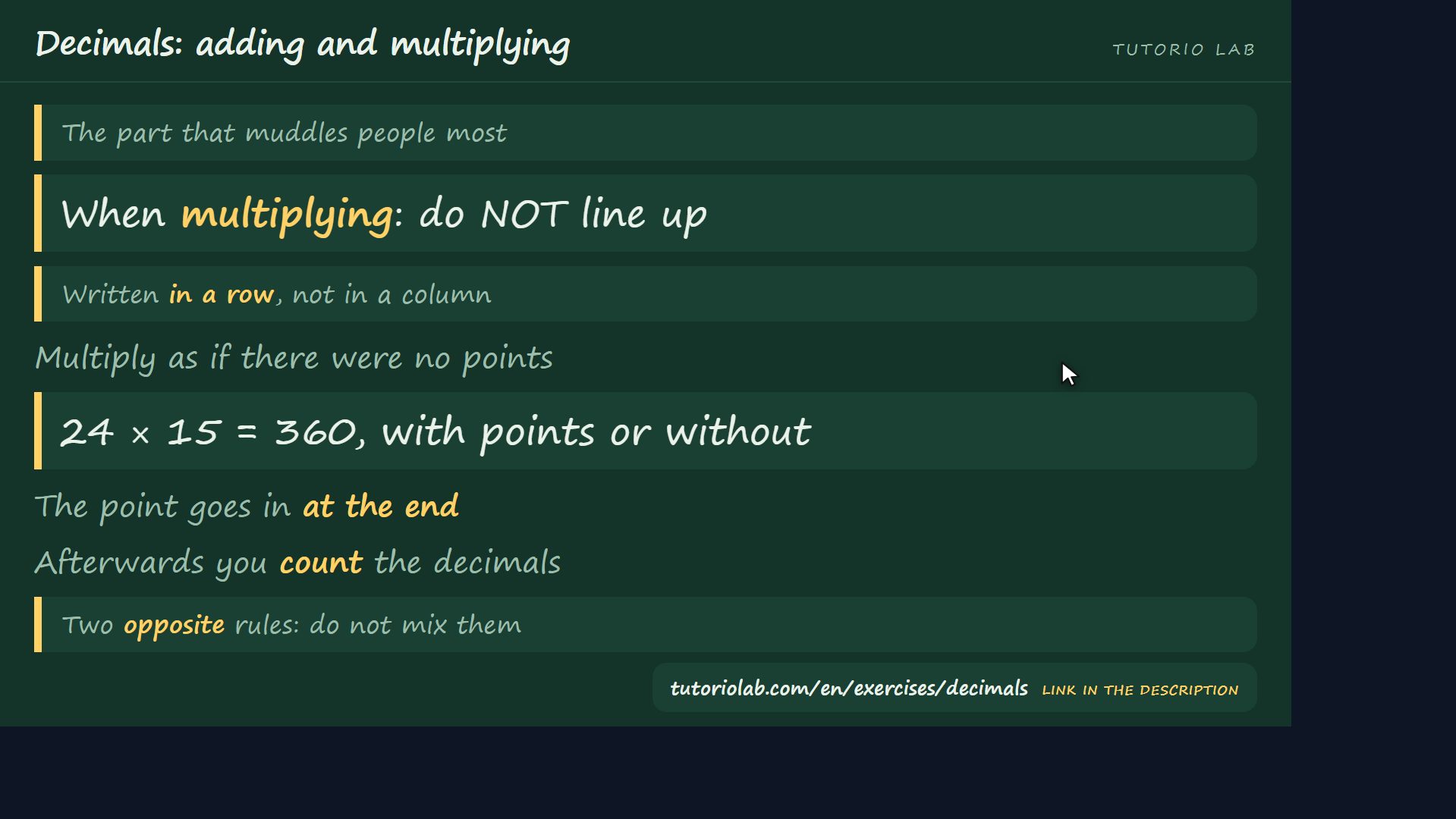
Now multiplying, and here comes the part that muddles people most, so pay attention: the rule is the opposite of the adding one. When multiplying decimals you do NOT line up the points. You do not line them up. What you do is multiply the two numbers as if the points did not exist, as if they were ordinary whole numbers. And when you already have the result, then, and only then, you count how many decimals there were in total between the two starting numbers, and you put the point in. Those two opposite rules are mistake number one in this topic: you add by lining up and you multiply by counting.
The multiplication, step by step
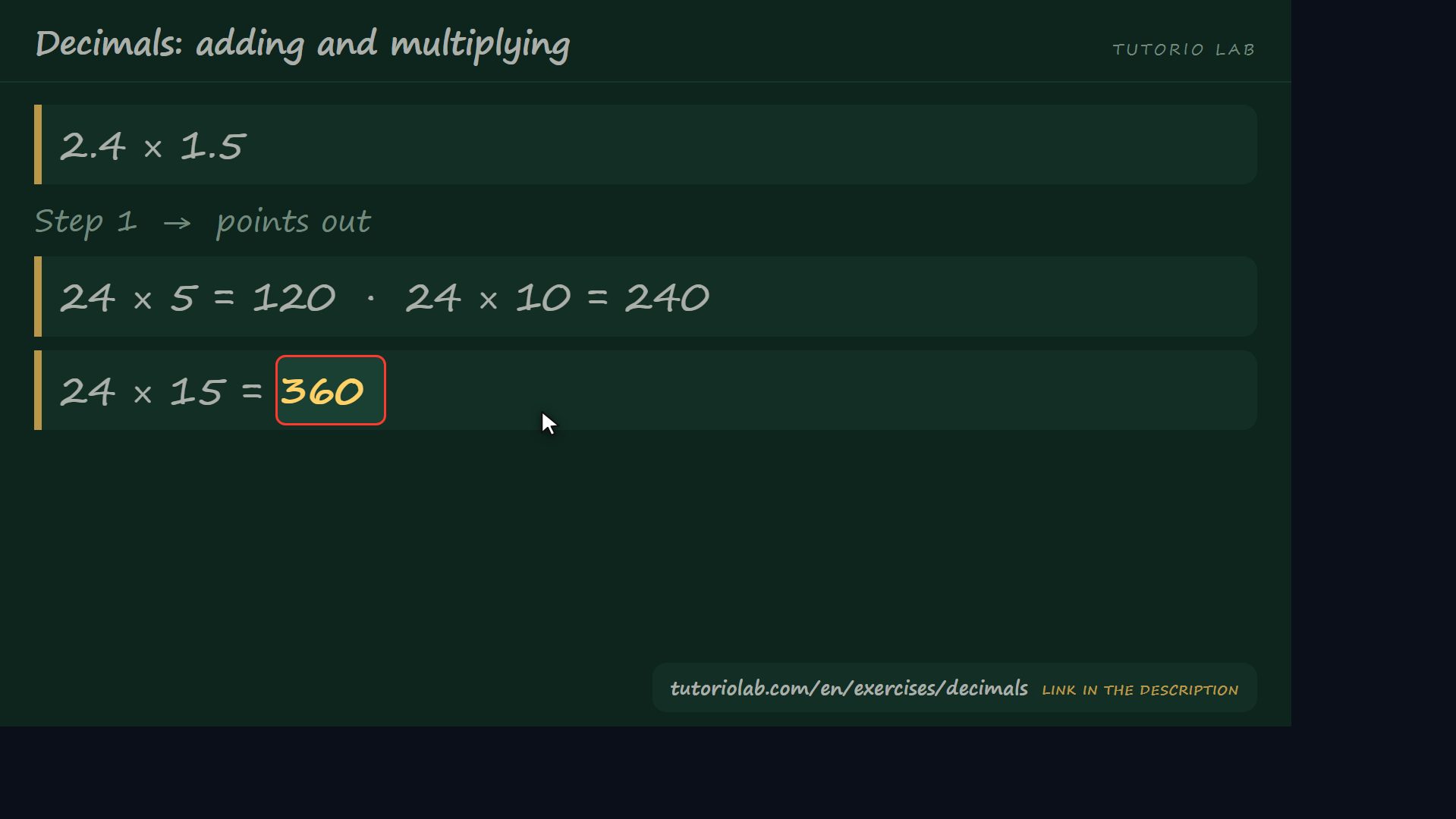
Let us do the example: two point four times one point five. Step one, we take the points out of our heads and multiply twenty-four by fifteen. Twenty-four times five is a hundred and twenty. Twenty-four times ten is two hundred and forty. Adding, three hundred and sixty. Step two, we count the decimals of the starting numbers: two point four has one, and one point five has another. One plus one, two. So in the result the point goes two places counting from the right. Three hundred and sixty with the point two places to the left is three point sixty. And that is the result: three point six.
Exercise 2, step by step
Second and last exercise, and it is that same multiplication: two point four times one point five. I repeat the whole route so it sticks. Step one: points out, twenty-four times fifteen, which is three hundred and sixty. Step two: I count decimals, one in each number, two in total. Step three: I put the point two places from the right in the three hundred and sixty, and I am left with three point sixty. And now look at the thirty-six point zero trap, because it is a very good one: that number comes from having counted a single decimal instead of two. The result is the same three hundred and sixty; the only thing that changes is where you put the point, and there is the whole exercise. That is why counting decimals is not a detail: it is the step that decides the result.
The 10 and 100 shortcut
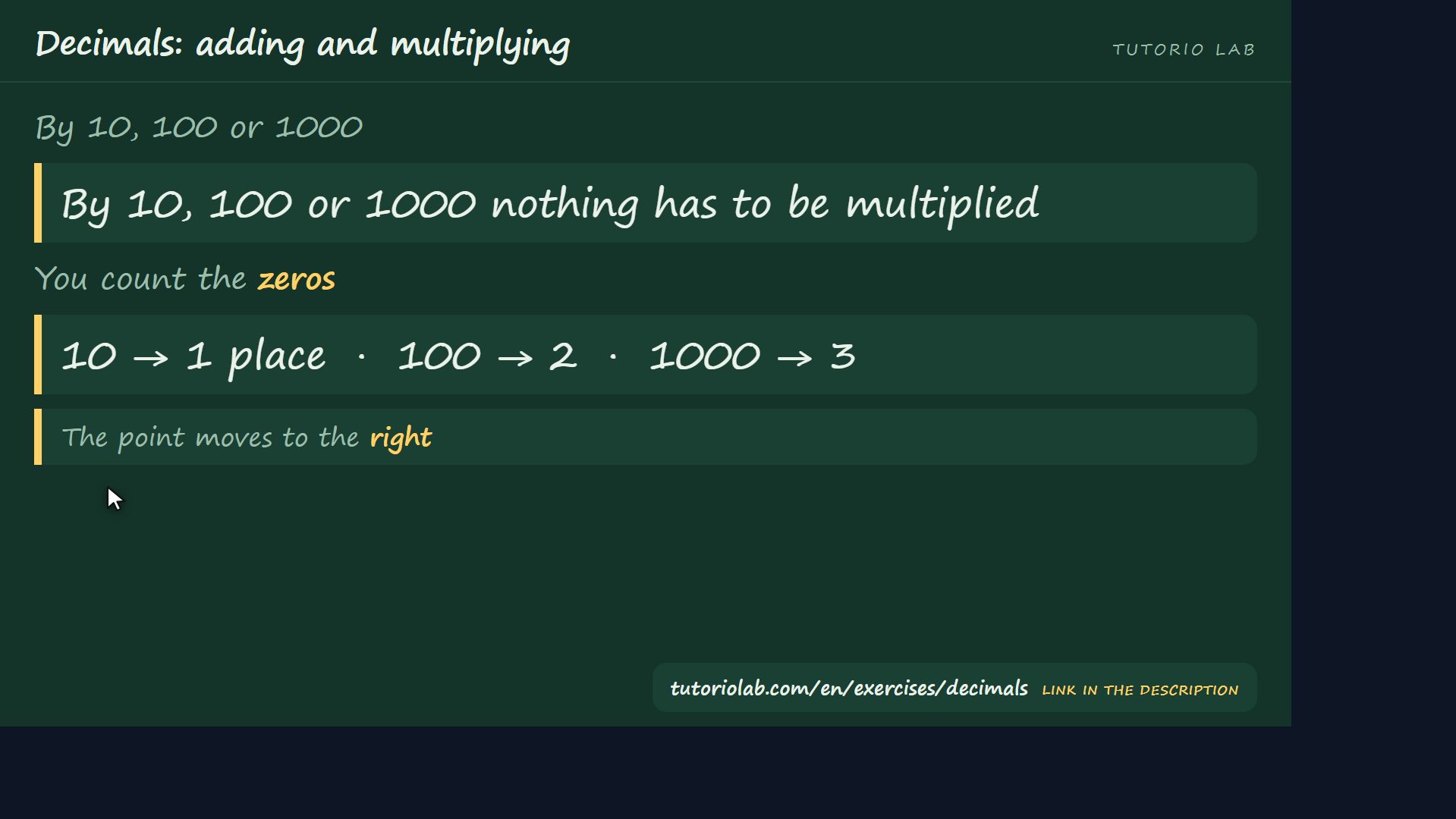
And now a shortcut that gets searched for a great deal and is worth knowing by heart: multiplying by ten, by a hundred or by a thousand. For that you do not have to multiply anything. All you have to do is count the zeros that the ten, the hundred or the thousand has, and move the point that many places to the right. To the right, which is the thing to remember, because multiplying makes the number bigger.
Moving the point
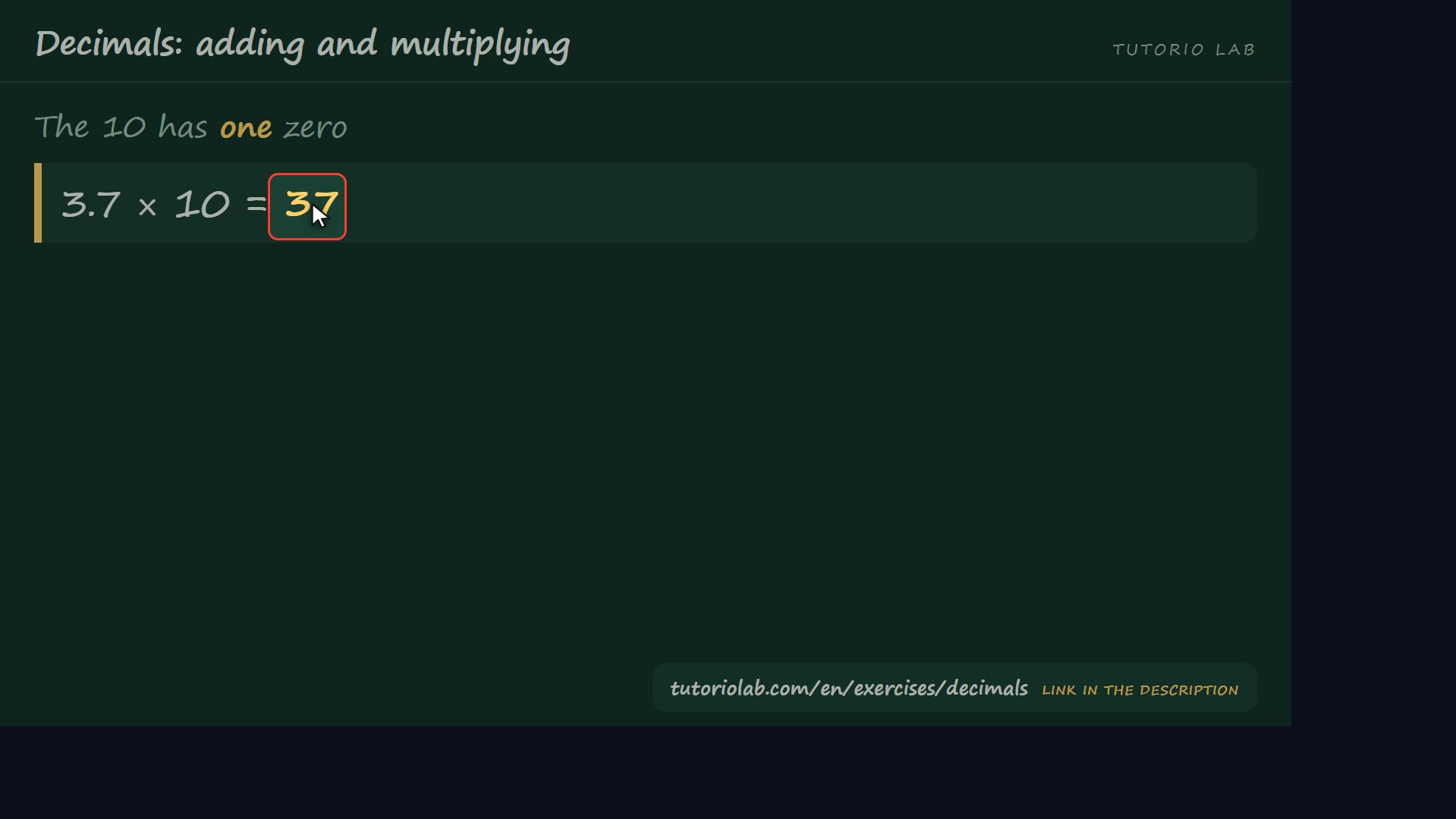
Let us see it. Three point seven times ten. The ten has one zero, so the point moves one place to the right: thirty-seven. Now three point seven times a hundred. The hundred has two zeros, so the point moves two places. But careful, after the seven there are no more digits: when that happens you pad with zeros. Three point seven becomes three hundred and seventy. And for dividing it is exactly the same but the other way round: the point moves to the left, because dividing makes the number smaller.
The two rules
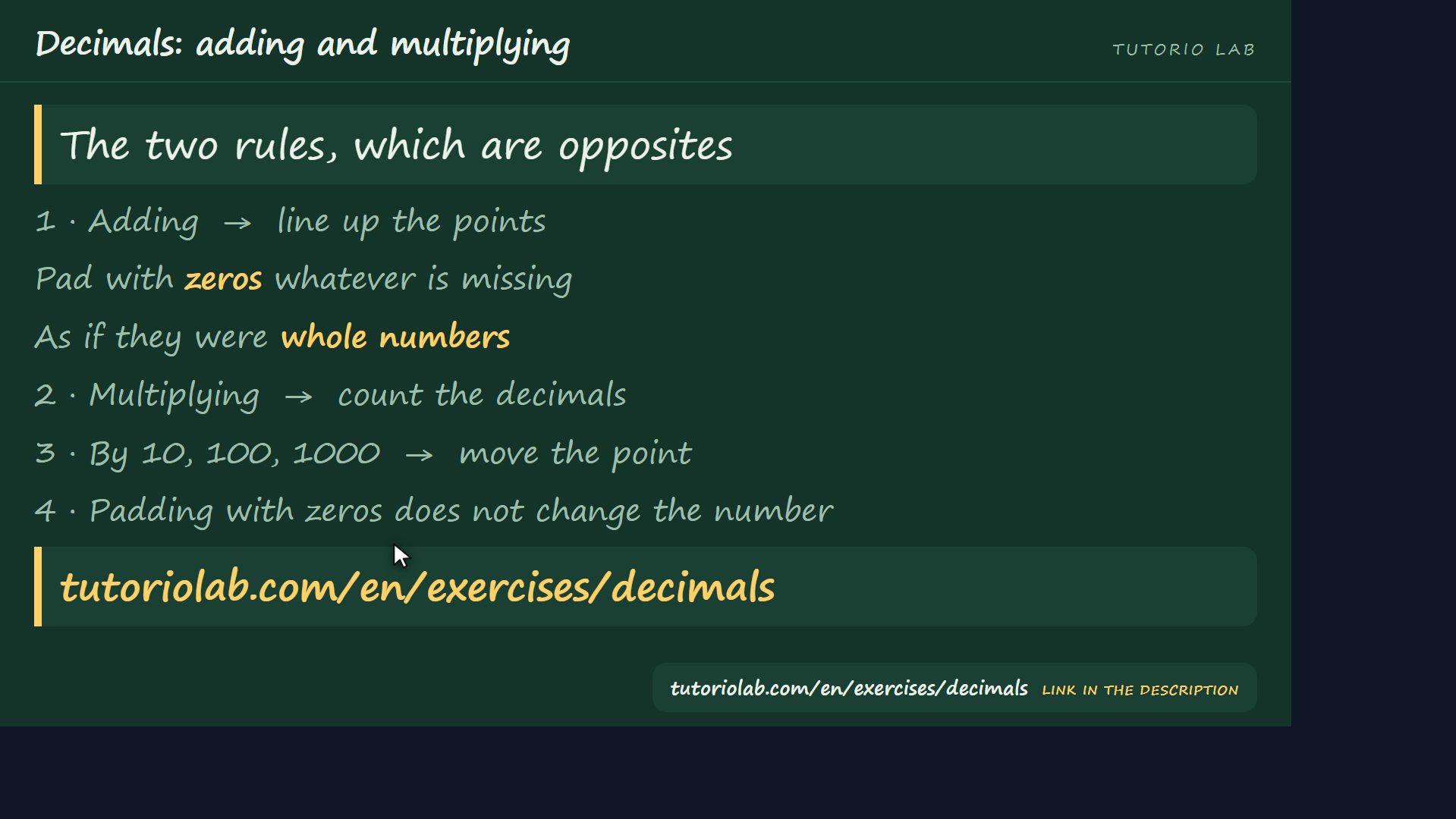
Let us go over it, and the important thing is not to confuse the first two, which are opposites. One: to add or subtract, line up the points, one under the other, and pad with zeros if needed. Two: to multiply, do not line up anything; multiply as if there were no points and then count how many decimals there were in total. Three: to multiply by ten, a hundred or a thousand, count the zeros and move the point to the right. And four, which helps with all of the above: adding zeros at the end of a decimal does not change its value. Practise it at tutoriolab.com, slash e n, slash exercises, slash decimals.
If this helped, subscribe.

Common questions
How do you add decimal numbers?
Line up the decimal points one under the other, pad with zeros so both have the same number of decimals, and add column by column from the right as usual. The point comes down in the same column: 12.45 + 3.80 = 16.25.
Do you line up the points when multiplying decimals?
No, and that is exactly the opposite of adding. You multiply as if there were no points, and only at the end do you count how many decimals the starting numbers had in total and move the point that many places from the right.
How many decimals does the result of a multiplication have?
As many as the two starting numbers have added together. 2.4 has one and 1.5 has one, so the result has two: 24 × 15 = 360 becomes 3.60. Counting one instead of two gives 36.0, which is the most common trap.
How do you multiply a decimal by 10, 100 or 1000?
Count the zeros and move the point that many places to the right, because multiplying makes the number bigger. 3.7 × 10 = 37 and 3.7 × 100 = 370, padding with zeros when the digits run out. For dividing, the point moves to the left.
Is 0.5 the same as 0.05?
No. The first digit after the point is tenths and the second is hundredths, so 0.5 is ten times bigger than 0.05 even though both have a five. What does not change anything is adding zeros at the END: 3.8 = 3.80 = 3.800.
Are there exercises to practise?
Yes, and they are free: tutoriolab.com/en/exercises/decimals. You get new numbers every time — adding, multiplying and the 10, 100 and 1000 shortcut — and when you get one wrong it tells you which mistake you made and shows you the worked calculation.