
The laws of exponents, from zero
Written and checked by the Tutorio Lab editors · Reviewed on · Who we are and how we are funded
The three rules for powers with the same base all come from counting factors. When MULTIPLYING the exponents are added (2³ × 2⁴ = 2⁷, because there are 3 + 4 = 7 twos). When DIVIDING they are subtracted, top minus bottom (3⁵ ÷ 3² = 3³, because two threes cancel). And in a POWER OF A POWER they are multiplied ((2³)⁴ = 2¹², because it is 2³ repeated 4 times and 3+3+3+3 = 3×4). Also: any number to the power 0 is 1, a negative exponent means dividing (2⁻³ = 1/8), and in base 10 the exponent is the number of zeros (10⁶ = a million). If you are unsure which rule applies, write it out and count.
The laws of exponents, from zero and with nothing to memorise.

What a power is
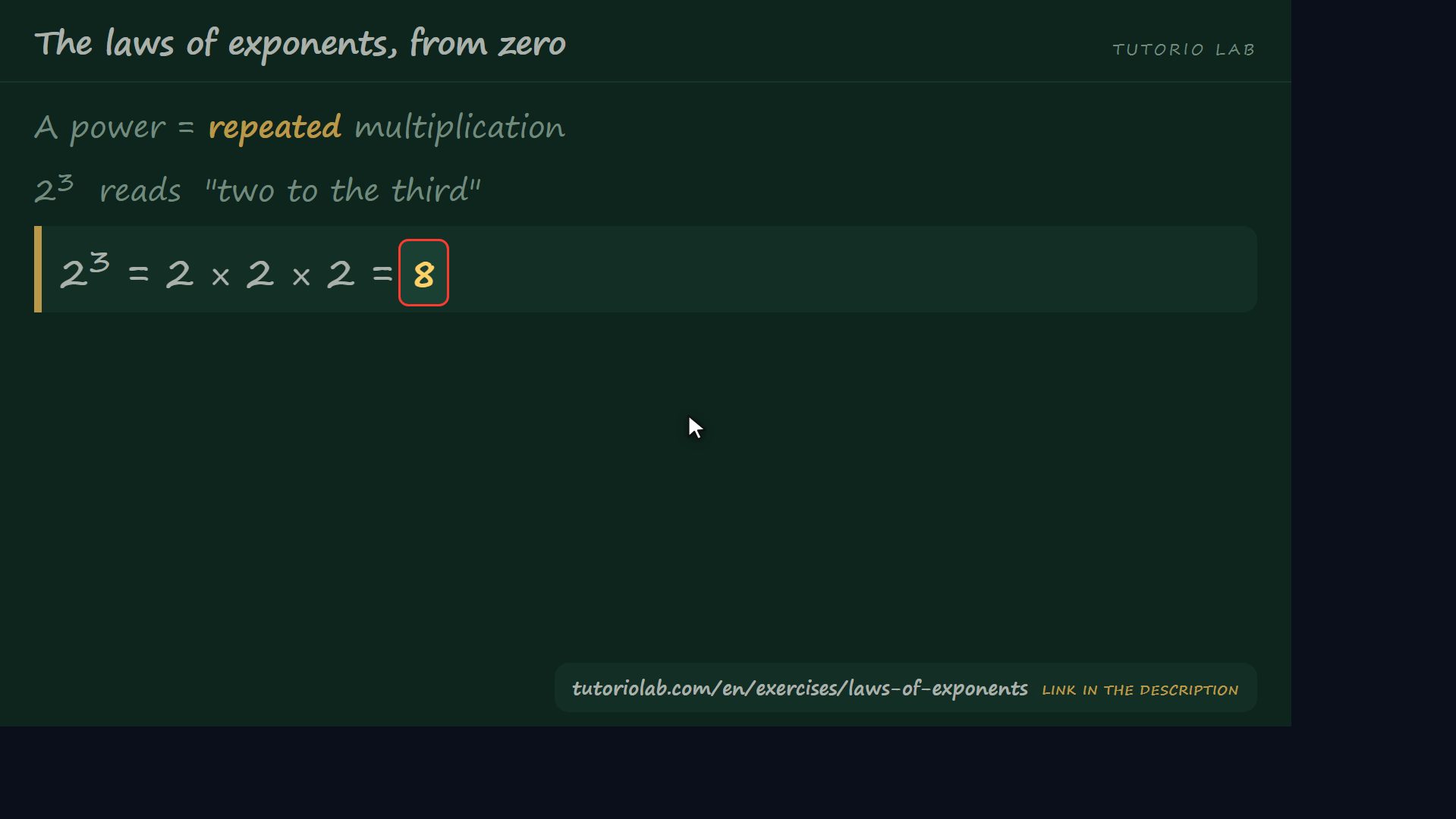
Let us start with the very basics, because I do not want to assume anything. A power is a short way of writing a multiplication of a number by itself. Two to the third means two times two times two, which is eight. That big two at the bottom is called the base, and it is the number that repeats. And the small three on top is called the exponent, and it says how many times it repeats. And now the most common mistake in the whole topic, which I want to get out of your way right now: two to the third is not two times three. It is not six. It is eight. The exponent does not multiply the base: it counts.
Multiplying: they add
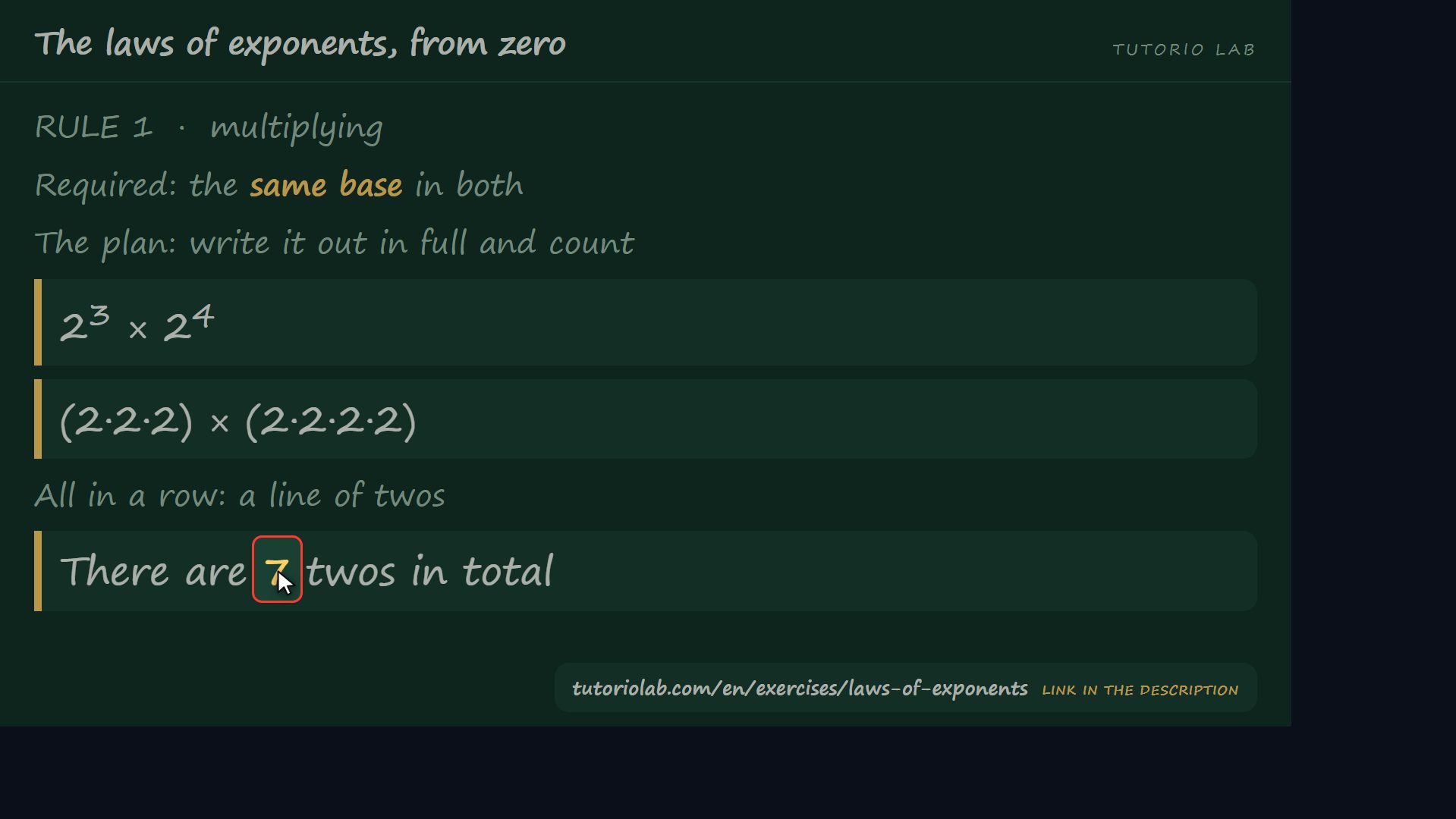
Now the first law, the one for multiplying two powers that have the same base. I am going to expand it so you can see where it comes from and you do not have to memorise it. We have two cubed times two to the fourth. Two cubed is two times two times two. And two to the fourth is two times two times two times two. If we write it all in a row, what we have is a multiplication of twos. How many twos are there in total? Three from the first and four from the second: seven. So the result is two to the seventh. And there is the law: when you multiply powers of the same base, the exponents are added. Three plus four, seven. And you can check it with numbers: eight times sixteen is a hundred and twenty-eight, which is two to the seventh.
Dividing: they subtract
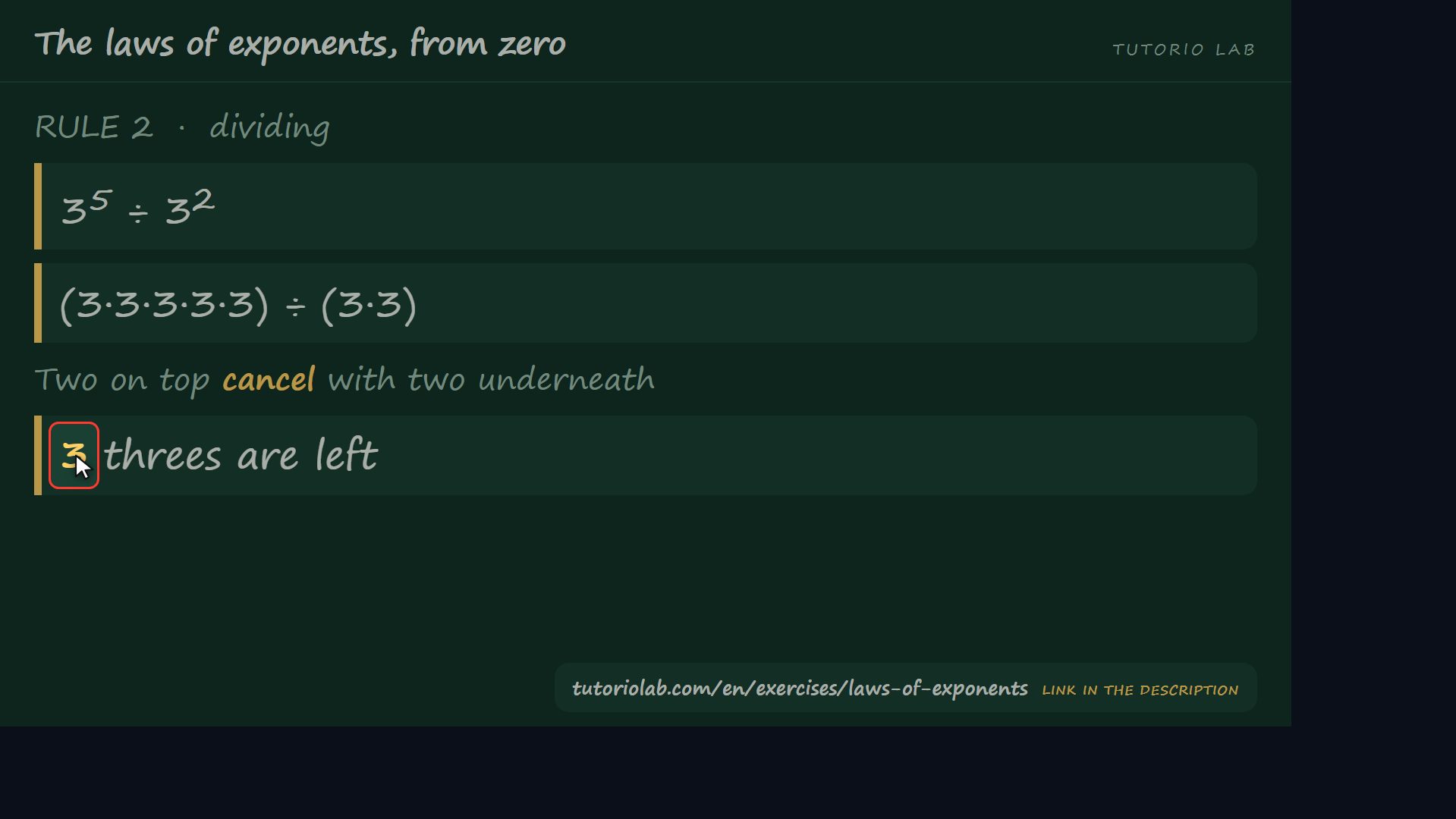
Second law, the one for dividing, and it comes from the same place. We have three to the fifth divided by three squared. We expand it the same way: on top there are five threes multiplying, and underneath there are two threes. And when you have the same number on top and underneath in a fraction, it cancels, because three divided by three is one. We cancel two threes on top with the two underneath. How many threes are left on top? Five minus two, three. So the result is three cubed. And there is the second law: when you divide powers of the same base, the exponents are subtracted. And watch the order, which is the top one minus the bottom one, never the other way round.
Power of a power: they multiply
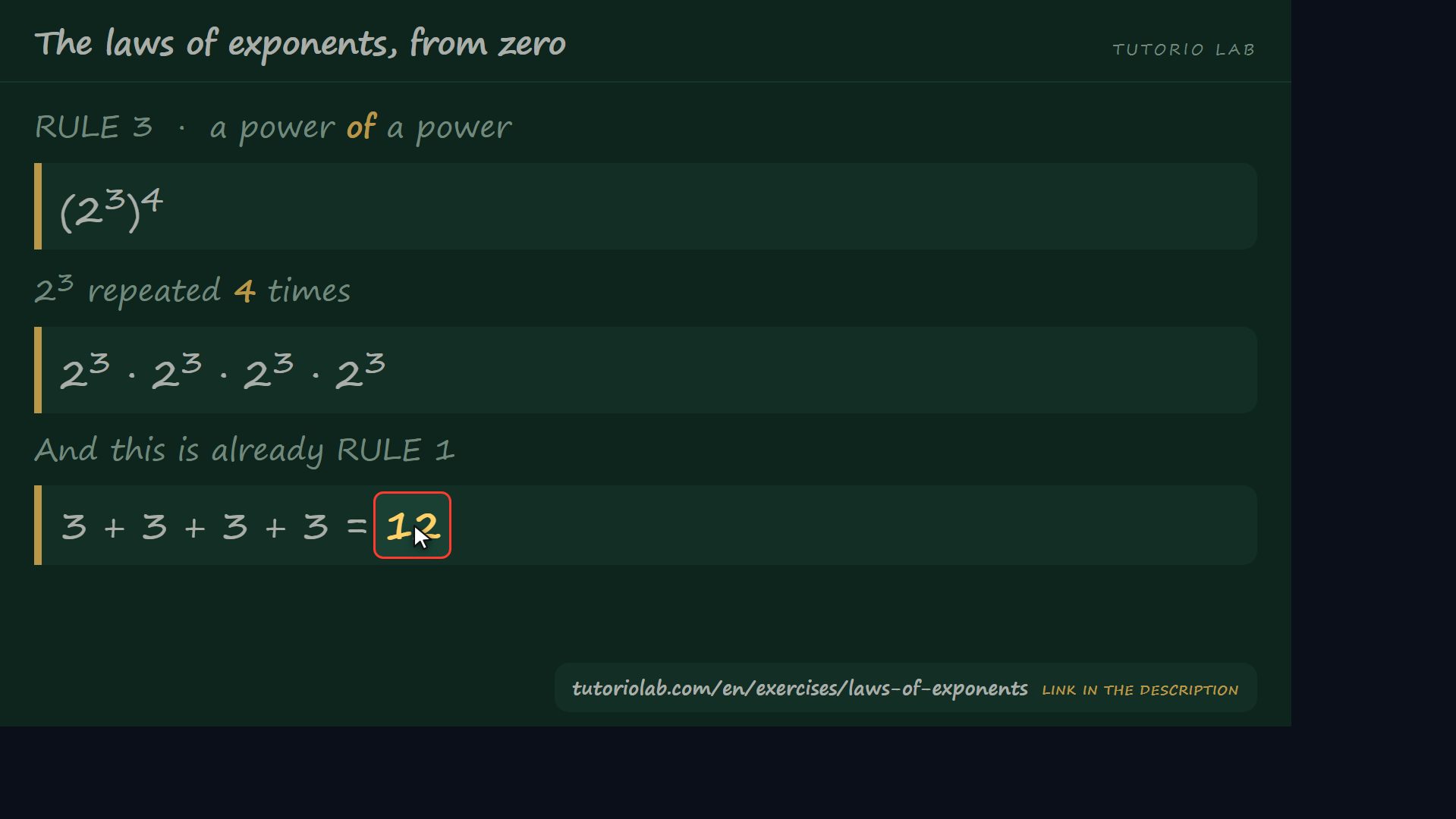
And the third, which is the one people confuse most: a power raised to another power. Two cubed, all of it raised to the fourth. What that four on the outside says is that you have to repeat four times whatever is inside the brackets. That is: two cubed, times two cubed, times two cubed, times two cubed. Four times. And we already know how to solve that with the first law, because they are powers of the same base multiplying: you add the exponents. Three plus three plus three plus three. And adding the three four times is the same as multiplying three by four: twelve. That is why, in a power of a power, the exponents are multiplied.
The three together
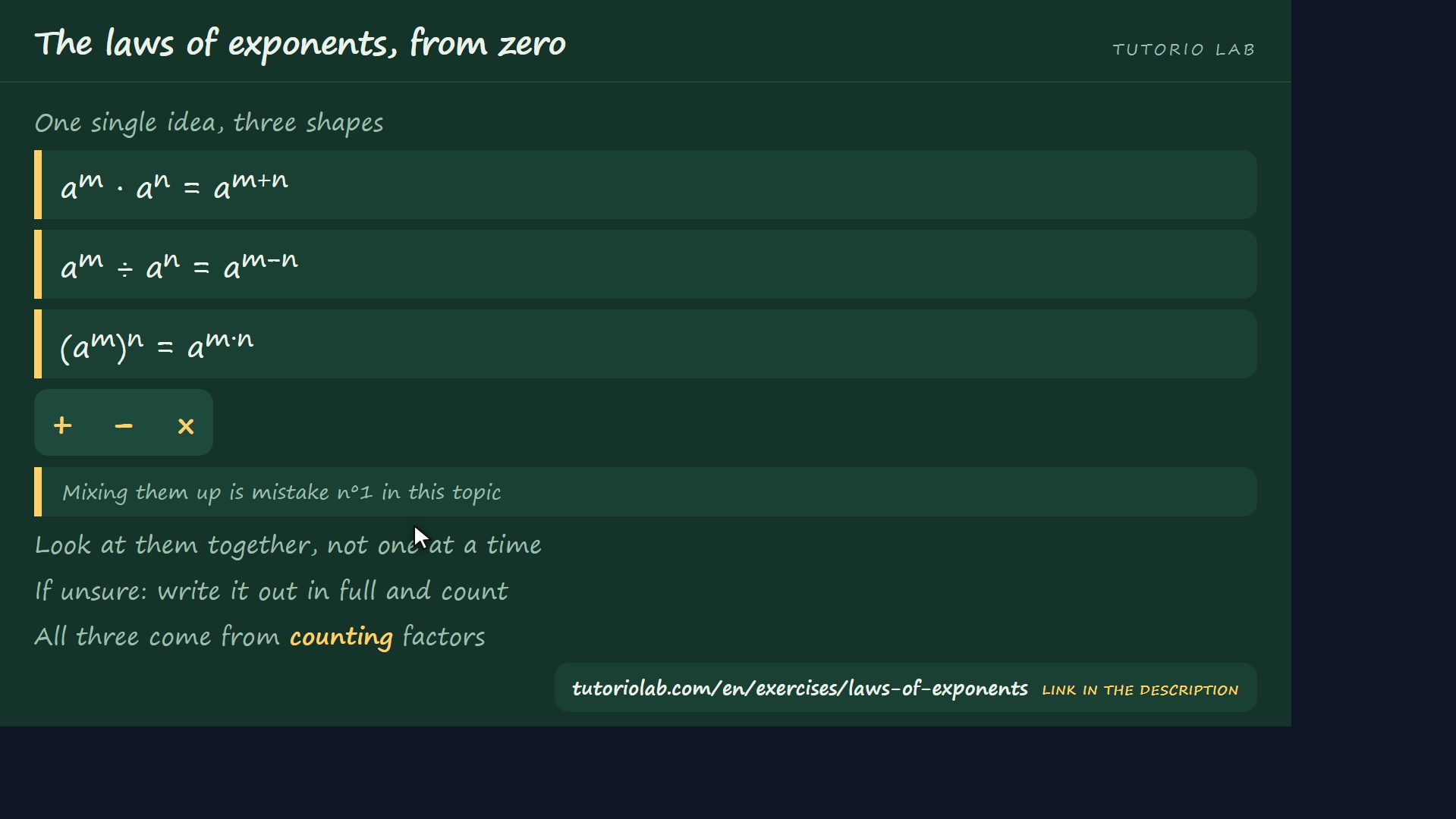
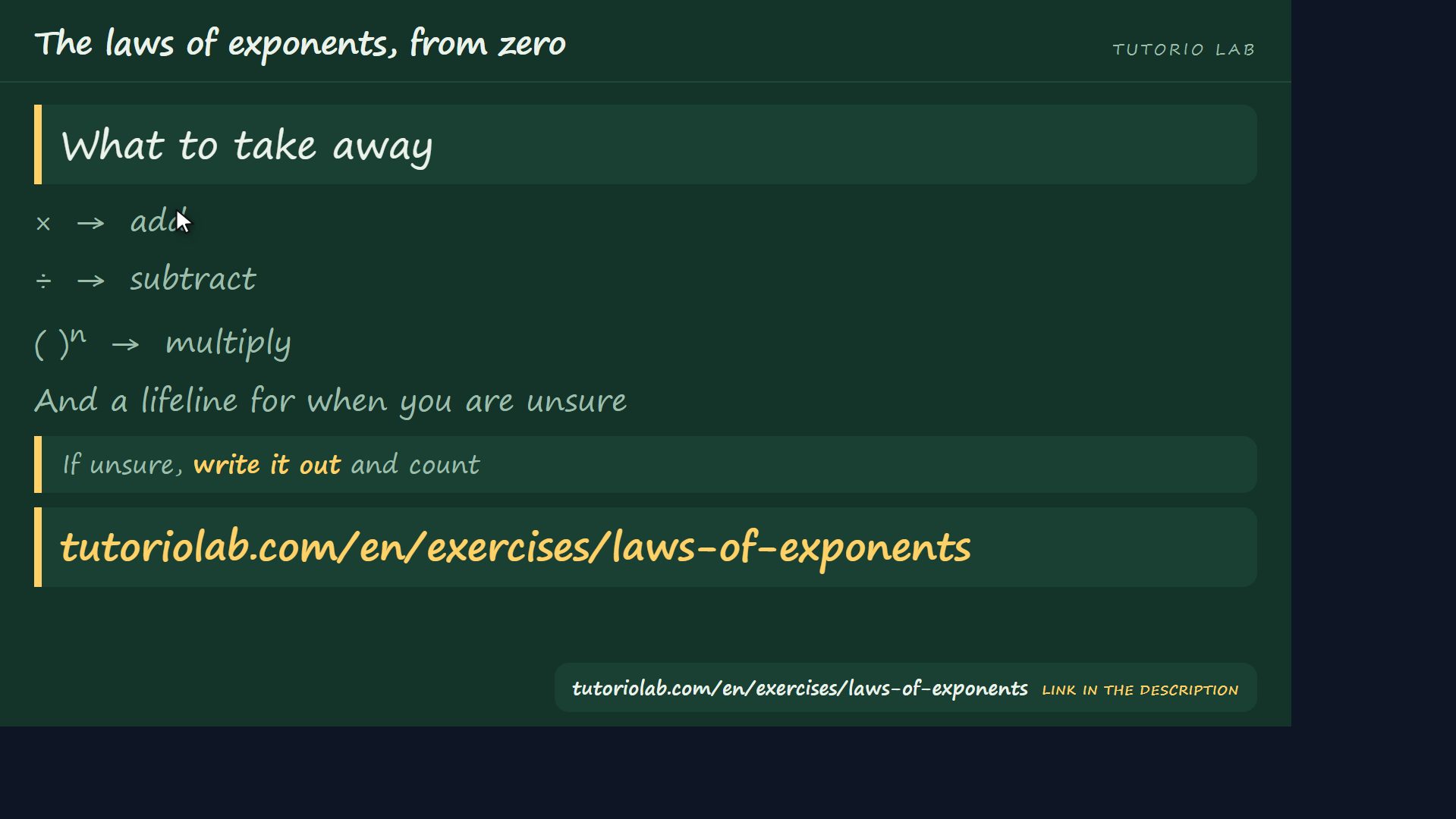
And now I want you to see the three of them together, because separately they look like three arbitrary rules you have to memorise, and together you can see they are the same idea. Multiplying powers with the same base: the exponents are added. Dividing them: they are subtracted. And one power raised to another: they are multiplied. Addition, subtraction, multiplication. Confusing which goes with which is, by far, the most common mistake in the topic, and that is why I am showing them to you side by side. And if one day you are unsure, do not try to remember: expand the power into factors and count how many there are. The law comes out on its own.
Exercise 1, step by step
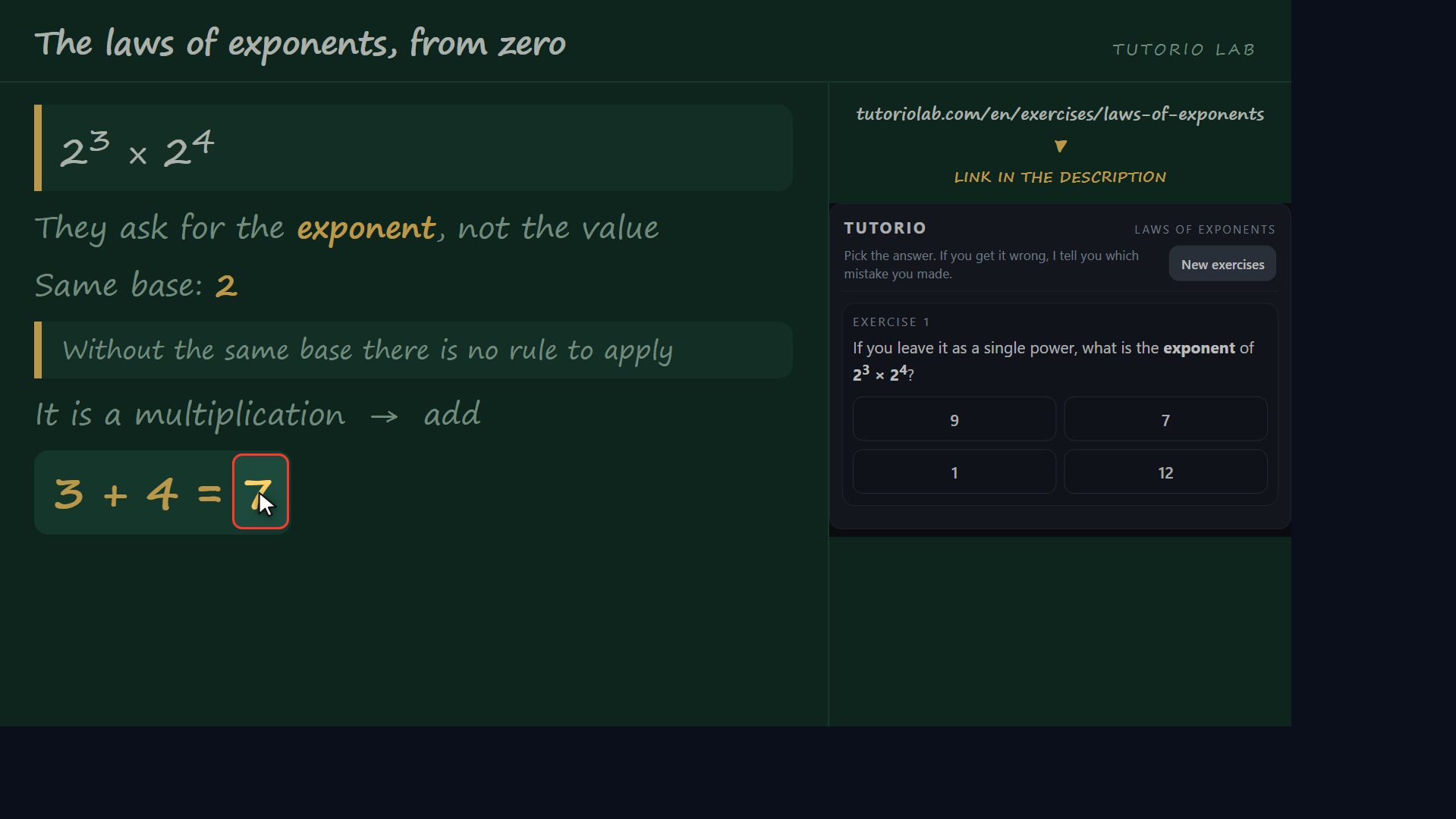
Let us do the first exercise, and we will solve it together before touching anything. Two cubed times two to the fourth, and they ask for the exponent if we leave it as a single power. First we look at the base: both are two, that is the same base, which is what you need in order to apply the law. And the operation is a multiplication, so we have to add the exponents. Three plus four, seven. The answer is seven. And we check it with numbers just in case: two cubed is eight, two to the fourth is sixteen, eight times sixteen is a hundred and twenty-eight, and two to the seventh is also a hundred and twenty-eight. It matches. And look at the twelve trap: the twelve comes from multiplying three by four, which is the bracket law, not the law for multiplying two powers. I mark the seven.
Practise for free
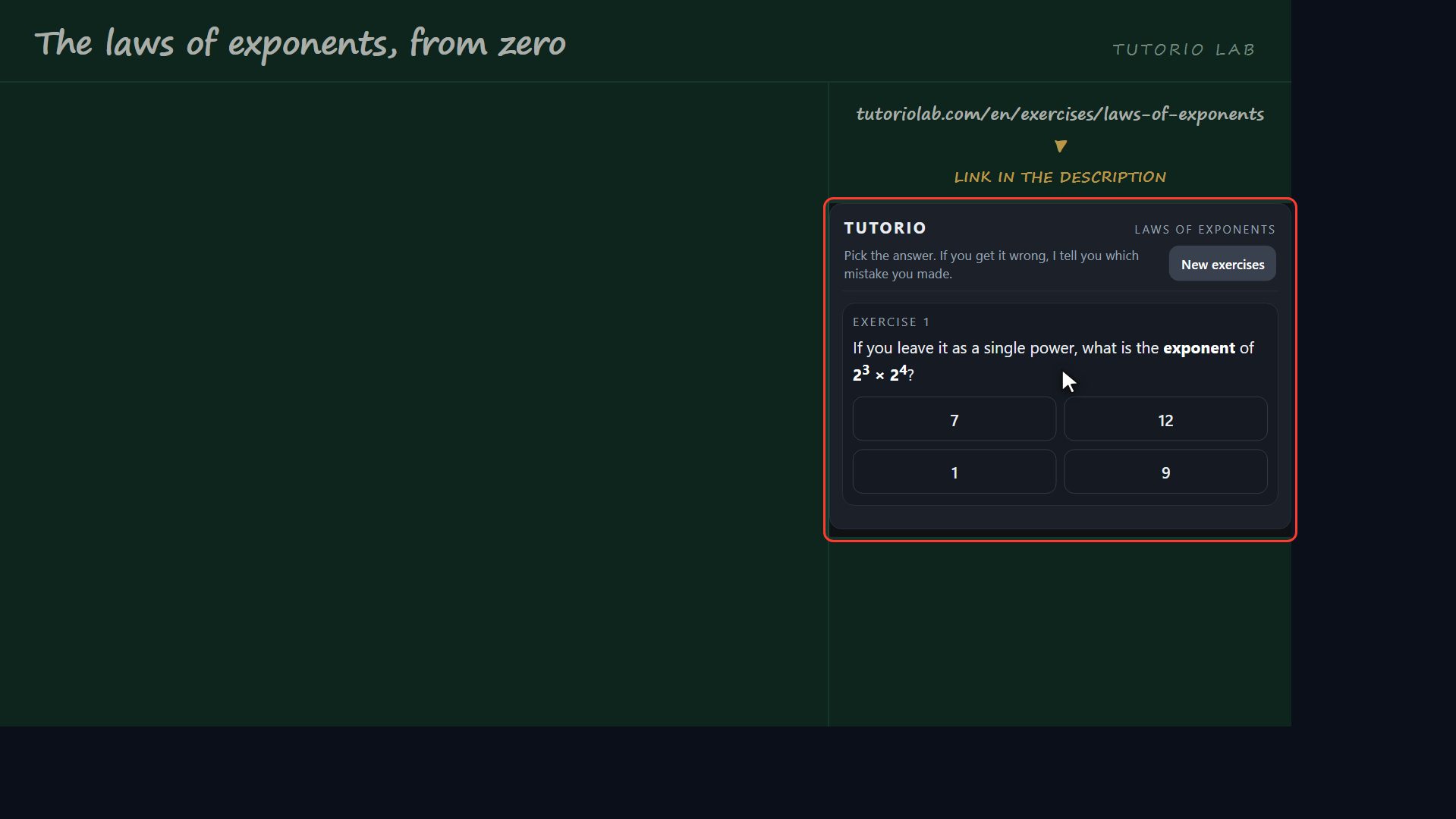
And I want you to take a good look at this on your right here, because it is ours and it is free. It is an exercise page: tutoriolab.com/en/exercises/laws-of-exponents. Every time you go in you get different powers, so you can practise as many times as you like without repeating. And what really matters: when you get one wrong it does not just throw an incorrect at you and leave you where you were. It tells you what mistake you made, by name, and it shows you the worked calculation.
Exercise 2, step by step
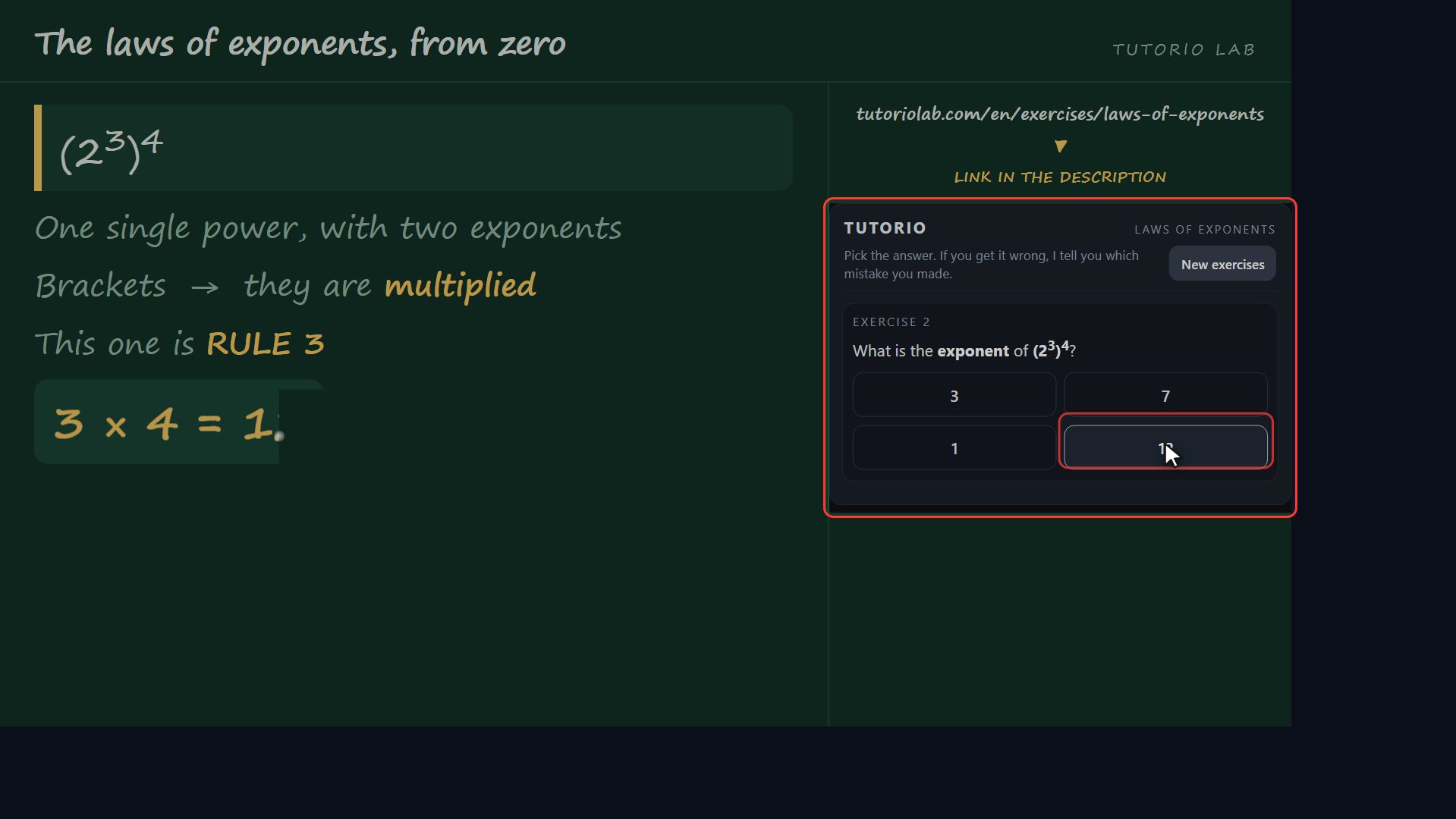
Second and last exercise, and it is exactly the other case so you can see the difference. Two cubed, in brackets, raised to the fourth. Here there are not two powers multiplying: there is one power inside brackets and another exponent outside. So the law that applies is the third one: the exponents are multiplied. Three times four, twelve. The answer is twelve. And we check it: two cubed is eight, and eight raised to the fourth is four thousand and ninety-six; two to the twelfth is also four thousand and ninety-six. It matches. And here the trap is the seven, which is the answer to the previous exercise: it comes from adding instead of multiplying. That is exactly the mistake I wanted you to see, with the two exercises one after the other.
Zero and negative exponents
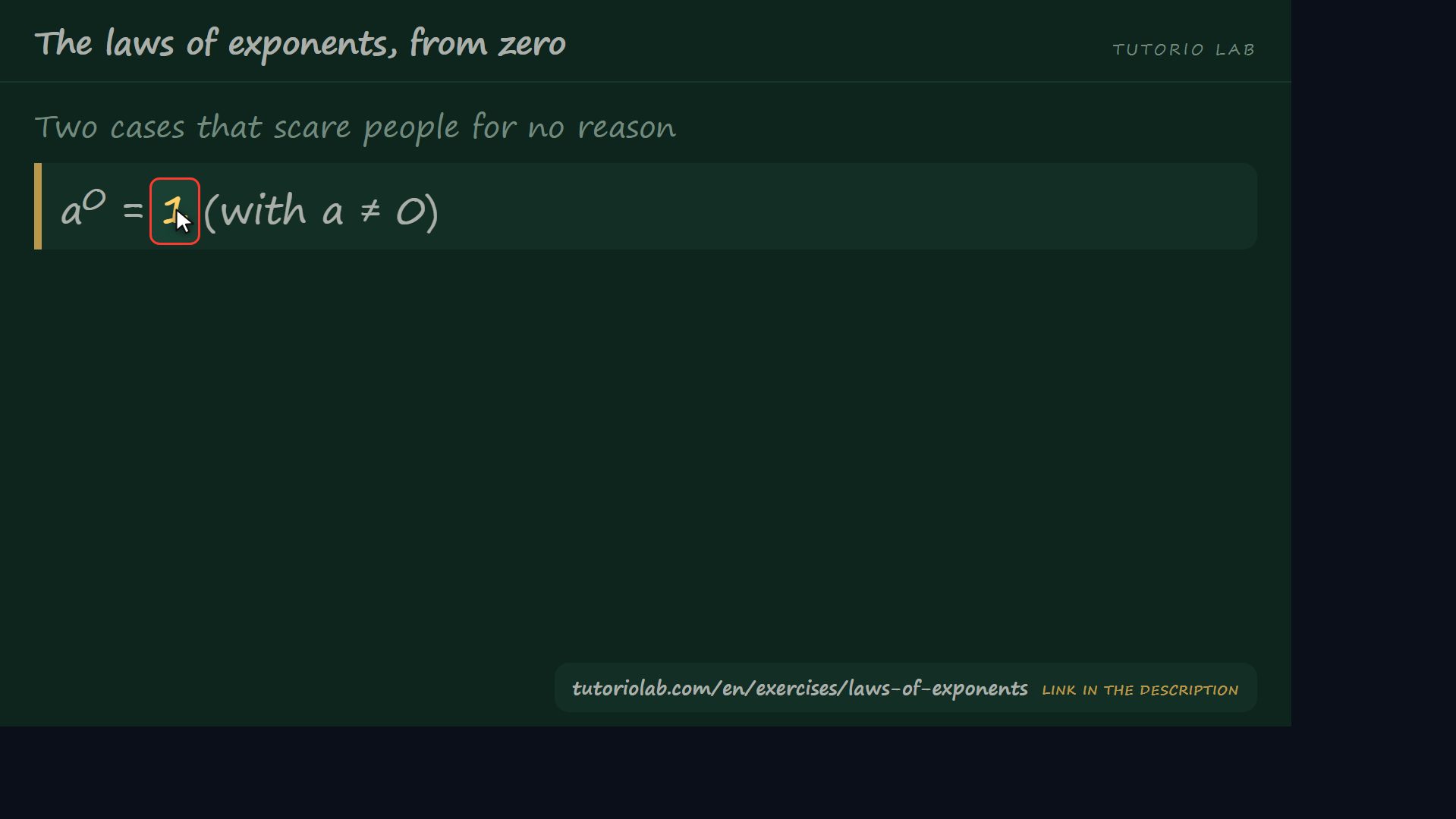
And there are two cases left that come up a lot and that usually scare people for no reason. The first: any number raised to zero gives one. Not zero: one. And it has a very simple explanation with what we have just learned. Take two cubed divided by two cubed. By the division law, the exponents are subtracted: three minus three, zero. So it gives two to the zero. But on the other hand, eight divided by eight is one, obviously. The two routes have to give the same thing, so two to the zero is one. The second case: a negative exponent does not mean the result is negative. It means it is dividing. Two to the minus three is one divided by two cubed, that is one over eight.
Powers of base 10
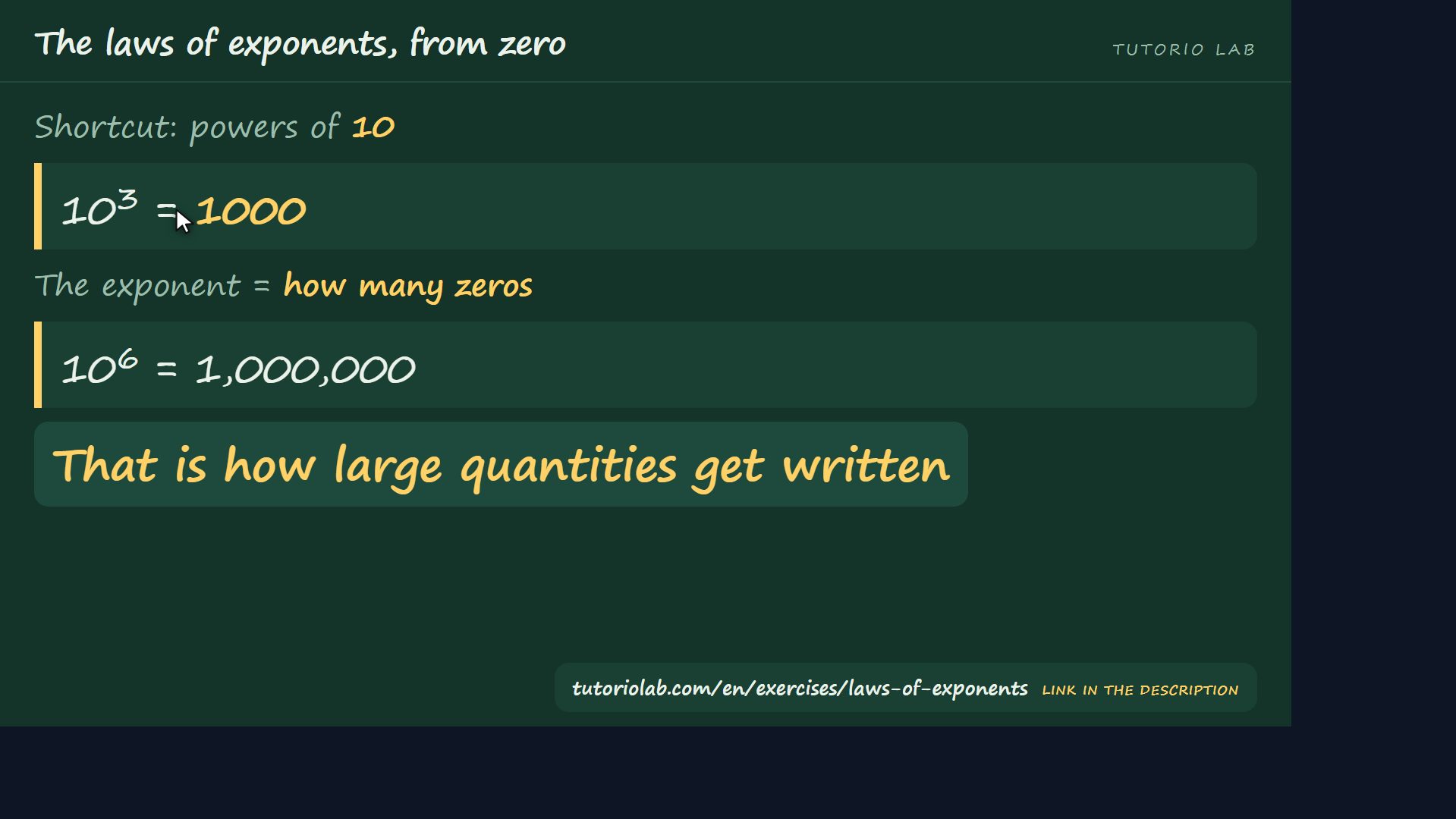
And one last shortcut that is worth it, because it gets used constantly: powers of base ten. Ten cubed is ten times ten times ten, a thousand. And notice what happens: the exponent tells you exactly how many zeros the number has. Ten to the three, three zeros: a thousand. Ten to the six, six zeros: a million. That is why you will see large quantities written like that, with powers of ten, instead of counting zeros by eye. It saves you mistakes and it saves you time when the numbers get big.
The three rules
Let us go over the three laws, which is what you have to take away. When you multiply powers of the same base, the exponents are added. When you divide them, they are subtracted, and always the top one minus the bottom one. And when there is a power raised to another power, they are multiplied. And the fourth one, which is not a law but a lifeline: if you are ever unsure which one applies, expand the power into factors and count how many there are. It never fails. Practise it at tutoriolab.com/en/exercises/laws-of-exponents.

Common questions
What are the laws of exponents?
With the same base: when multiplying the exponents are added (aᵐ · aⁿ = aᵐ⁺ⁿ), when dividing they are subtracted (aᵐ ÷ aⁿ = aᵐ⁻ⁿ) and in a power of a power they are multiplied ((aᵐ)ⁿ = aᵐ·ⁿ). All three come from counting how many factors there are.
Why are the exponents added when multiplying?
Because 2³ is three twos and 2⁴ is four twos; multiplying them gives you seven twos in a row, which is 2⁷. There is nothing to memorise: you count. And you can check it: 8 × 16 = 128 = 2⁷.
Is 2³ the same as 2 × 3?
No, and it is the most common mistake in the topic. 2 × 3 is 6; 2³ is 2 × 2 × 2, which is 8. The exponent does not multiply the base: it says how many times it repeats.
Why is any number to the power of zero equal to 1?
Because 2³ ÷ 2³ is, by the division rule, 2³⁻³ = 2⁰; and on the other hand 8 ÷ 8 = 1. Both routes have to give the same thing, so 2⁰ = 1. It holds for any base other than zero.
What does a negative exponent mean?
That it is dividing, not that the result is negative. 2⁻³ = 1 ÷ 2³ = 1/8 = 0.125. The result stays positive; what changes is that the power moves to the denominator.
Are there exercises to practise?
Yes, and they are free: tutoriolab.com/en/exercises/laws-of-exponents. You get new powers every time — multiplying, dividing and power of a power — and when you get one wrong it tells you which mistake you made and shows you the worked calculation.